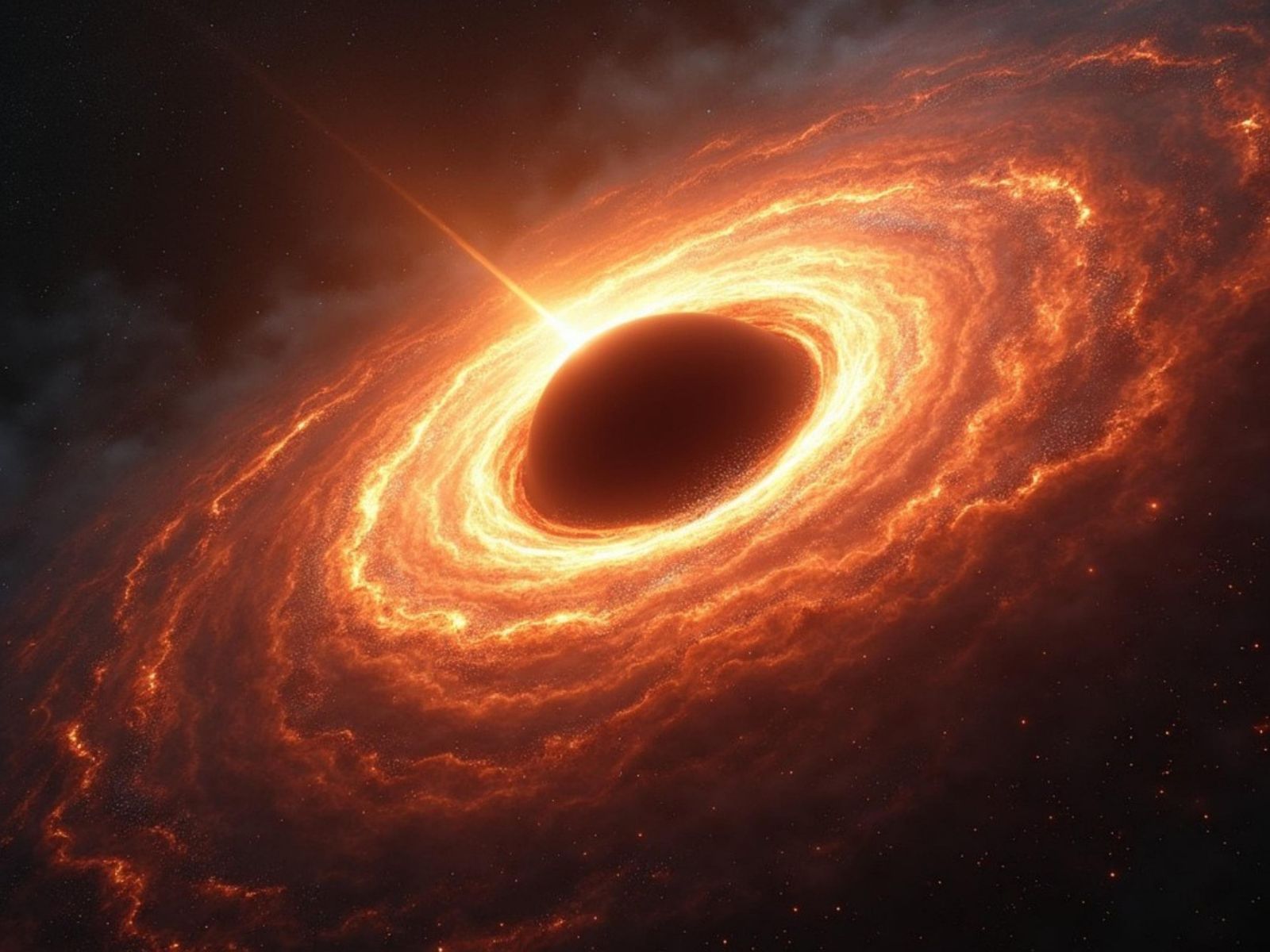
An unusual supermassive black hole is puzzling astronomers after doing something that doesn’t fit the typical pattern of a stellar destruction event: it’s getting brighter years later.
Supermassive black holes are among the most extreme objects in the universe. When a star wanders too close, the black hole’s immense gravity can rip it apart in a dramatic episode known as a tidal disruption event. As the star is shredded, its material forms a swirling accretion disk around the black hole, heating up and producing a powerful flare. Normally, this kind of cosmic outburst brightens for a relatively short time and then steadily fades.
But the object known as AT2018hyz isn’t behaving “normally.” The star’s disappearance was recorded in 2018, and the event initially followed expectations. Then came the surprise: instead of continuing to dim, AT2018hyz began brightening again in 2019. Even more striking, radio observations indicate it is now about 50 times brighter than it was in 2019.
Researchers say the energy being released is comparable to gamma-ray bursts, putting AT2018hyz among the brightest phenomena currently observed in the universe. That kind of delayed, long-lasting rise in brightness is what makes this case so confounding. If the main “explosion” already happened years ago, why would the system suddenly ramp up again—especially after showing no earlier signs that such a resurgence was coming?
For astronomers, AT2018hyz has become a rare long-term mystery, challenging existing models of how black holes feed after tearing a star apart. The event’s unusual duration and late-time brightening suggest there’s more going on than scientists typically expect from tidal disruption events—possibly changes in how stellar debris falls back toward the black hole or how energy is released into its surroundings.
For now, the real cause remains unknown. What is clear is that AT2018hyz will require continued monitoring and new studies to explain its unexpected behavior and what it may reveal about the complex physics of black holes, accretion disks, and extreme cosmic explosions.


