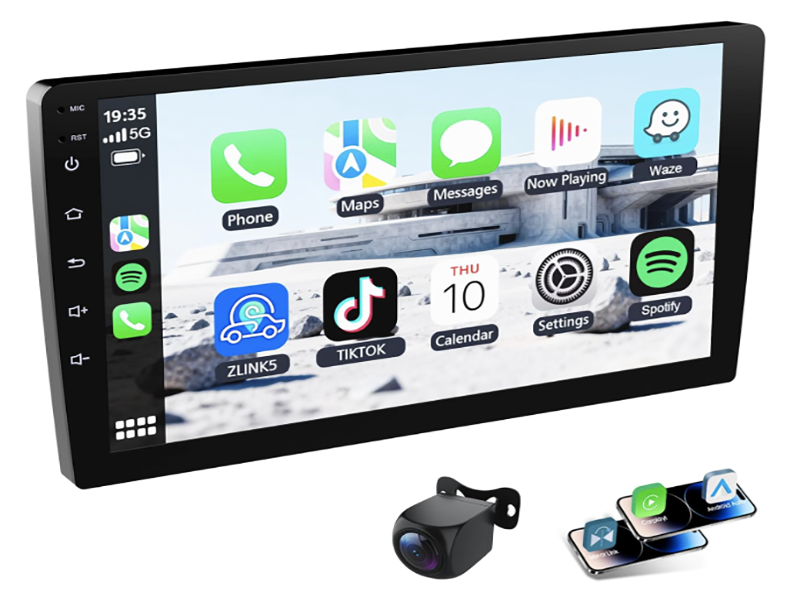
Cheap Android car stereos from unfamiliar brands are everywhere right now, and the pitch is hard to ignore: bigger screens, more features, and a price that can be a fraction of what you’d pay for a name-brand head unit. But what do you actually get for around $80, and will it still work years later?
To understand the real value, it helps to compare what you’re replacing. Upgrading an older vehicle’s factory radio is one of the easiest ways to add modern infotainment features like Apple CarPlay, Android Auto, and reversing camera support. The problem is cost. A mainstream 7-inch head unit with a roughly 6.8-inch display, CarPlay, Android Auto, and backup camera compatibility can easily sit around the $250 range and climb quickly depending on the model and extras.
That price gap is why budget Android head units have become so popular. Many of these low-cost options run Android (in some form), which means access to apps through the Play Store—something traditional car audio brands typically don’t offer. On paper, the feature list looks incredible for the money: touchscreens in larger sizes, WiFi, Bluetooth, extra USB ports, camera inputs, and enough storage for apps and offline media. Most come with entry-level hardware, usually around 2GB to 4GB of RAM and 32GB to 64GB of storage, paired with bargain processors commonly found in low-end devices.
The big question is longevity. After five years of daily use, an $80 Android-based head unit can still be usable—but it doesn’t age gracefully.
The display is a good example. A 9-inch, 720p screen was never going to be razor sharp, but it can be “good enough” for navigation and basic controls. Over time, though, issues can creep in. After around four years, vertical lines may begin to appear on the panel. The number of lines can change day to day—sometimes several, sometimes only one—yet the stereo can continue working normally. Touch response can remain fine, which matters more than pixel-perfect clarity in real-world driving. Still, it’s a clear reminder of where corners are cut to hit that price.
Performance is where budget units tend to show their age the most. Even if the system is merely “okay” when new, it often slows down noticeably over the years. Basic tasks—loading Google Maps, entering an address, starting navigation, installing updates—can become an exercise in patience. With a lightweight launcher you may get a little improvement, but it won’t transform low-end hardware into a responsive infotainment system. You can install media apps like VLC, but if the device is already struggling, it’s not the kind of experience most drivers would want.
The saving grace is that Android Auto and Apple CarPlay can work very well, because the heavy processing is handled by your phone. If your primary goal is to get modern phone-based navigation, calls, messaging, and music into an older car, this type of head unit can stay surprisingly “serviceable” even after years. Depending on the unit, iPhone support may require an additional CarPlay dongle, and Android Auto functionality may depend on specific apps or compatibility choices, but once set up, the day-to-day experience can be solid.
One detail many people notice immediately with these units is how thin they are. Name-brand head units often occupy a substantial amount of depth behind the dash, partly due to more robust internal components. Some budget Android models are only a little over an inch thick, and that can make installation easier in tight spaces. The downside is that the slim design hints at minimal internal amplification hardware. For simple factory speaker setups, sound quality can be comparable to the original stock unit—especially if you’re not pushing high volume or demanding audio performance. But if you plan to run multiple high-wattage speakers or want strong amplification, you may be better off feeding the signal into an external amplifier. Many wiring looms for these units include outputs that can support that kind of upgrade later.
Connectivity tends to hold up better than raw speed. Extra USB ports are genuinely useful for adding a CarPlay dongle or loading music onto external storage when you don’t want to rely on your phone. WiFi and Bluetooth can continue working reliably, and tethering the head unit to a phone hotspot makes it possible to download app updates or use native navigation apps—even if they run slowly.
Backup cameras are another common “bundle” feature with these stereos, and they often reveal the clearest difference between budget accessories and higher-quality components. A camera included in the box may function well enough, but build quality can be questionable. Over years of use, a mounting bracket may rust and stain paintwork. The camera lens assembly may start separating from its housing within months, creating a real risk of parts coming loose. A simple fix like tightly wrapping the body to hold it together can keep it running far longer than you’d expect, and the image can remain perfectly usable. Even without infrared night vision, reversing lights can provide enough illumination for safe maneuvering, and the camera’s low-light sensitivity may be sufficient for typical night driving.
Of course, choosing a cheap Android head unit isn’t just about performance. It’s also about risk. Long-term warranty coverage, reliable after-sales support, consistent software updates, and even security considerations are major unknowns with off-brand units. Even if you buy from a marketplace that offers a basic warranty window, that protection is short compared to what you’d expect from established manufacturers.
There’s also the compatibility factor. Installing any aftermarket head unit can cause problems if your vehicle has integrated features tied to the original infotainment system. If your car uses the factory unit for steering wheel controls, vehicle settings, built-in camera systems, multi-speaker setups, or other essential functions, you could lose features—or create bigger headaches than the upgrade is worth. These budget head units make the most sense when the vehicle setup is simple and you’re primarily replacing an older CD player or basic radio.
So, is an $80 Chinese Android head unit “worth it” after five years? It can be, if your expectations match the price. You may deal with a screen that develops faults, a system that becomes increasingly slow, and accessories like backup cameras that aren’t built to last. But if your main goal is affordable Android Auto or Apple CarPlay in an older car, and you accept the trade-offs, the value can still be impressive. In fact, the cost savings can be so large that even replacing the unit down the line may still leave you spending less than a single name-brand head unit.
Ultimately, these stereos can last—sometimes far longer than people expect. Just go in knowing that “cheap” doesn’t only describe the price. It describes the entire ownership experience, from long-term reliability to performance to support. If you’re comfortable with that reality, the upgrade can still feel like a huge win.