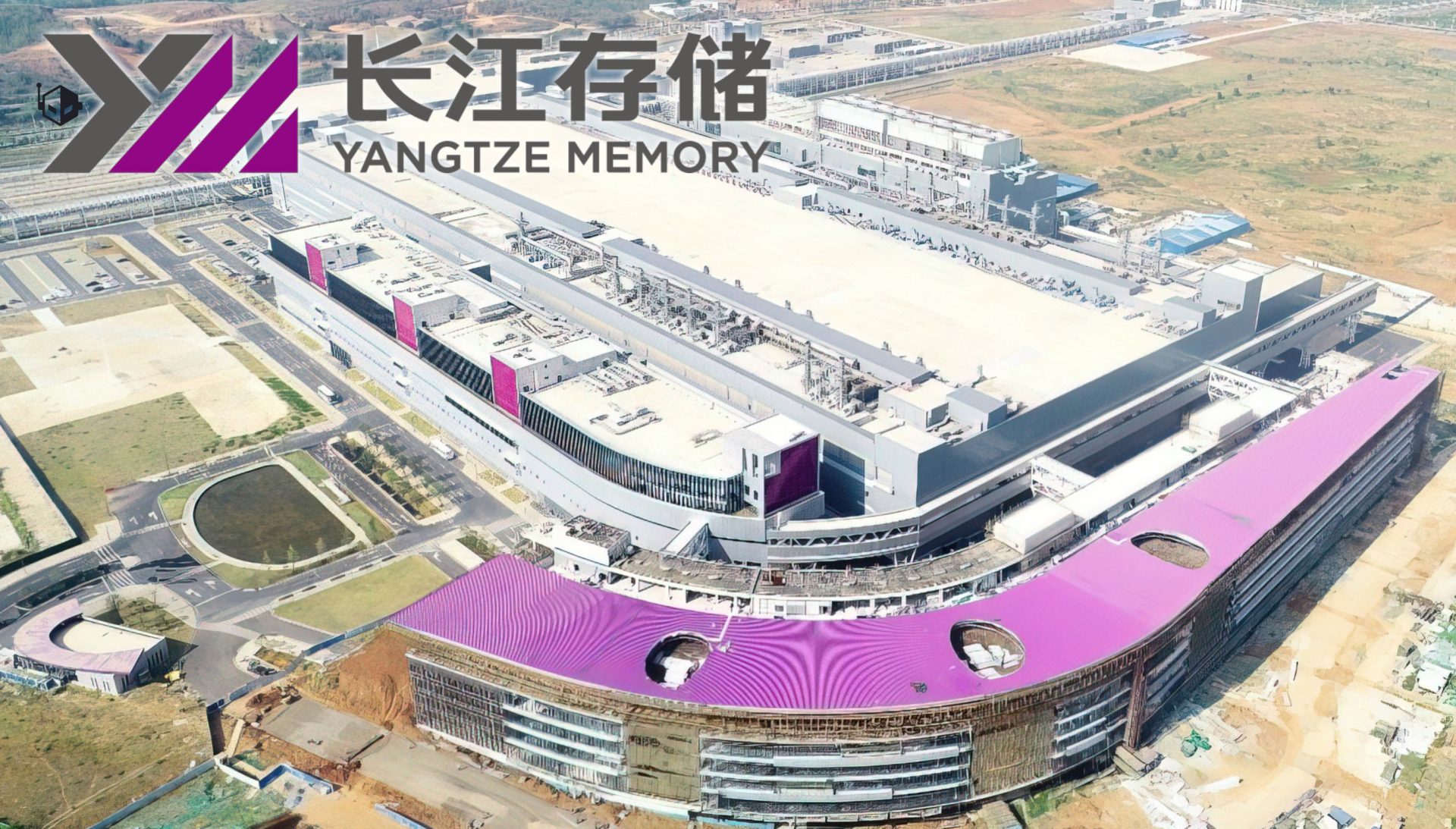
As U.S.–China trade tensions keep tightening around advanced semiconductor technology, China’s Yangtze Memory Technologies (YMTC) is moving to boost domestic chip output in a big way. With Washington expanding export controls and lawmakers pushing to restrict the sale of key chipmaking tools to Chinese firms—including equipment used in leading-edge manufacturing—Chinese memory makers are increasingly focusing on self-reliance and scaling production at home.
YMTC is already building a new fabrication plant expected to be completed this year, and that facility is designed to produce 100,000 wafers per month. Now, the company is reportedly preparing to go further by adding two more chipmaking factories, each also targeting 100,000 wafers per month. If these plans reach full operation, the three new fabs would bring in up to 300,000 wafers of additional monthly capacity.
That expansion would significantly change YMTC’s production footprint. The company currently has an estimated wafer output capacity of around 200,000 per month. With the new projects online, total capacity could rise to roughly 400,000 wafers per month—effectively doubling what YMTC can produce. In the global memory market, where scale and cost efficiency matter, that kind of increase can have ripple effects on supply, pricing, and competition.
A key part of this push is a stronger domestic supply chain. The newest fab effort is said to rely heavily on local suppliers, with more than half of the equipment, tools, and materials sourced inside China. That includes tools connected to advanced packaging and vertical stacking processes—an area of growing importance as memory technology increasingly depends on stacking more layers to raise density and performance. This emphasis suggests that, as external restrictions grow, Chinese manufacturers are investing not only in factories, but also in the supporting ecosystem required to keep those factories running.
Beyond NAND flash, YMTC is also positioning itself to expand into DRAM. Reports indicate that each of the three new plants could allocate some portion of capacity to DRAM production, although the exact split may depend on how quickly the company advances its DRAM development and what customer demand looks like. YMTC has reportedly already sent low-power DRAM (LPDDR) samples to potential clients and expects feedback by the end of the year, which could shape how aggressively it ramps DRAM output.
If YMTC successfully scales NAND production while adding meaningful DRAM capability, it could strengthen China’s domestic memory supply and potentially raise its position in the global NAND market. With a reported NAND share around 11.8% today, an expansion of this size could help YMTC push beyond the 14% range under the right market conditions—putting it closer to the tier of top memory manufacturers.
In a semiconductor landscape increasingly defined by geopolitical pressure, YMTC’s factory buildout highlights a clear strategy: expand capacity fast, reduce dependency on foreign suppliers, and prepare for a future where access to cutting-edge tools and international supply chains may be less predictable.