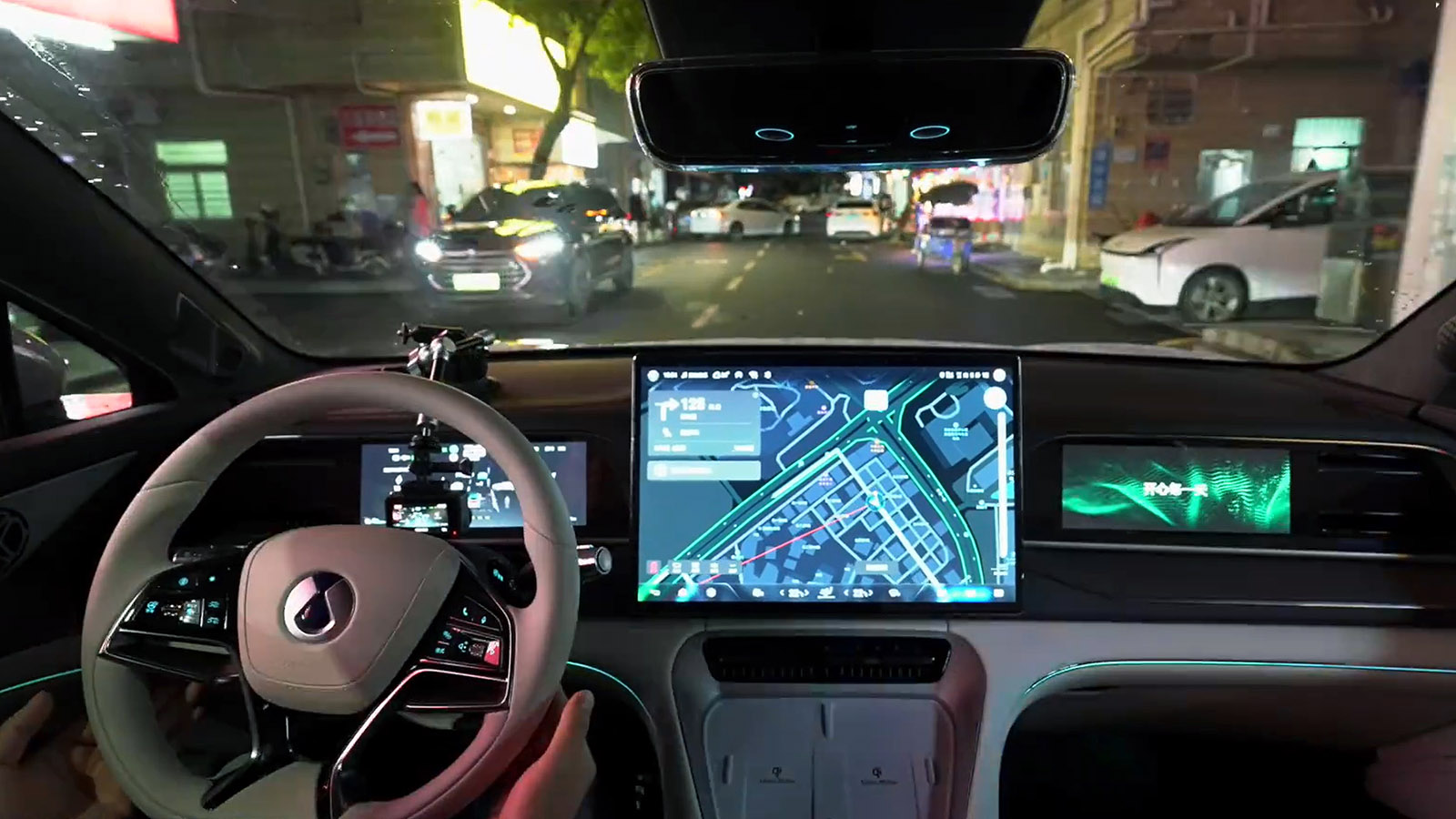
Amid the rising competition in the autonomous vehicle (AV) industry, Chinese electric vehicle (EV) giant BYD has demonstrated a remarkable achievement with its own version of Full Self-Driving (FSD) technology. The company has successfully showcased its ‘City Pilot’ in action on busy city roads at night, navigating complex urban scenarios smoothly and without human intervention.
Tesla Expands Testing in China
Tesla, a leader in the autonomous driving space, has recently received clearance from Shanghai authorities to begin testing its advanced self-driving system on public roads with a fleet of ten cars. This move is a considerable step towards launching its FSD feature in the Chinese market. However, Tesla will face stiff local competition from established EV manufacturers such as NIO and XPeng, who are already offering advanced autonomous driving features.
NIO, for instance, has shown off its autonomous capabilities by demonstrating how its vehicles can exit a highway, drive autonomously to a battery-swapping station, replace their spent battery with a charged one, and continue driving to the designated destination.
BYD Enters the Fray with City Pilot
The litmus test for any FSD system is navigating through the chaotic and unpredictable urban streets. BYD, Tesla’s main competitor in China, has stepped up to the challenge by releasing a video demo of its own ‘City Pilot’ system. What sets this demo apart is that it took place at night on intricate city roads, where the City Pilot operated flawlessly without any human intervention.
The video released by BYD presents the City Pilot in action on a BYD Denza N7 SUV. The City Pilot managed to tackle narrow streets, heavy traffic, and complex driving maneuvers during the night, showcasing the potential of BYD’s autonomous technology.
BYD’s Technology Approach
Unlike Tesla, which has been focusing on a vision-only system for its FSD, Chinese AV systems, including BYD’s, largely depend on a more diverse array of sensors including, but not limited to, cameras, LiDARs, and other technologies to analyze road conditions and city traffic. This multi-sensor approach has been central to BYD’s strategy as it works towards releasing a reliable and capable AV system.
The company’s CEO has expressed a firm belief in the importance of autonomous driving technology, a sentiment echoed by Tesla’s Elon Musk. Committed to the cause, BYD is investing nearly $14 billion in research for self-driving AI and developing larger vehicle models. With a team of about 5,000 engineers dedicated to this initiative, BYD is gearing up to play a significant role in the future of AVs.
Autonomy as Standard in Premium Models
In an interesting strategic move, BYD plans to include its FSD competitor as a standard feature in its more high-end models, while the feature will be optional for vehicles priced under $40,000. This not only positions BYD as a competitive player in the marketplace but also signals the increasing importance of autonomous driving features as standard across the EV industry.
As companies like BYD and Tesla push the boundaries of AV technology, it becomes clear that the future of driving is tilting towards a more connected, autonomous experience. The developments in this field not only promise enhanced convenience for drivers but also have the potential to greatly increase road safety and efficiency in the years to come.


