Bolt Graphics Zeus GPU Moves Closer to Reality After First Silicon Test Success
Bolt Graphics’ highly ambitious Zeus GPU has taken an important step forward, moving from bold concept to working silicon. After first drawing attention with big performance claims and an unconventional design, the company has confirmed that its first Zeus test chip has successfully powered on and passed initial hardware validation.
The Zeus project has been positioned as far more than a traditional graphics card. Bolt Graphics has previously claimed that Zeus could deliver up to 10 times the path-tracing performance of Nvidia’s GeForce RTX 5090, while introducing unusual features such as expandable memory and built-in 400 GbE networking. Those claims remain unproven in real-world product form, but the successful bring-up of the first test chip suggests the architecture is progressing.
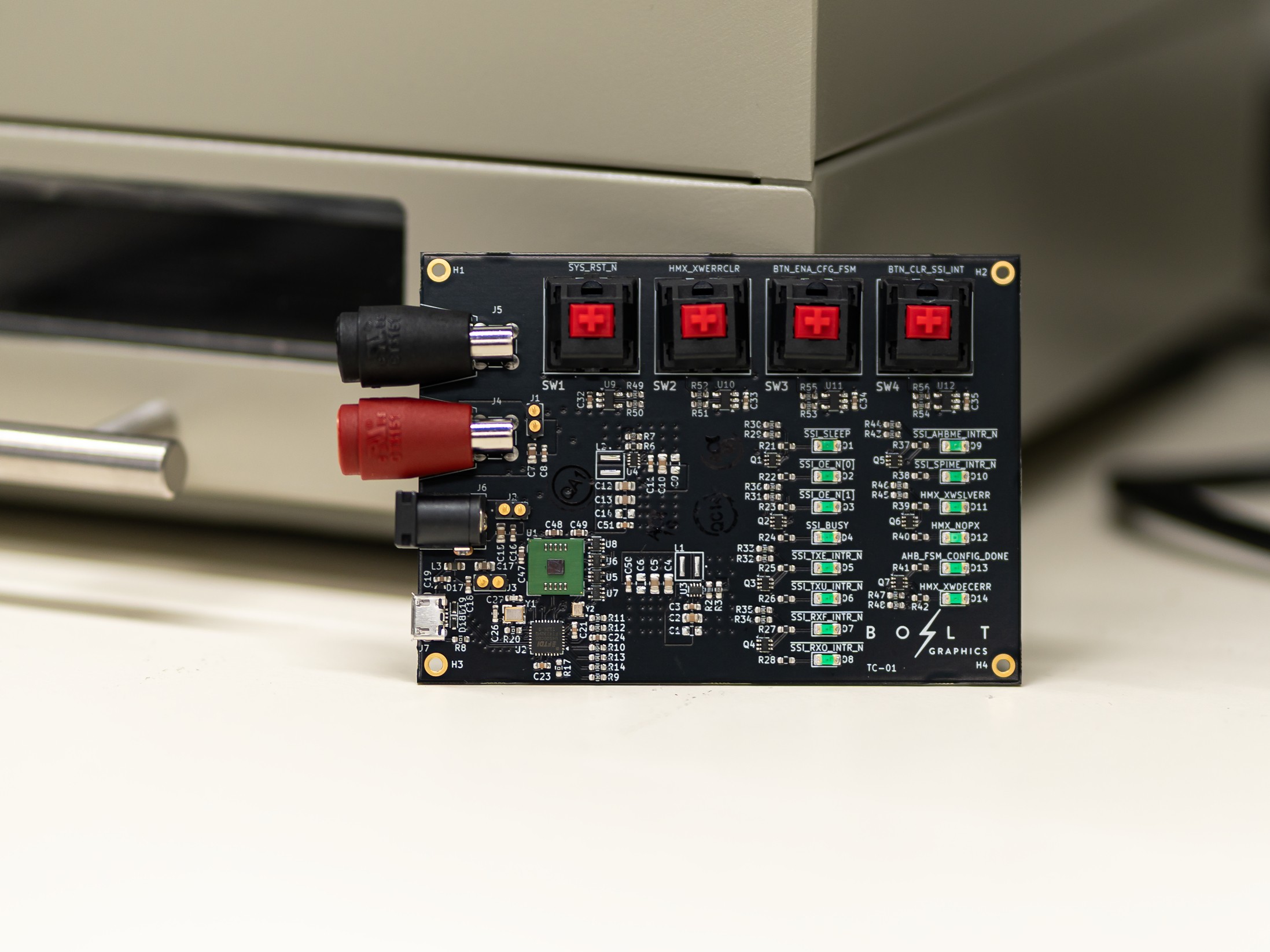
According to Bolt Graphics, the first Zeus test chip was manufactured using TSMC’s 12 nm process. The prototype is extremely small, measuring just 6 mm², and consumes around 1.4 W of power. Engineers reportedly powered on the A0 silicon and completed the initial bring-up process within 24 hours, with no functional issues detected during early testing.
The chip was also tested across a wide temperature range, from -40°C to 85°C, an encouraging sign for reliability during early validation. Bolt Graphics says the test silicon used significantly less power than the FPGA-based platform previously used to evaluate the Zeus architecture, which consumed about 35 W. The company also claims the chip performed better than its internal expectations for both performance and efficiency.
Still, these results should be viewed carefully. This is not a full commercial Zeus GPU, and Bolt Graphics has not released independent benchmarks that can confirm its earlier performance claims. The current test chip is mainly designed to validate core parts of the architecture, rather than prove final product-level performance.
What makes Zeus especially interesting is how different it is from conventional GPUs. The planned entry-level configuration is expected to run at around 120 W and include 32 GB of LPDDR5X memory, with expansion available through DDR5 SO-DIMMs. Larger server-focused versions could support up to 2.25 TB of memory using DDR5 RDIMMs.
That memory flexibility, combined with integrated high-speed networking and dedicated path-tracing hardware, points to a GPU aimed primarily at professional workloads. Scientific simulations, advanced rendering, engineering workloads, and content creation appear to be the main targets. Gaming, at least for now, is not the central focus of Zeus.
Bolt Graphics says the first test chip is specifically designed for electromagnetic simulation workloads. The company believes dedicated hardware can speed up calculations involving Maxwell’s equations, potentially allowing engineers to simulate entire products rather than only individual components. Over time, Bolt Graphics also wants to apply similar acceleration techniques to computational fluid dynamics and molecular dynamics.
If successful, this could give Zeus a unique position in the GPU market. Rather than directly competing with mainstream gaming graphics cards, it could target specialized industries that need faster simulation, rendering, and scientific computing tools. This includes sectors such as aerospace, automotive design, electronics, research, and advanced manufacturing.
However, major questions remain. A working 6 mm² prototype is an important milestone, but it does not guarantee that a full-sized Zeus GPU will meet the company’s ambitious goals. Scaling an architecture from a small validation chip to a large commercial processor is a major challenge, especially when the final product is expected to include high memory capacity, networking, and specialized compute features.
Bolt Graphics has also updated its production schedule. The company previously aimed for Zeus production in late 2027, but the new plan is more gradual. Developer access is now expected in the first quarter of 2027, with early hardware availability for select Early Access Program customers planned near the end of that year. Full volume production of Zeus PCIe cards and server systems is now scheduled for 2028.
To support its hardware ambitions, Bolt Graphics has opened a new office in Taipei, strengthening its coordination with manufacturing partners. While the first test chip was built on TSMC’s 12 nm process, the final commercial Zeus GPUs are expected to use TSMC’s more advanced N5P node.
For now, Zeus remains one of the more unusual and ambitious GPU projects in development. The successful test chip bring-up is a promising sign, especially for a company trying to rethink how graphics processors can be used for simulation and professional rendering. But until full-scale hardware is available and independently tested, the biggest performance claims will remain just that: claims.
Still, the project is now more than a concept. Bolt Graphics has working silicon, a revised development timeline, and a clearer path toward early hardware access. If Zeus can deliver even part of what has been promised, it could become a serious new option for high-performance rendering, scientific simulation, and specialized GPU computing.