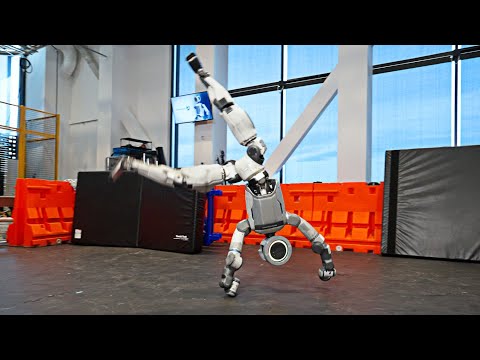
Boston Dynamics’ new Atlas humanoid robot is quickly closing the gap with its well-known, hydraulic-powered predecessor, and its latest progress is the kind that grabs attention instantly. In a newly shared demonstration created with the RAI Institute, Atlas pulls off a cartwheel into a backflip combo—cleanly landing the move without losing balance or taking visible damage.
That’s a big milestone for a robot that, not long ago, struggled with early attempts. In fact, during its first backflip try, Atlas reportedly lost a hand, underscoring just how punishing high-impact acrobatics can be for humanoid robotics. This time, the motion looks far more controlled, suggesting improved coordination, timing, and whole-body stability.
As usual, the team doesn’t just show the highlight reel. The footage also includes the messy, realistic path to success: missteps, falls, and failed attempts while Atlas learns the complex maneuver. The good news is that these stumbles aren’t always catastrophic anymore. In many cases, the robot can catch itself mid-fall, showing better recovery behavior—an important capability for real-world use, where robots need to handle unexpected slips and collisions.
Speed, however, still appears to be a tougher challenge. Training Atlas to run faster leads to more dramatic crashes, including face-first impacts and collisions with obstacles like pallets. Those impacts can knock off components, revealing that durability and hardware resilience still matter just as much as advanced AI control and motion planning when you’re pushing a humanoid robot to its limits.
Alongside the acrobatics, Atlas is also learning to move in a more human-like way. The latest testing shows a more natural walking gait compared to earlier footage, where the robot’s steps often looked stiff or awkward and noticeably slow. While a perfect walking style hasn’t been critical for many commercial scenarios yet, smoother, more efficient motion can translate into better stability, safer navigation around people, and improved energy usage—key factors for practical humanoid robots designed to work in real environments.
Boston Dynamics has also moved Atlas forward beyond the lab. A modified version has been launched as an enterprise product, though it’s described as less sleek than the research-focused model seen in these videos. The research version itself appears to be nearing the end of its run, with the company describing the showcased tests as a “final push” to explore just how far the platform can go.
Taken together, the cartwheel-to-backflip, the improved recovery from falls, and the more natural walking all point to the same takeaway: Atlas is evolving fast, and Boston Dynamics is using these high-risk stunts not just for spectacle, but as stress tests to refine balance, agility, and real-world robustness in humanoid robotics.