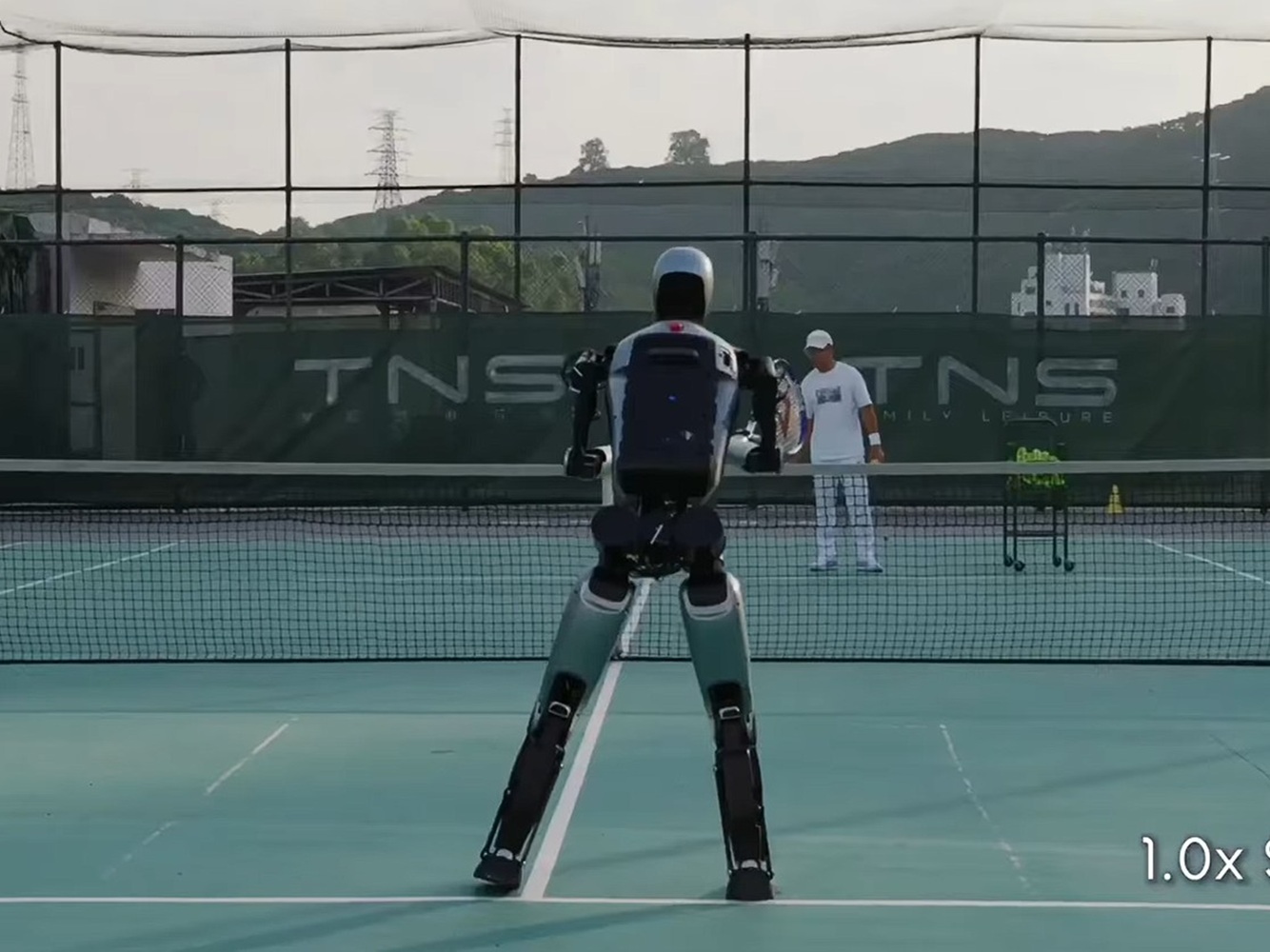
A new video from Chinese robotics company Ubtech Robotics is turning heads by showing its Walker S2 humanoid robot rallying on a tennis court against a human opponent. In the short clip, the humanoid holds a tennis racket, returns incoming shots, and moves around its side of the court with surprisingly smooth, balanced footwork—an eye-catching demo of coordination and stability from a bipedal robot.
The footage appears to be tightly edited, but it still highlights several moments that make the Walker S2 look notably capable. The robot shifts between different ready stances, times forehand swings, and even pulls off a backhand return. Its movements look controlled and fluid rather than jerky, suggesting careful tuning of balance, joint control, and motion planning—key challenges in humanoid robotics.
One detail that stands out is the robot’s racket hand: it appears to be missing digits. That becomes more obvious near the end of the roughly 43-second video, when the Walker S2 high-fives the human player using its other hand with visible fingers. It’s a small visual cue, but it hints at the practical, prototype-like nature of these machines, where different hands or end-effectors may be used depending on the task being demonstrated.
Tennis is a tough test for any robot because it combines multiple difficult problems at once. The machine has to visually track a fast-moving ball, predict its path, and coordinate full-body motion—legs, torso, shoulder, elbow, and wrist—to meet the ball with the racket at the right angle and timing. On top of that, it must keep its balance through rapid weight shifts, while making the action look natural enough to be convincing on camera. Even for humans, reliably hitting a small, moving target at speed takes practice; for a humanoid robot, it’s a demanding benchmark for perception, control, and real-time decision-making.
What the video doesn’t make clear is just as important: it’s not confirmed whether the Walker S2 is operating fully autonomously or being tele-operated by a human controller. And while the rally makes for a compelling showcase, the clip doesn’t provide match details, scoring, or context around how consistently the robot can perform outside of edited highlights.
Ubtech has previously said the Walker S2 is aimed at commercial applications, though some earlier promotional material has drawn scrutiny online. In the broader industry, attention is increasingly shifting from flashy demos to concrete deployment plans, with major manufacturers planning for real-world humanoid robot work in the coming years.
Sports demonstrations like this one are becoming a popular way to show what modern humanoids can do. Beyond tennis, other robots have been seen taking on activities such as basketball, martial arts-inspired routines, and even training for combat-sport exhibitions. Whether these performances translate cleanly into day-to-day jobs is still an open question—but they do provide a vivid snapshot of how quickly humanoid balance, coordination, and motion control are advancing.