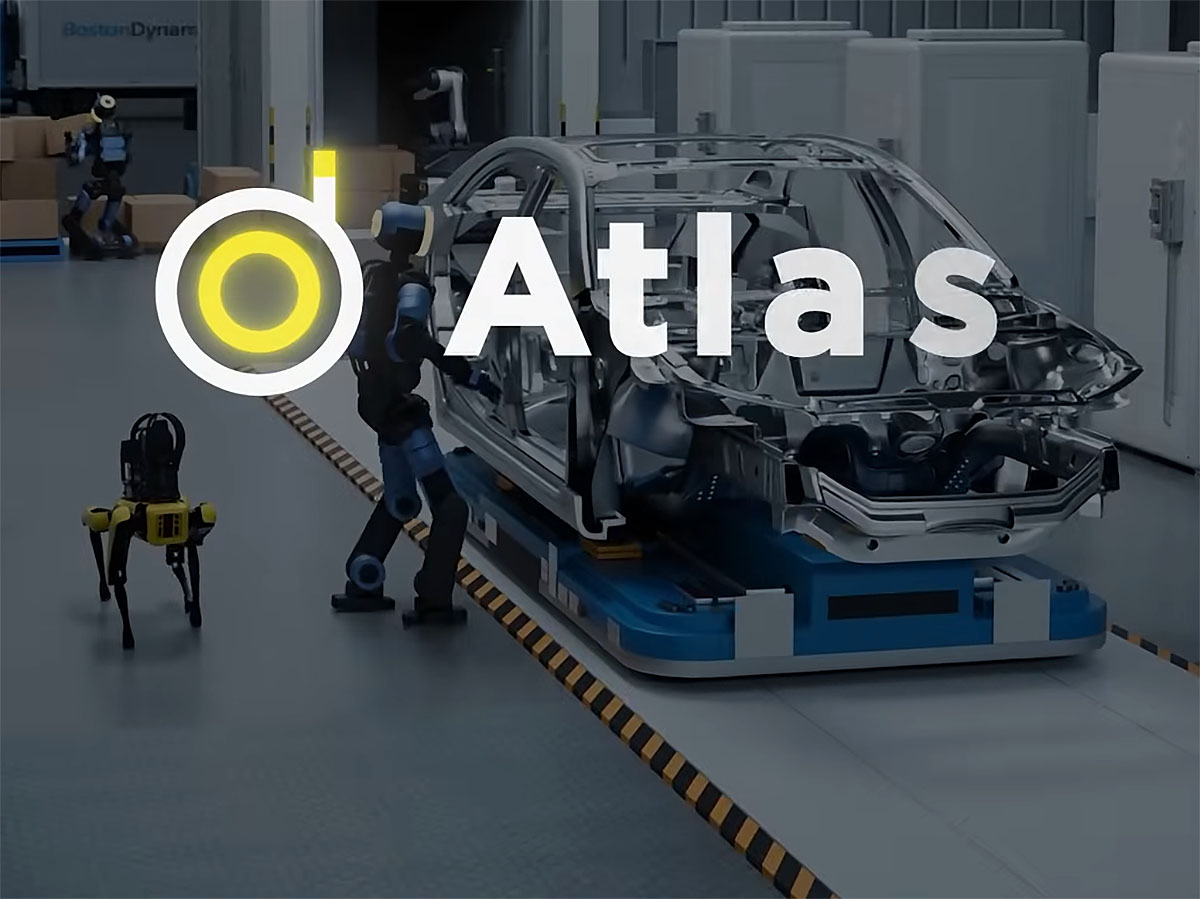
Hyundai is moving quickly to bring humanoid robots from flashy demos to real, everyday factory work. Through its robotics subsidiary Boston Dynamics, the company has revealed a next-generation version of Atlas designed specifically for large-scale manufacturing and continuous operation on the production line.
Unlike earlier humanoid robot prototypes that relied on complex, specialized parts, the latest Atlas has been rebuilt with mass production in mind. Boston Dynamics is starting production right away, with plans to ramp output to as many as 30,000 Atlas humanoid robots per year. Hyundai’s goal is to deploy these robots across its US vehicle manufacturing facilities, where they can support repetitive and physically demanding tasks while helping keep assembly lines running smoothly.
A major shift in this new Atlas is its focus on scalability and cost efficiency. To manufacture robots faster and more affordably, Boston Dynamics has minimized custom components and replaced them with parts that already exist in Hyundai’s supply chain. That approach should make it easier to source materials, streamline assembly, and expand production without the bottlenecks that typically slow down advanced robotics programs.
Key specs outline a humanoid robot built for industrial strength and practical uptime:
– 56 degrees of freedom, with hydraulics fully eliminated
– Aluminum and titanium construction
– 6 feet 2 inches tall, weighing about 198 pounds
– Able to lift up to 110 pounds or carry up to 66 pounds
– Approximately 7.5 feet of reach
– About 4 hours of autonomy, plus the ability to swap its own battery for continuous operation
That self-swappable battery design is especially important for factory deployment. Instead of needing long charging breaks or human intervention, Atlas can keep working by replacing its own power pack, reducing downtime and helping facilities maintain consistent throughput.
On the intelligence side, the robot is built to understand and react to the factory environment in real time. Actuators help Atlas adjust posture and balance dynamically, while tactile sensing allows it to regulate grip force—critical for handling different shapes and materials safely. Its hands can also be reconfigured depending on the job, supporting a wider variety of workflows without needing an entirely new robot design.
For computing and perception, Atlas uses Nvidia chips to process its surroundings, and Boston Dynamics is also partnering with Google’s DeepMind to develop foundation models aimed at improving robot cognition. In other words, this isn’t just about stronger motors and sturdier frames—Atlas is being positioned as a smarter, more adaptable humanoid worker that can learn, generalize, and perform a growing range of tasks.
The first production-ready Atlas units are headed to key partners including Hyundai and Google for workflow evaluation. With Hyundai committing to large deployment numbers and humanoid robot manufacturing accelerating globally, competition in the factory humanoid space is heating up fast—and any company planning to introduce similar robots onto production lines will be entering a market that’s getting crowded in a hurry.


