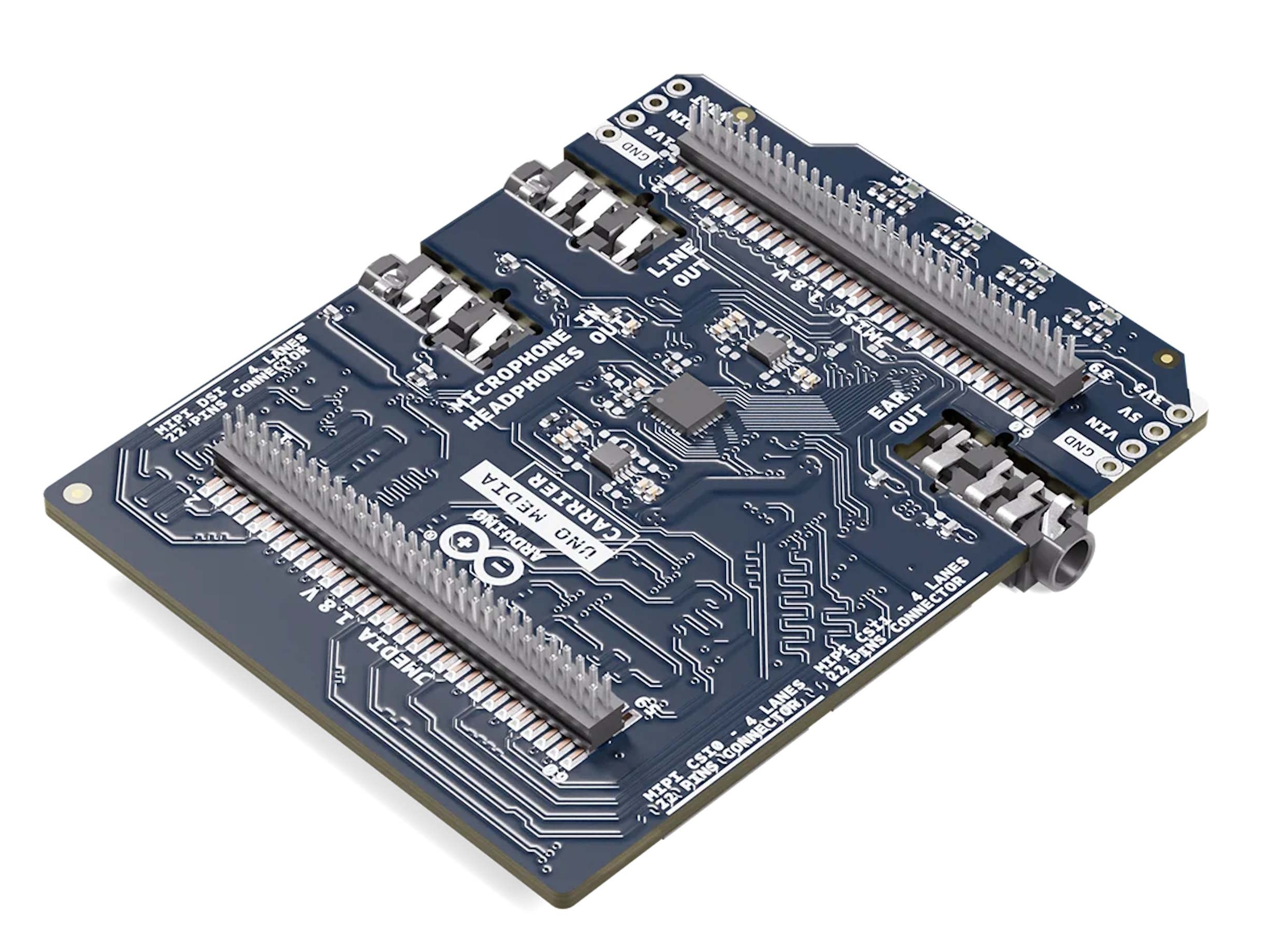
Arduino has quietly made it much easier to turn its compact developer boards into multimedia-ready projects with a new add-on called the UNO Media Carrier. It’s an expansion board, not a standalone computer, and it’s built to dramatically widen what compatible Arduino boards can do—especially when it comes to cameras, displays, and audio.
The UNO Media Carrier is designed to work with the Arduino UNO Q, as well as the upcoming Ventuno Q. The idea is simple: you start with a compatible board, then drop in the Media Carrier to unlock a far richer set of connectors for real-world builds like smart cameras, lightweight vision systems, compact kiosks, and interactive display projects.
The biggest upgrades are on the imaging and display side. The board adds two 22-pin, four-lane MIPI-CSI connectors, letting you attach camera modules directly. That’s a notable boost because the Arduino UNO Q already supports image recognition—so adding proper camera connectivity can turn it into a much more capable computer vision platform for tasks like object detection, monitoring, or automation.
Arduino is also leaning heavily into Raspberry Pi ecosystem compatibility, which is likely to catch the eye of makers and developers searching for flexible camera and screen options. Raspberry Pi camera module compatibility is explicitly called out, making it easier to reuse common parts and find replacements. On the display side, the UNO Media Carrier includes a MIPI-DSI interface as well, enabling direct connection of supported displays. Initial support is expected to include camera modules based on the IMX219 sensor and the Waveshare 8-DSI-TOUCH-A display.
Audio is another area where the Media Carrier expands possibilities. It includes a combined 3.5 mm jack that supports both headphone output and microphone input, which is useful for voice-enabled projects, simple recording setups, or interactive prototypes. On top of that, there are dedicated connectors for a speaker and for headphones, offering more flexibility depending on how you want to route sound in your build.
Price is one of the most attention-grabbing details: Arduino lists the UNO Media Carrier at $19.25, putting it in reach for hobbyists while still being attractive for prototyping and small deployments. The board is expected to launch soon, though Arduino hasn’t shared exact availability timing yet.
For anyone looking to build compact camera-and-display systems, experiment with image recognition, or create multimedia-focused Arduino projects with familiar camera module options, the UNO Media Carrier looks like a small, affordable add-on that could make a big difference.