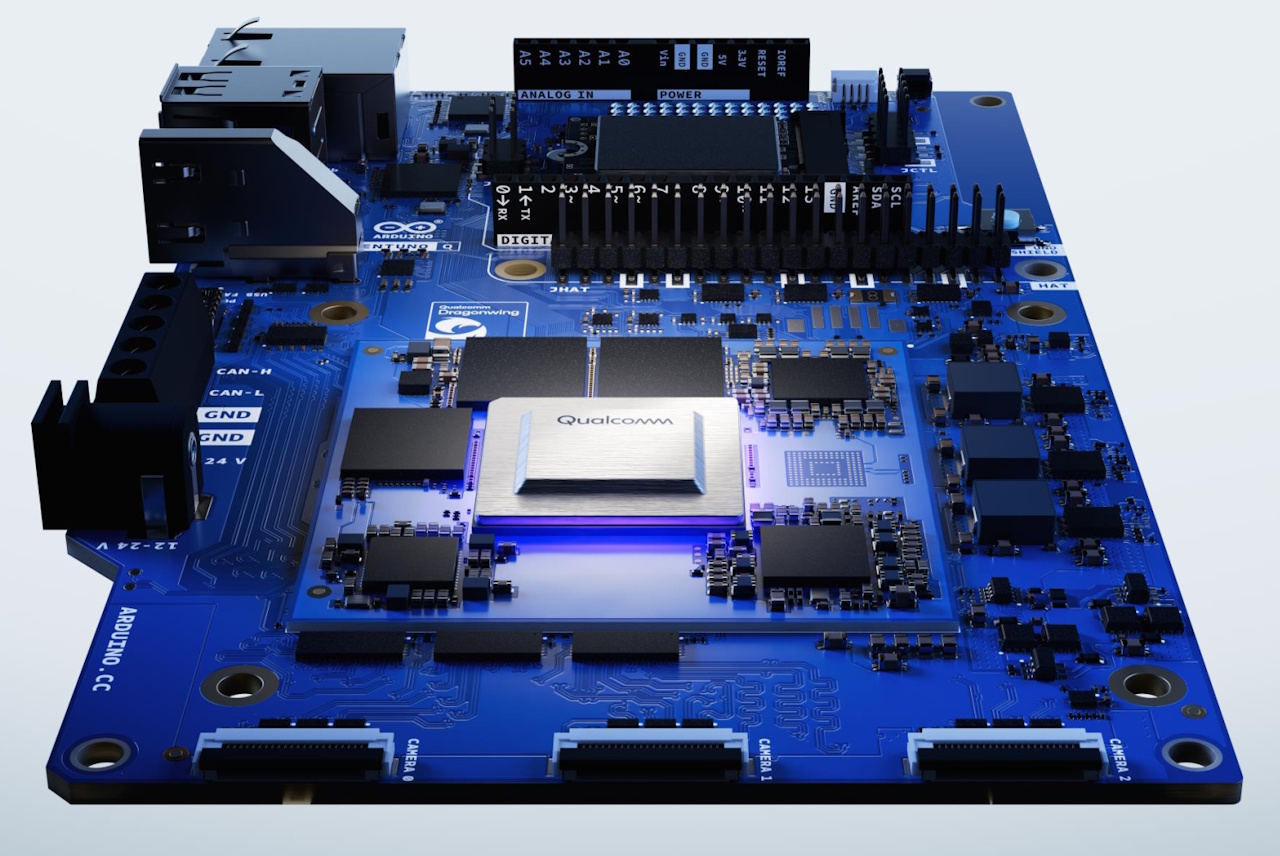
Qualcomm has introduced the Arduino Ventuno Q, a new single-board computer designed for developers, makers, and hobbyists who want to build “physical AI” projects—devices that blend on-device artificial intelligence with real-world control of motors, sensors, cameras, and other hardware. Priced at under $300, the Ventuno Q is expected to become available in the second quarter of 2026, positioning it as a developer-friendly option for advanced robotics and embedded AI builds.
At the heart of the Ventuno Q is the Dragonwing IQ8 platform, built to handle modern edge AI workloads without relying on the cloud. It comes with an 8-core Kryo Gen 6 CPU and an Adreno 623 GPU, paired with 16GB of LPDDR5 memory and 64GB of onboard eMMC storage. That combination targets projects where you need both responsive system performance and enough RAM to run demanding AI pipelines, vision models, or multitasking applications on Linux.
What makes this board especially relevant for real-world hardware projects is its inclusion of a dedicated real-time microcontroller unit. Alongside the main system-on-chip, there’s an STM32H5 MCU with an Arm Cortex-M33 core. This real-time companion is intended for deterministic control tasks such as reading sensors with precise timing, driving motors, and handling time-sensitive input/output—areas where general-purpose Linux systems can struggle due to scheduling and latency.
For connectivity and everyday development convenience, the Ventuno Q includes USB-C and USB-A ports, Ethernet, and HDMI. Wireless connectivity is also on board, with Wi‑Fi and Bluetooth supported, making it easier to prototype mobile robots, smart home devices, and connected industrial tools without extra adapters.
Expansion is another major focus. The board supports external input and add-on hardware through a MIPI-CSI camera interface, an RPi connector, plus UNO and expansion headers. This setup gives developers multiple ways to connect camera modules and sensors, while also offering familiar header-based access for controlling peripherals like servos, relays, drivers, and custom electronics.
On the software side, Ventuno Q is built to run AI applications on Debian or Ubuntu Linux, with up to 40 TOPS (trillion operations per second) of AI processing capability. For creators who want a streamlined workflow, Qualcomm also points to Arduino App Lab as a way to build applications using Python and modular services such as networking, AI, and vision sensing. Those services can be containerized using Docker, helping teams package deployments cleanly and keep projects reproducible from prototype to production-like builds. The platform also emphasizes support for deterministic real-time hardware control, which is key for robots and machines that must react consistently.
In practical terms, the Ventuno Q is aimed at a wide range of edge AI and embedded development use cases. With modular AI services spanning computer vision, speech, language, and sensor intelligence, it’s positioned to power projects such as autonomous or semi-autonomous robots, voice-controlled assistants, industrial visual inspection systems, and smart home peripherals where AI needs to run locally with low latency.
If you’re shopping specifically for a lower-cost Arduino single-board computer to start developing sooner or on a tighter budget, the Arduino Uno Q is also mentioned as a more affordable alternative available through the Arduino store on Amazon.