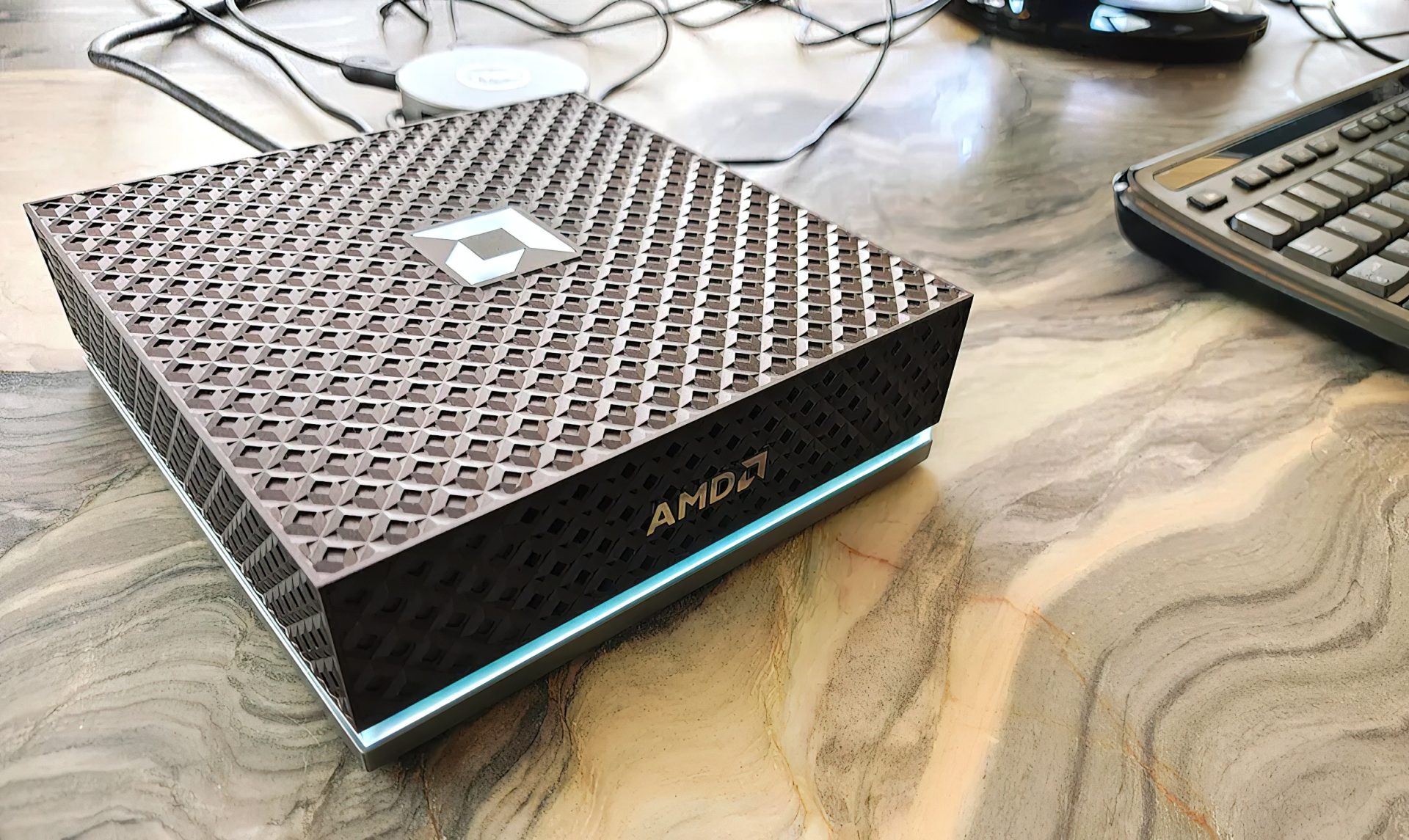
AMD is gearing up to bring serious AI horsepower to a tiny desktop with its upcoming Ryzen AI Halo Mini PC, and a new report suggests the launch is expected in June. The compact system has been shown again at AMD’s AI-focused developer event, where it appeared as a polished, near-ready product aimed squarely at AI developers and small-form-factor power users.
At the center of the Ryzen AI Halo Mini PC is AMD’s top-end Ryzen AI MAX+ 395 processor, part of the Ryzen AI MAX lineup (also known by the “Strix Halo” codename). This family has been gaining momentum across the PC landscape in recent months, showing up in everything from premium laptops to handheld gaming devices and now mini PCs. The appeal is straightforward: these chips combine modern Zen 5 CPU performance, RDNA 3.5 graphics, and an XDNA 2 neural processing unit built to accelerate AI workloads efficiently.
While the Ryzen AI Halo is compact, it’s designed to function like a full AI developer platform. Think of it as a small desktop workstation meant to speed up model experimentation, local inference, and AI-driven creative workflows without requiring a large tower PC.
One of the biggest highlights is software readiness. The Ryzen AI Halo Mini PC is expected to ship with full ROCm support, including the ROCm 7.2.2 suite, and it’s positioned to work smoothly with popular developer and creator tools. The system is described as being optimized for “dev-ready” apps such as LM Studio, ComfyUI, and VS Code, with planned optimizations for widely used models and workflows including GPT-OSS, FLUX.2, and SDXL. AMD is also emphasizing day-one support for leading AI models, signaling that this mini PC is meant to be productive immediately rather than requiring extensive setup.
In terms of hardware configuration, the Ryzen AI Halo Mini PC is expected to leverage the wider Ryzen AI MAX range, scaling up to 16 CPU cores and up to 40 GPU compute units. Memory is another major selling point: configurations can go as high as 128 GB of LPDDR5X-8533, which is a key advantage for local AI workloads that benefit from large, fast unified memory pools. Despite the small enclosure, the device is said to include a dual-fan cooling setup and support large storage capacities, making it more than just a compact showcase unit.
Pricing hasn’t been officially shared, but expectations are forming based on the current market. For reference, a similarly specced mini PC already available with a Ryzen AI MAX+ 395, 96 GB of LPDDR5X, and 2 TB of storage is priced around $2300–$2400. Meanwhile, a competing AI-focused small-form-factor system with 128 GB memory sells for considerably more, around $4699. Based on those comparisons, the Ryzen AI Halo Mini PC is widely expected to land in the $2000–$3000 range in the US, depending on memory and storage options.
A smaller detail, but one likely to appeal to enthusiasts and workstation builders, is the inclusion of a programmable LED accent bar—an aesthetic touch that also hints at a consumer-friendly finish rather than a purely industrial developer box.
If AMD follows through with a June launch, the Ryzen AI Halo Mini PC could quickly become one of the most interesting small desktops for local AI development, model testing, and GPU-accelerated creative work—especially for users who want high-end performance without dedicating desk space to a full-size workstation.


