Micron could be one of the biggest winners from the AI memory boom if DRAM and HBM prices continue rising through 2026 and 2027, according to financial firm Aletheia Capital. The firm believes that tight memory supply, surging AI server demand, and the growing importance of high-performance memory in data center hardware could drive major gains for Micron’s earnings over the next two years.
The current AI infrastructure race has already reshaped the memory market. Micron, SK hynix, and Samsung have all benefited from rising demand for advanced memory chips used in AI accelerators, servers, and high-performance computing systems. As companies continue building larger AI clusters, memory has become a critical bottleneck, pushing prices sharply higher.
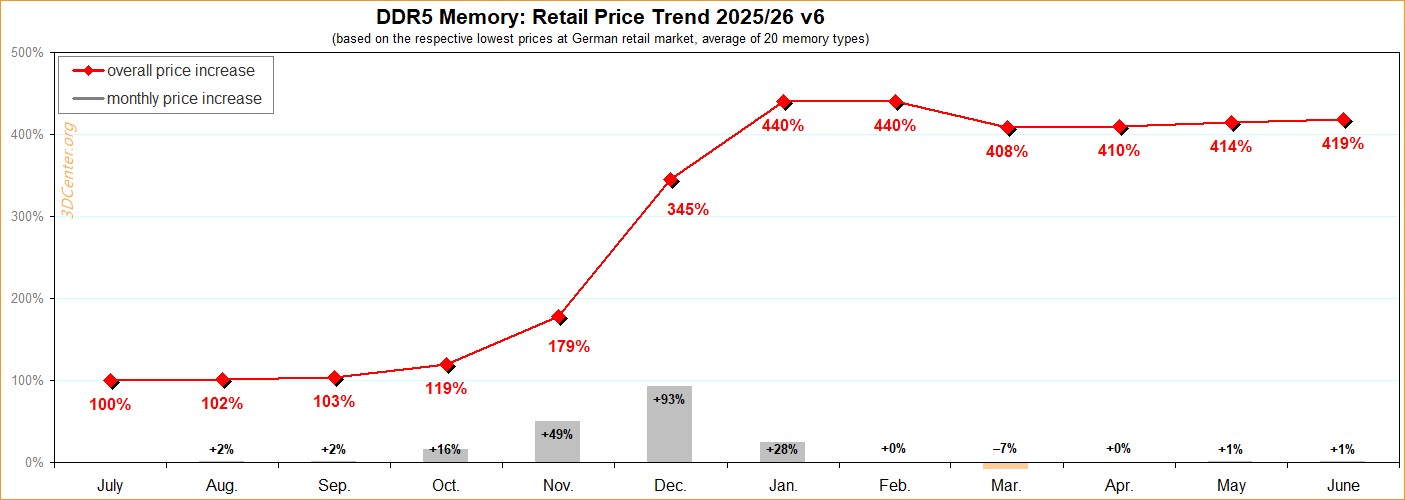
Recent retail market data from Germany highlights how dramatic the price movement has become. In June, DRAM prices posted triple-digit percentage gains compared with the same period last year, along with double-digit increases from the previous month. One example was a 2x 32 GB DDR5-6000 CL28 memory kit, which rose 22% sequentially. Overall, DDR5 memory prices were reported to be up 419% year over year in June, extending the increase seen in May.
Aletheia Capital believes the price rally may still have much further to go. The firm now expects server DRAM average selling prices to rise another 30% in the third quarter of calendar 2026. That is a major upward revision from its earlier forecast, which called for a 10% to 15% increase. For the fourth quarter of 2026, Aletheia still expects DRAM prices to climb another 10% to 15%.
High Bandwidth Memory, or HBM, could see an even stronger pricing trend. HBM is essential for AI chips because it provides the extreme memory bandwidth required by modern machine learning workloads. As demand for AI accelerators expands, HBM supply remains constrained, giving memory suppliers significant pricing power.
Aletheia estimates that HBM average selling prices could double annually in 2027. The firm argues that memory devices are becoming the most important components in AI hardware systems. According to its analysis, the combined content value of memory in AI systems could exceed 70% in 2027, compared with the mid-40% range in 2025.
This shift could have major implications for the cost of AI server racks. Aletheia suggests that rising memory prices may push the cost of NVIDIA’s Vera CPU rack as high as $26 million, largely due to more expensive advanced packaging, modules, and memory content.
For Micron, the financial impact could be substantial if these forecasts play out. Aletheia expects Micron’s earnings per share to rise 8.5 times in calendar 2027, followed by another 1.8 times increase in calendar 2028. That would imply roughly 15 times cumulative earnings-per-share growth, along with estimated free cash flow generation of $350 billion to $400 billion during fiscal years 2026 through 2028.
The broader takeaway is clear: memory is no longer just a supporting part of the AI supply chain. As AI models grow larger and servers require more bandwidth, DRAM and HBM are becoming central to performance, cost, and profitability across the entire ecosystem.
If demand remains strong and supply stays tight, Micron could be positioned for one of the most significant growth periods in its history. At the same time, rising memory prices may also make next-generation AI infrastructure far more expensive for cloud providers, hyperscalers, and enterprise customers.