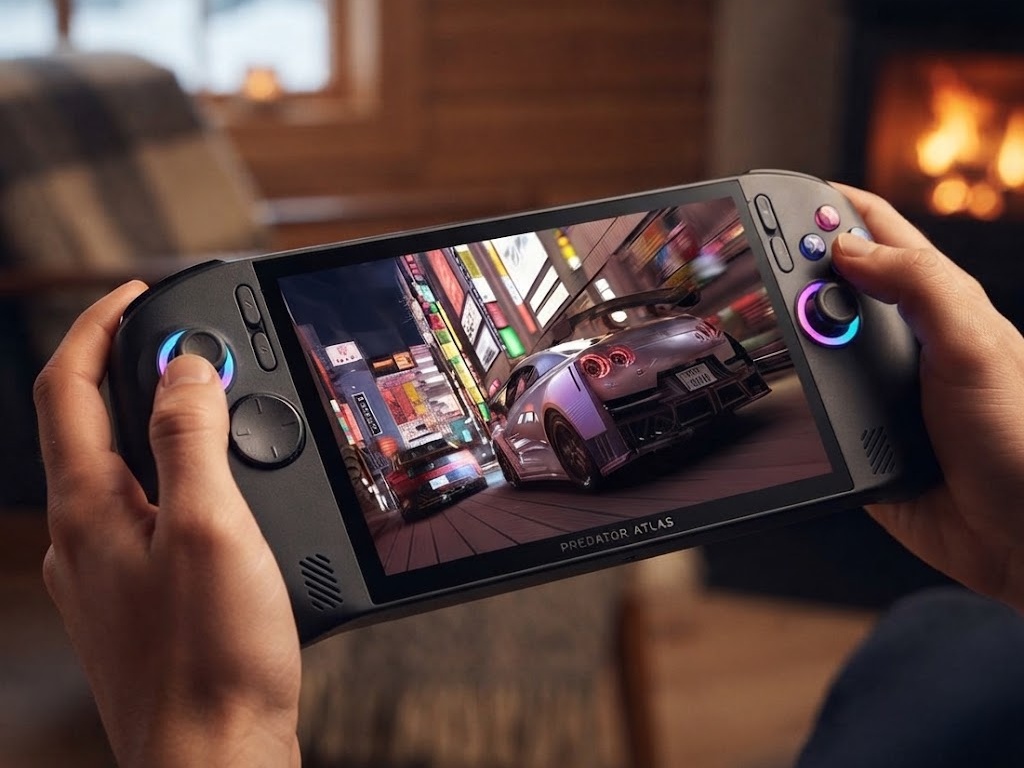
Acer Predator Atlas 8 early impressions: powerful handheld gaming PC impresses, but a few issues stand out
The Acer Predator Atlas 8 gaming handheld is beginning to land in the hands of early buyers, and first impressions suggest Acer may have a serious contender in the premium handheld gaming PC market. Early feedback from a UK customer points to strong gaming performance, a sharp high-refresh display, quiet cooling, and impressive connectivity, though not everything appears polished just yet.
The unit in question is a 24GB model purchased in the UK for £1,300, which is roughly $1,741. Acer had previously planned an October launch window, but availability appears to have moved forward in select regions, including parts of Europe and North America. Wider shipping is expected to begin soon, though exact timing may vary by market and retailer.
One of the most praised parts of the Acer Predator Atlas 8 is its display. The handheld features an 8-inch IPS touchscreen with a 1,920 x 1,200 resolution, a 120Hz refresh rate, variable refresh rate support, and brightness of up to 500 nits. Early comments describe the screen quality as excellent and comparable to other high-end handheld gaming devices. For players who value smooth motion, crisp visuals, and a larger display than the typical 7-inch handheld, the Atlas 8 looks promising.
Gaming performance also appears to be strong. The Predator Atlas 8 is powered by Intel’s Arc G3 Extreme processor with integrated Arc B390 graphics, paired with 24GB of LPDDR5X-7467 memory and a 1TB PCIe 4.0 SSD. That combination should give it enough power for modern PC games, especially at handheld-friendly resolutions. Early testing across several titles reportedly delivered solid results, though power behavior at the 30W “Balanced” setting seemed inconsistent in some cases.
Cooling is another area where Acer appears to have done well. The Predator Atlas 8 uses a dual-fan cooling system, and early feedback suggests the fans remain relatively quiet without the irritating high-pitched whine that can affect some compact gaming devices. That is a major advantage for handheld gaming, where fan noise can quickly become distracting during longer sessions.
The speakers are also described as extremely loud, which could make the device useful for gaming without headphones. However, the sound reportedly has an unusual echo effect, so audio quality may not be perfect despite the high volume.
The controls are more divisive. While the handheld includes Hall-effect triggers, which are generally valued for durability and precision, the face buttons and D-pad have been criticized for feeling mushy. For a gaming handheld, controls are a major part of the overall experience, so this could be a concern for players who frequently use platformers, fighting games, retro titles, or anything requiring precise directional input.
The biggest problem reported so far is sleep mode. According to early user feedback, sleep mode does not function properly, leaving the fans running instead of allowing the system to fully rest. As a workaround, hibernation is being used instead. This sounds like an issue that may be fixable through firmware, driver, or software updates, but it is still an important flaw for a portable gaming device where quick suspend-and-resume functionality is expected.
Battery capacity is one of the Predator Atlas 8’s strongest specifications on paper. Acer includes an 80Wh battery, which is large for a handheld gaming PC and should help with longer play sessions, depending on performance settings and game demands. However, real-world battery life will likely vary significantly based on wattage, brightness, refresh rate, and the type of game being played.
Connectivity is another highlight. The Acer Predator Atlas 8 includes two Thunderbolt 4 ports, Wi-Fi 7 support, and a UHS-II microSD card reader. That is a strong setup for a handheld, giving users flexibility for fast external storage, docking, accessories, high-speed networking, and expansion. For players who want a device that can double as a compact gaming PC at a desk, these features make the Atlas 8 especially appealing.
One detail that may disappoint some buyers is the weight. Acer lists the 80Wh version at under 810 grams, but the early retail unit was reportedly measured at around 870 grams. That difference is noticeable in a handheld device, especially during longer gaming sessions. While the larger battery and premium hardware help explain the heft, buyers expecting a lighter device may want to keep this in mind.
Overall, the Acer Predator Atlas 8 is shaping up to be an ambitious premium handheld gaming PC. Its strong display, capable Intel Arc hardware, quiet cooling, large battery, and generous connectivity make it an exciting option for players looking beyond the usual handheld choices. At the same time, the mushy controls, strange speaker behavior, broken sleep mode, and heavier-than-expected build show that Acer still has some rough edges to address.
If software updates can resolve the sleep issue and improve power management, the Predator Atlas 8 could become one of the more interesting high-end handheld gaming devices of the year. For now, early impressions are mostly positive, but cautious buyers may want to wait for broader reviews and long-term testing before making the jump.