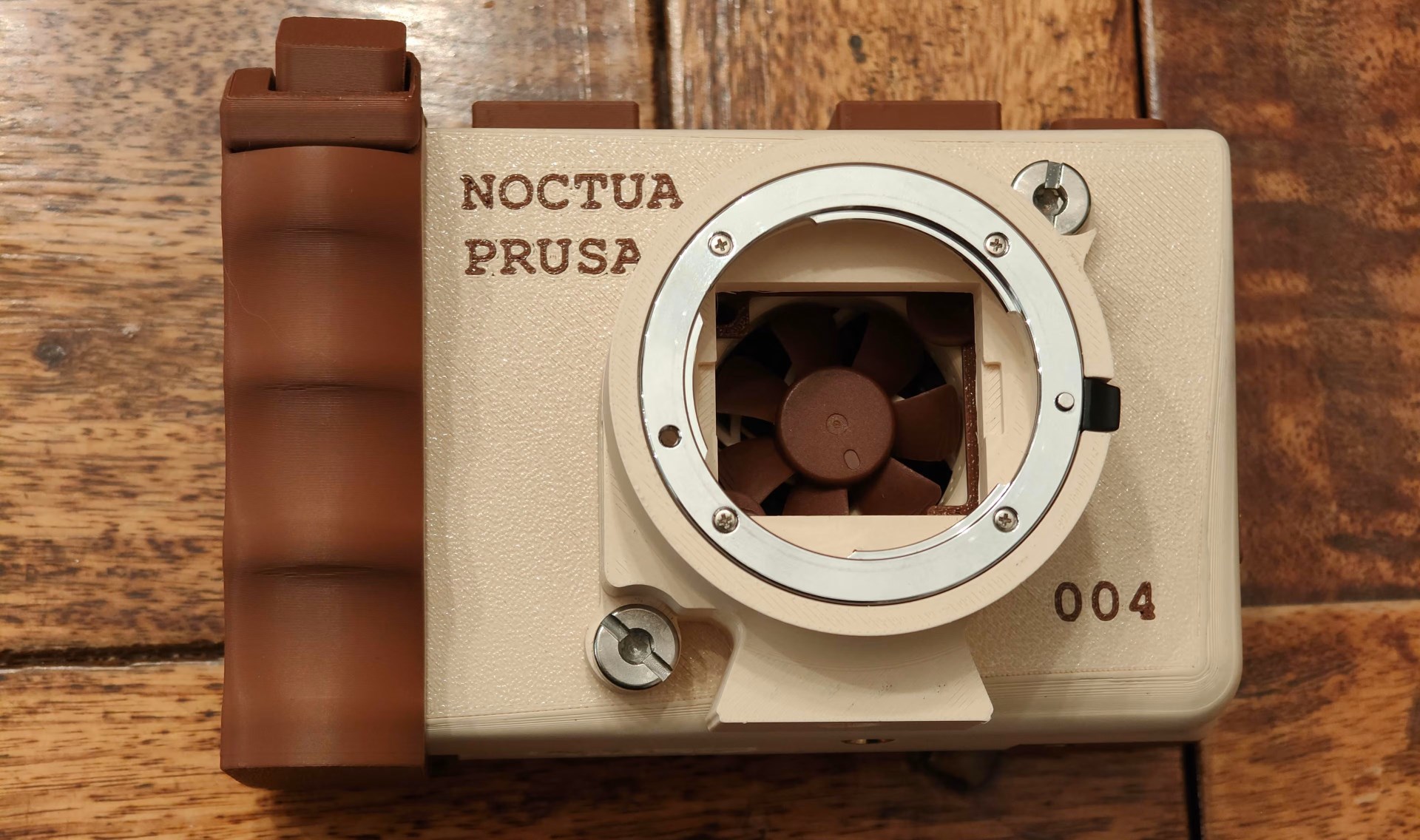
Noctua’s Tiny NF-A4x10 Fan Finds a New Home Inside the CAIM1 Portable Camera
Noctua cooling fans are best known for keeping high-performance PCs quiet and cool, but their next destination is far more unusual: a portable camera designed to prove that photos and videos are authentic.
The CAIM1, short for Counter Artificial Intelligence Machine 1, is a new camera project built around one major goal: capturing real-world images and video while generating cryptographic proof directly on the device. In an era where AI-generated images and deepfake videos are becoming increasingly convincing, CAIM1 aims to provide a hardware-based way to verify that recorded media is genuine.
The device is being developed to record up to 4K video at 60 frames per second while simultaneously handling cryptographic verification tasks. That is a demanding workload for a compact portable camera, especially because the system includes processors and an image sensor inside a mostly enclosed protective shell.
This is where cooling becomes a major challenge.
Unlike a regular camera that mainly needs to manage heat from imaging hardware, CAIM1 also performs edge computing and hardware attestation while recording. The camera processes proof data on-device before sending it to immutable, decentralized storage. All of that extra computing activity generates heat, and passive cooling alone may not be enough to keep performance stable.
Without active cooling, the internal processors could thermal throttle. That could lead to dropped frames, reduced performance, or reliability issues during recording. For a camera designed to verify real-world footage, maintaining smooth and consistent capture is critical.
However, adding a fan to a camera is not as simple as it sounds. A typical small fan could introduce unwanted noise that interferes with audio recording. It could also create vibrations that affect the image sensor, potentially causing motion blur or rolling-shutter artifacts.
To solve this, CAIM1 creator Josh Cowell selected the Noctua NF-A4x10 5V PWM fan, a compact cooling solution known for quiet operation and controlled airflow.
The NF-A4x10 5V PWM measures just 40 x 40 x 10 mm, making it small enough to fit inside the CAIM1’s compact body. Its PWM speed control allows the camera to adjust fan speed depending on thermal demand, helping balance cooling performance with low noise.
That level of control is especially important for a portable camera. During lighter workloads, the fan can spin more slowly to reduce noise. When the processors are under heavier load, the fan can increase airflow to prevent overheating and maintain stable recording performance.
The CAIM1 team reportedly redesigned the main circuit board to make room for the Noctua fan, showing how important active cooling is to the camera’s overall design. Instead of treating cooling as an afterthought, the project appears to be integrating it as a core part of the system.
Noctua fans have long been popular among PC builders and hardware enthusiasts because of their strong cooling efficiency, low noise levels, and reliability. Their use inside CAIM1 highlights how compact, quiet cooling is becoming important beyond traditional desktop PCs. As more portable devices take on advanced computing workloads, thermal management is becoming a key design factor.
CAIM1 is still in the prototype stage. The first production batch is currently targeted for Q1 2027. Before that, the prototype is expected to be shown during Ethereum Tokyo Week and Pragma Tokyo 2026.
If the project succeeds, CAIM1 could become an important example of how future cameras may fight digital misinformation. By combining 4K video capture, on-device cryptographic proof, decentralized storage, and quiet active cooling from a tiny Noctua fan, the camera is being built for a world where proving a photo or video is real may become just as important as capturing it.