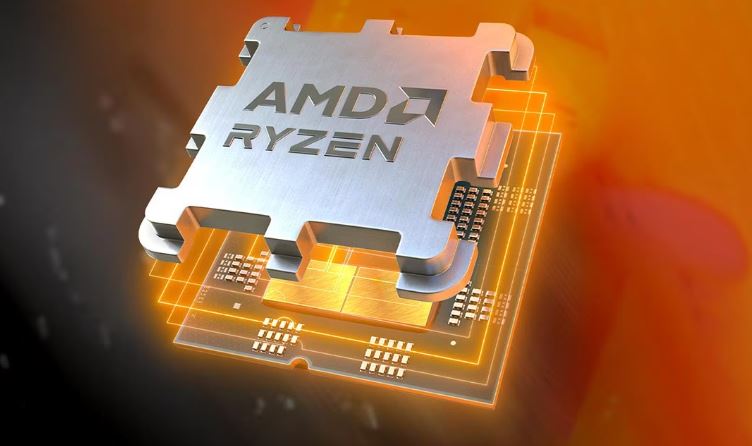
In the world of computing, enthusiasts and professionals alike eagerly await advancements in processor technology. The AMD Zen 5 architecture has been a topic of much speculation, and recent reports suggest an impressive performance leap over its predecessor, Zen 4.
Leakers have provided insights suggesting that on a core-for-core basis, Zen 5 could be more than 40% faster than Zen 4 in SPEC benchmarks, which is a suite used to assess processor performance. This estimate indicates a significant lead over Zen 4 and positions Zen 5 competitively against Intel’s forthcoming processors.
Further performance estimates hint at varying levels of Instruction Per Cycle (IPC) gains for the Ryzen 9000 CPUs across different applications:
– Approximately 7% improvement in Fortnite, a popular gaming title
– An 11% increase in Passmark, a PC benchmarking tool
– A 20% rise in the Cinebench R23 single-core test, which is used to evaluate CPU performance
– Gains of 28% in the 7-zip compression software
– An advancement of 33% in the V-Ray CPU rendering benchmark
– Up to 38% in the demanding game Metro Exodus
– Notable boosts of 71% and 86% in Dolphin, an emulator benchmark, and WPrime, a computational benchmark, respectively
It’s worth noting that the substantial gains in Dolphin and WPrime are likely to be linked to the inclusion of the AVX-512 instruction set, which significantly benefits specific workloads such as machine learning and 3D modeling. However, not all applications will harness this advantage, so performance improvements can vary.
While these figures average out to a speculated 30% IPC gain, there’s a note of caution: the reported performance figures could change, as they are subject to re-testing prior to the official announcement. This leaves room for adjustments and final confirmation closer to the processor’s release.
This is an exciting prospect for the AMD lineup, promising to deliver enhanced performance for various applications. However, it is essential to maintain a level of skepticism towards leaks and speculations until we receive concrete data and official announcements.
Keep an eye out for further developments as we get closer to the unveiling of AMD’s next-gen CPUs, which are shaping up to redefine performance expectations in the computing industry.
Whether you’re a gamer seeking more fluid gameplay, a content creator in need of faster rendering times, or a professional relying on computational efficiency, the incoming reports around Zen 5 suggest that the wait for a significant leap in processing power may soon be over. As always, stay informed and watch for official updates to make the most informed decisions about your tech investments.