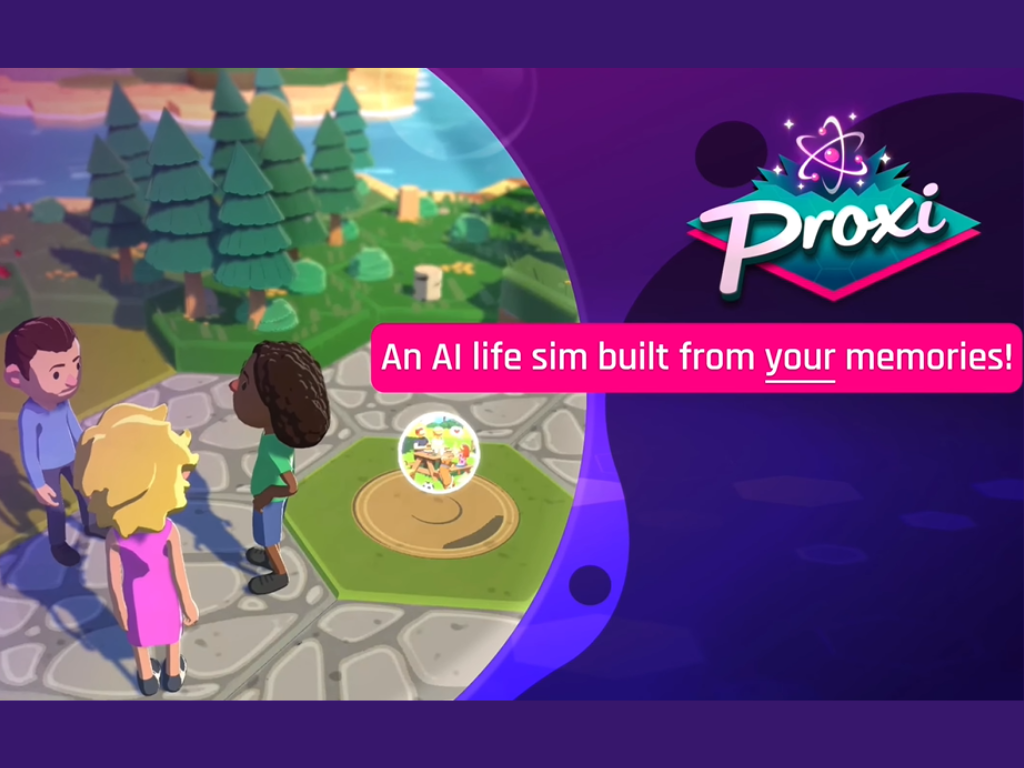
Will Wright, the creative mind behind The Sims, SimCity, and Spore, has spent the past decade chasing a deeply personal, high-risk idea that he believes could reimagine what games can do. Since 2015, he’s been building an experimental project called Proxi: Yesterday’s Tomorrow’s You, sinking millions into development and pushing forward even after major layoffs and dwindling funding. His mindset hasn’t softened with time, either. Wright says he’d “rather have a glorious failure than a mild success,” and Proxi is the kind of long-shot concept where that philosophy matters.
At its core, Proxi: Yesterday’s Tomorrow’s You is an AI-powered memory game designed to turn a player’s real-life memories into a playable digital world. Instead of creating a typical character from scratch, players shape avatars called Proxies—digital stand-ins based on real people from their lives. The bigger goal isn’t just nostalgia. Wright wants the experience to uncover subconscious connections between moments, mapping how memory threads together and how seemingly unrelated events might influence one another.
To bring this unusual vision to life, Wright partnered with the co-designer of Where in the World is Carmen Sandiego? and launched Gallium Studios. The team leaned heavily into neuroscience, storytelling research, and expert interviews, eventually growing to around 30 people. The project was shown publicly as early as GDC 2018, positioning it as a bold blend of artificial intelligence, personal storytelling, and interactive simulation.
But ambition comes with a price tag, and Proxi became an expensive gamble. Wright reportedly poured at least a million dollars of his own money into the project, separate from additional millions raised from investors. The team experimented with AI systems meant to sort memories, generate scenes, and build avatars that could represent the people who appear in your life story. Yet even with years of effort, the project struggled to find the stable financial runway it needed. Over time, cash flow dried up, and the studio’s future became increasingly uncertain.
In October 2024, Gallium Studios ran out of funding and laid off its full team. What remained was a small, unpaid skeleton crew trying to keep Proxi alive, including key figures such as lead designer Adam Lopez and product manager Jenna Chalmers, with Wright still guiding the direction.
Wright has described the concept as “kind of like Frankenstein,” suggesting that a player’s memories effectively become the “brain” of their Proxy, which then helps shape a new world from that personal material. The promise is that AI won’t simply store memories—it will help connect them, finding patterns inside what Wright calls “nested memories.” A routine day might unexpectedly link to a childhood fear. A small moment might echo a major family incident. The game’s AI is intended to surface those relationships and help players see their own life narratives in a more interconnected way.
Looking ahead, Wright has floated even more expansive possibilities. One idea is that Proxies could eventually represent friends, family members, or even ancestors, potentially interacting through data connected to genealogy research. It’s an intriguing notion: a future where personal history, family connections, and AI-generated simulation blend into a living web of relationships.
Still, the challenges remain steep. Wright worries that memories can blur together, overlap, or lose clarity, and he’s still searching for how to make the experience feel truly alive rather than mechanical. Another hurdle is that investors have struggled to understand the concept—an obstacle Wright notes feels familiar, considering how unusual The Sims once seemed before it became a cultural phenomenon.
Even in 2026, Proxi: Yesterday’s Tomorrow’s You is far from finished. Wright is still seeking new backers, still refining the idea, and still committed to seeing how far this experiment can go. Whether Proxi becomes a breakthrough in AI-driven interactive storytelling or a costly passion project that never fully lands, Wright is clearly all in—and he’s willing to accept the risk if it means aiming for something unforgettable.