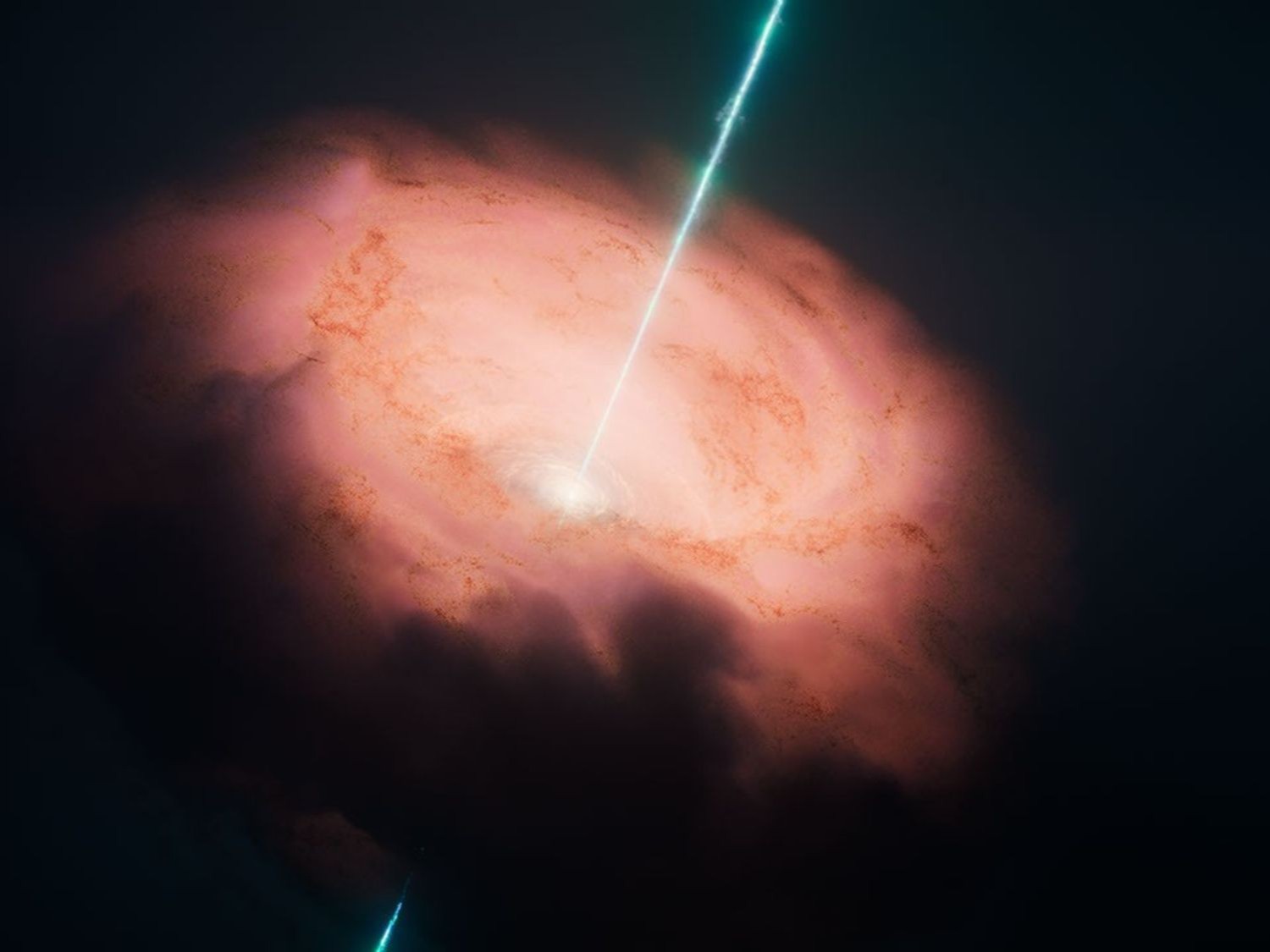
The James Webb Space Telescope has delivered its sharpest, most detailed view yet of the active supermassive black hole at the heart of the Circinus galaxy, and the results are changing what astronomers thought they were seeing.
Circinus sits roughly 13 million light-years from Earth and has long been known for an unusual “extra” glow in infrared light around its galactic center. Earlier observations suggested that much of this infrared excess came from powerful outflows driven by the black hole—streams of heated material blasting outward. The problem was that researchers couldn’t clearly pinpoint the true source of that glow.
Webb’s latest observations cut through that uncertainty. The new findings show that about 87% of the hot infrared emission is coming from dust packed extremely close to the black hole itself. In contrast, less than 1% of the hot infrared light comes from dusty outflows. Another 12% originates from regions farther away. In simpler terms: instead of the infrared brightness being dominated by material being pushed outward, most of it appears to come from hot dust near the black hole—dust that is likely part of the process feeding it.
This breakthrough was made possible by an advanced high-resolution observing method using Webb’s NIRISS instrument (Near-Infrared Imager and Slitless Spectrograph) and its Aperture Masking Interferometer mode. Interferometry combines light in a way that can reveal fine details that would otherwise be blurred or hidden, helping astronomers deal with the clutter of starlight and glowing material surrounding the galactic core.
That matters especially in Circinus, where the black hole is wrapped in a thick “torus”—a dense, donut-shaped ring of gas and dust formed as material falls inward and accumulates. This structure can block direct views into the inner region, making it notoriously hard to separate what’s happening close to the black hole from what’s occurring farther out. Webb’s interferometric approach helped overcome that barrier, producing an exceptionally sharp infrared look into the galaxy’s core.
The observation marks major firsts: it is the first infrared interferometric image of an extragalactic object taken from space, and it is also the first time Webb’s high-contrast mode has been used to study a galaxy beyond the Milky Way. Researchers say this technique could become a powerful tool for probing the environments of other supermassive black holes, helping clarify how they are fueled, how they shape their host galaxies, and why some shine so brightly in infrared light.
The study detailing these results was published in Nature.