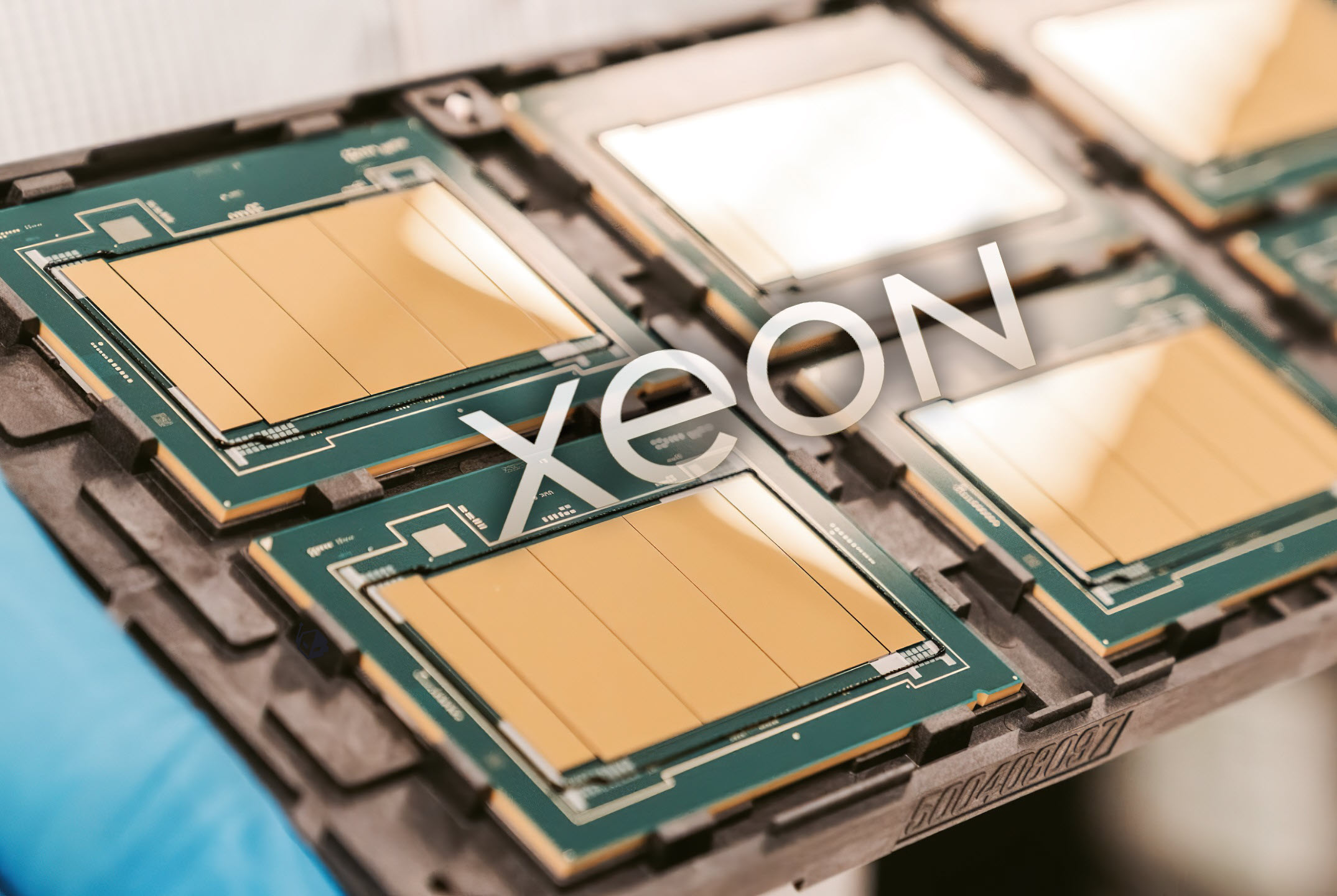
Intel’s next round of powerhouse workstation chips is taking shape, and the early signs point to a serious leap in multi-core performance. A Granite Rapids-WS engineering sample has surfaced in public benchmarks, revealing an 86-core, 172-thread behemoth aimed squarely at high-end desktops, professional workstations, and content creation rigs. Built for the upcoming W890 platform, this next-gen Xeon Workstation family is designed to take on today’s most demanding workloads—and AMD’s latest Threadripper processors.
An engineering sample identified as “Intel 0000” appeared in the OpenBenchmarking database, showing 86 cores and a 2.1 GHz clock, which is typical for early silicon. The chip was tested on an Intel GNR-WS reference platform with 512 GB of DDR5 memory, an NVIDIA RTX 3090, and 1 TB of storage. Networking capabilities looked similar to what’s expected from Arrow Lake-S class platforms.
Based on the core count and configuration, Granite Rapids-WS appears closely aligned with Intel’s Xeon 6700P series at the top end. In that server lineup, the Xeon 6787P and 6788P both top out at 86 cores and 172 threads, carry base clocks around 2.0–2.1 GHz, and push up to 350W TDP with as much as 336 MB of cache. Expect similarly generous I/O on Granite Rapids-WS, including up to 88 PCIe Gen 5 lanes and support for extremely high DDR5 data rates, potentially reaching up to DDR5-8000 depending on configuration.
Competition in this space is fierce. AMD’s latest Threadripper 9000 series still leads on raw core count with up to 96 cores—about 12% more than the 86-core Granite Rapids-WS sample—with impressive efficiency from its Zen 5 architecture. Current Threadripper parts also offer 80–128 PCIe Gen 5 lanes, up to 384 MB of cache, and TDPs up to 350W, setting the stage for a very tight contest across rendering, simulation, compiling, and heavy multitasking.
Platform strategy could be just as important as core counts. Intel’s W890 ecosystem will come in two tiers to match different workstation needs:
– Mainstream: 4-channel DDR5 and 80 PCIe Gen 5 lanes
– Expert: 8-channel DDR5 and 128 PCIe Gen 5 lanes
The W890 chipset itself adds 24 PCIe Gen 4 lanes plus 8 lanes dedicated to GMI links. Granite Rapids-WS will move to a new LGA 4710 socket, which means current Xeon workstation users will need a full platform upgrade to adopt it. By contrast, many existing users of the latest rival workstation platform can transition to newer CPUs without replacing the entire board, which could sway upgrade decisions for some studios and engineering teams.
Why this matters for creators and professionals:
– More cores and threads accelerate 3D rendering, VFX, simulation, scientific computing, CAD, and large-scale compiling.
– Expansive PCIe Gen 5 support enables multi-GPU setups, high-speed networking, and dense NVMe storage arrays.
– Wider DDR5 memory configurations and higher data rates help feed bandwidth-hungry applications and massive datasets.
Key takeaways so far:
– Up to 86 cores and 172 threads spotted on an engineering sample
– Tested with 512 GB DDR5 on a GNR-WS reference platform
– Likely parity with top 6700P-class features: up to 88 PCIe Gen 5 lanes, large caches, and high DDR5 speeds
– Two-tier W890 platform with 4- or 8-channel DDR5 and up to 128 PCIe Gen 5 lanes
– New LGA 4710 socket for Granite Rapids-WS
– Positioned against 96-core Zen 5-based alternatives with 80–128 PCIe Gen 5 lanes
Intel has not announced official specifications, pricing, or release dates yet, though the internal roadmap points to a 2025 window for top HEDT/workstation parts. As engineering samples continue to circulate, expect more clarity on clock speeds, final TDPs, cache configurations, motherboard availability, and how the platform will scale across mainstream and expert tiers. If the early data holds, Granite Rapids-WS could deliver a major uplift for professionals who need maximum I/O, memory bandwidth, and multi-core throughput in a single-socket workstation platform.


