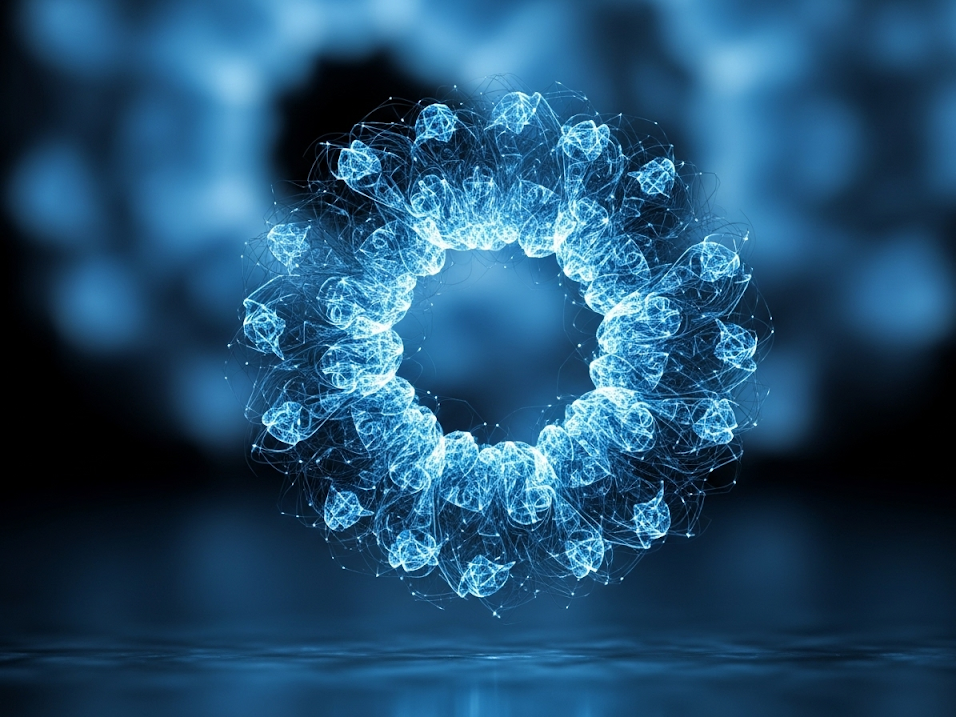
First visible time crystal could transform anti-counterfeiting and data storage
Imagine a material that “ticks” forever without a battery. Physicists at the University of Colorado Boulder have created the first macroscopic time crystal that you can see with the naked eye, turning a once-theoretical oddity into something tangible. Beyond the wow factor, the team says this breakthrough could lead to new ways to protect currency and store data.
Time crystals are an unusual phase of matter first proposed in 2012 by Nobel laureate Frank Wilczek. Unlike ordinary materials, they repeat in time rather than space, maintaining a constant, rhythmic motion even at rest. Previous demonstrations relied on microscopic quantum systems. What makes this advance different is scale and simplicity: the effect is big enough to observe directly, and it’s built from materials already familiar to everyday tech.
The researchers, Professor Ivan Smalyukh and graduate student Hanqing Zhao, used liquid crystals—the same class of materials in many displays. They sandwiched a liquid crystal solution between two glass plates coated with a special dye. When illuminated with a specific kind of light, the dye molecules squeezed the liquid crystals, spawning thousands of tiny “kinks.” Those kinks started to move, interact, and self-organize into intricate, repeating patterns that persisted for hours. Remarkably, the patterns remained stable even as the temperature changed, hinting at a robustness that’s important for real-world use.
Why this matters goes beyond fundamental physics. Because these time-crystal patterns can be turned on with light and are visible without specialized equipment, they could underpin practical, easily verifiable security features. One proposed application is a time watermark for currency or official documents: shine a light and watch a unique, time-based pattern appear, making counterfeiting far more difficult. The team also suggests stacking different time crystals to generate highly complex, layered patterns—a concept that could be harnessed for novel forms of data storage.
This macroscopic, light-driven approach makes time crystals more accessible to engineers and product designers. With materials and methods compatible with existing manufacturing, the door opens to experiments that tune pattern complexity, longevity, and responsiveness. From secure authentication to next-generation information encoding, this visible time crystal is more than a scientific curiosity—it’s a promising platform for future technologies.