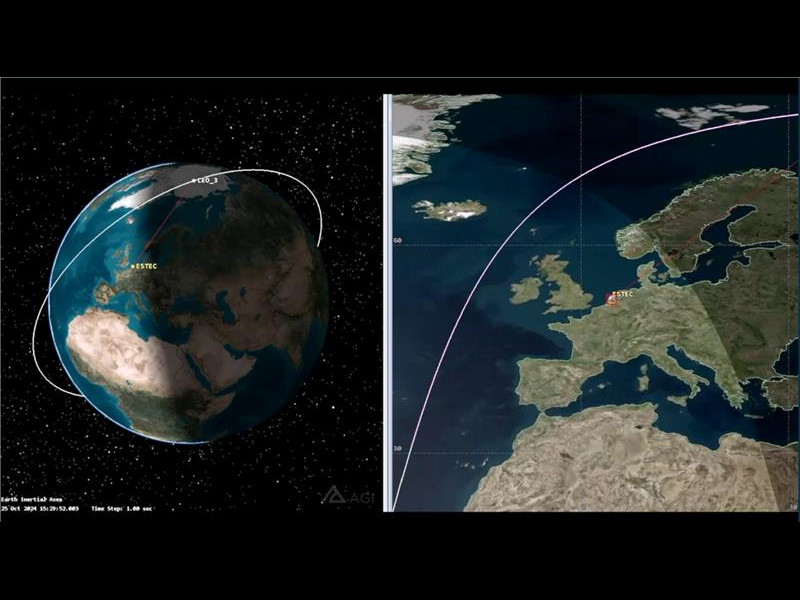
In a groundbreaking development, the European Space Agency (ESA), in partnership with various European collaborators, has successfully demonstrated the feasibility and cost-effectiveness of a satellite-based telephone network equipped with 5G technology. This achievement marks a significant milestone, as a recent test confirmed that a 5G connection to a satellite remains stable while the satellite is visible from the receiver’s location.
The test involved the LEO 3 satellite, a research satellite launched into low Earth orbit specifically for demonstration purposes. Positioned just under 1,000 kilometers above the Earth’s surface, and sometimes up to 2,000 kilometers due to its oblique trajectory from the receiver, the satellite’s operation posed numerous challenges for antenna technology. Maintaining a stable 5G connection was particularly challenging, given that the satellite travels at approximately 28,000 kilometers per hour to maintain its orbit.
Historically, 5G tests have been restricted to geostationary satellites, which remain consistently positioned relative to the Earth’s surface. However, this method is ineffective for achieving a low-latency 5G connection, which is crucial for real-time applications. Geostationary satellites orbit at altitudes of about 36,000 kilometers and can reach up to 50,000 kilometers when factoring in the angle, resulting in a latency of nearly a third of a second. This latency is too high for applications that require real-time communication.
The success of this test with the LEO 3 satellite, which achieved a stable connection using standard frequency bands with established technology, opens new possibilities. It aligns with the specifications set by 3GPP, an essential standardization body for mobile communications. This breakthrough paves the way for mobile networks that operate without the need for additional terrestrial infrastructure, offering significant advantages for remote regions, crisis zones, and communication channels requiring enhanced security.
Moving forward, ESA has plans for extensive practical tests by 2025, which promise to further explore the potential and applications of this innovative technology in mobile communications. As this technology matures, it could revolutionize connectivity in areas that have, until now, been difficult to serve effectively.