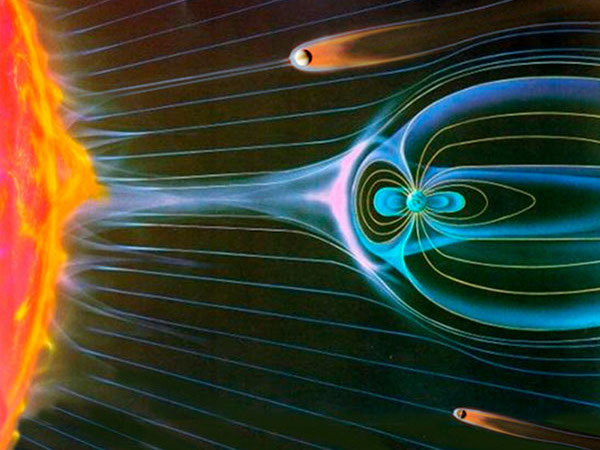
In an effort to improve space weather forecasting, the European Space Agency (ESA) has launched the Solar Orbiter satellite. By positioning the Solar Orbiter at the Earth-Sun L5 Lagrange point, space weather predictions, currently limited to a few days, are anticipated to extend much further, potentially up to several weeks in advance.
The placement of the Solar Orbiter is strategic; it will be situated 60 degrees behind Earth in its orbit around the Sun. This particular position allows a unique vantage point where the satellite maintains a stable orbit balanced between the gravitational forces of the Earth and the Sun. Equipped with a powerful camera system, the Solar Orbiter will observe portions of the Sun that will turn towards Earth at a later time, providing an early view of potential solar eruptions.
By accurately capturing and analyzing the early stages of solar activity, scientists will be able to make better-informed predictions about the strength and trajectory of impending solar storms. This advance warning is crucial as space weather, including radiation and solar particles, can interfere with satellites, GPS, power grids, and aviation.
The mission, which was presented by ESA four years prior, aims to deliver more reliable space weather forecasts by utilizing the Solar Orbiter’s advanced observational capabilities. Improved forecasting can help mitigate the risks associated with solar storms, offering better preparation and protection for technology and infrastructure both in space and on Earth.
Further information and updates on space weather forecasts can be accessed through the appropriate ESA channels, providing insight and background on the conditions surrounding our planet.
Watch the video below to learn more about ESA’s groundbreaking mission, which promises to reshape our understanding and preparation for space weather phenomena.