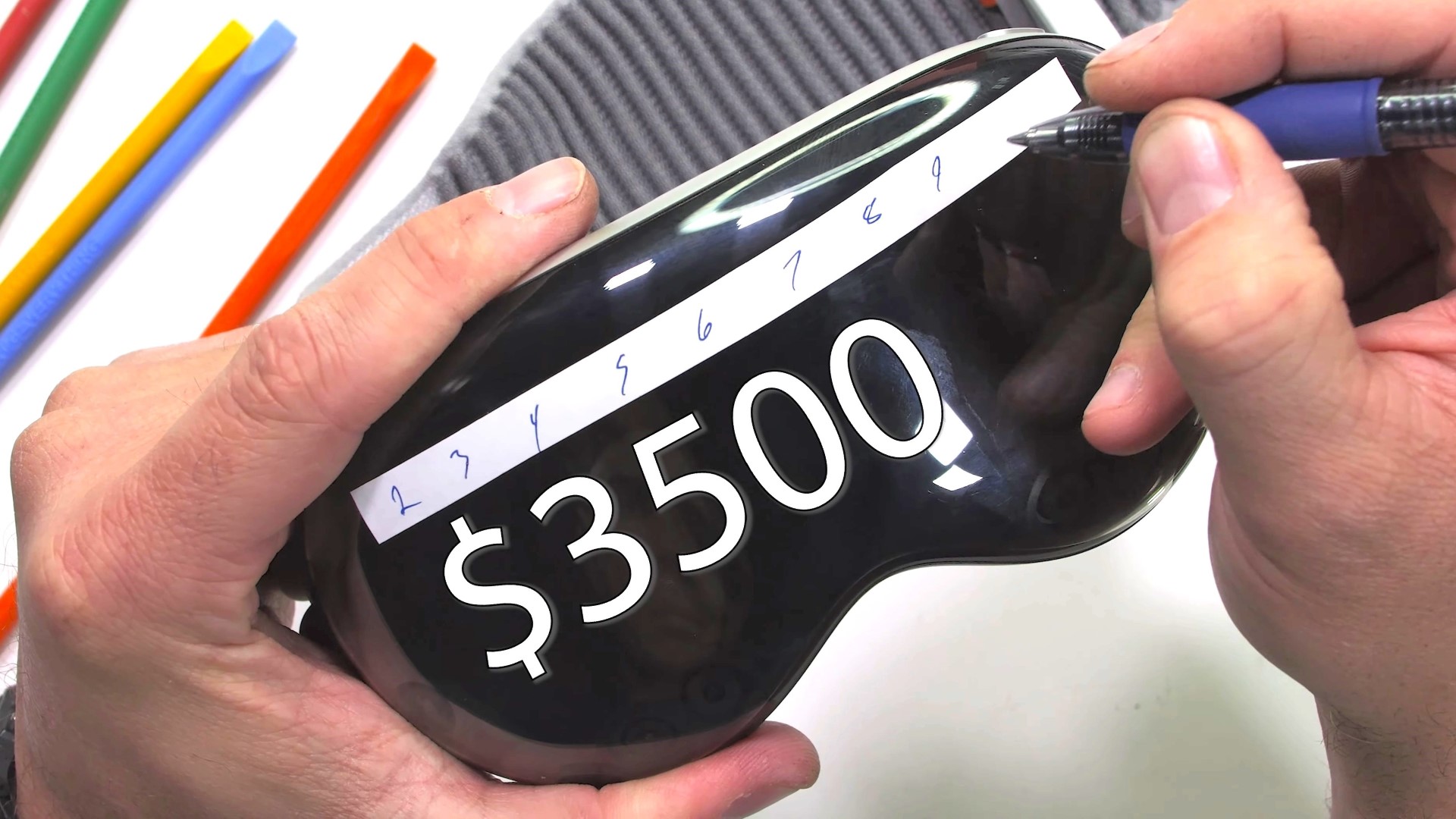
Apple’s recently launched Vision Pro Mixed Reality headset has caught the attention for its hefty price tag of $3,500. Designed as a premium spatial computing device, one would expect it to be built with durability in mind. However, a recent durability test has revealed some surprising – and perhaps concerning – insights into the construction of this high-end gadget.
The prominent feature of the Apple Vision Pro Mixed Reality headset is its curved front, which the company refers to as “laminated glass.” Surprisingly, a new professional durability test has shown that this element is not actually made of glass but plastic. During the test, the material was found to scratch at a level 2 on the Mohs scale, demonstrating a level of fragility akin to that of plastic, which is significantly less than the level 6 one might expect from glass.
This preference for plastic on the exterior – purportedly to increase drop resistance – presents a double-edged sword. While the drop tests indicated the headset is difficult to shatter, the downside is that this exterior is much more susceptible to scratches. Everyday objects such as keys or coins could easily leave a lasting mark on the headset, potentially diminishing the high-quality passthrough experience it aims to offer.
Should this outer layer suffer damage, the cost of replacement is another staggering $799. It seems that the accompanying “fluffy” travel case, priced at an additional $200, is more of a necessity than a luxury. In this context, it appears to be a protective measure for both the external plastic and the delicate lens inside. The headset’s robust bend test results speak to the strength of its aluminum and plastic housing; however, any form of disassembly for repair suggests that the headset’s design did not prioritize repairability.
Taking into account these revealed design choices, users are advised to exercise extra caution when handling the device. Cleaning the lenses, for instance, should not involve paper tissues or any rough materials, to minimize the risk of scratching.
The recent deep dive into the “laminated glass” of Apple’s foray into spatial computing can be explored in its entirety in the video below. It sheds light on the complexities and considerations one must weigh when investing in the latest, yet potentially fragile, technological advancements.