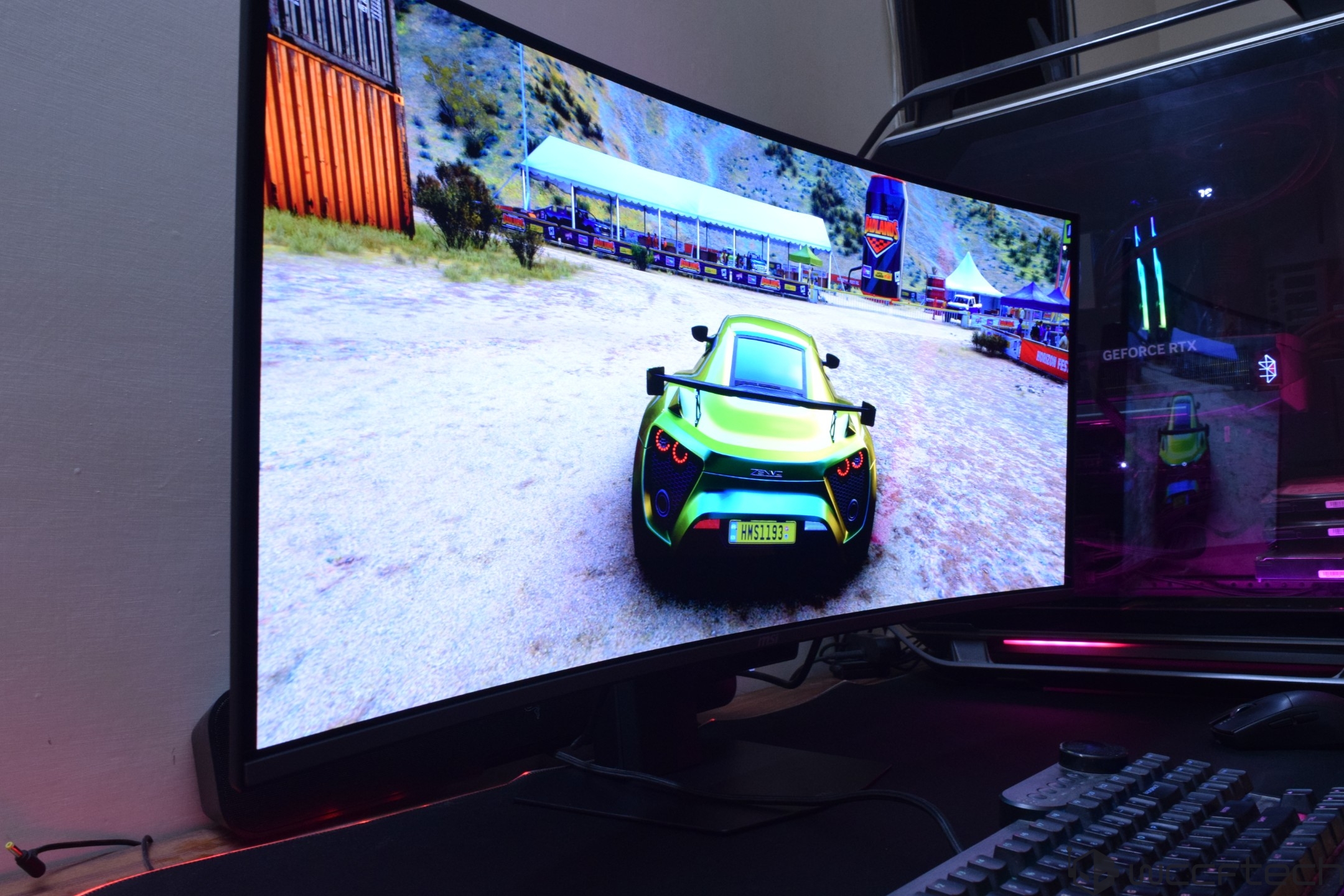
MSI is kicking off 2026 with another serious addition to its gaming monitor lineup: the MSI MPG 341CQR X36 QD-OLED, priced at $1099 in the US. Sitting in MSI’s performance-focused MPG tier (below the flagship MEG series and above the MAG and G-Series lines), this model is built for players who want ultrawide immersion without giving up speed, clarity, or premium OLED contrast.
MSI has been expanding its OLED range quickly, offering multiple sizes across its catalog. While the company has been refreshing parts of its QD-OLED family with updated panels, upgraded display capabilities, and more flat-panel options, the MPG 341CQR X36 is aimed squarely at fans of curved ultrawide gaming. With a 34-inch 1800R curve and a 21:9 aspect ratio, it’s designed to pull you into the action—especially in shooters, racing games, and expansive open-world titles where extra horizontal space can feel like a competitive advantage.
At the core is a 3440 x 1440 UWQHD QD-OLED panel with a strong focus on contrast and motion performance. MSI rates it for a 1,500,000:1 contrast ratio, 10-bit color (1.07 billion colors), and VESA ClearMR 18000 certification. Brightness is listed at 300 cd/m² in SDR, while HDR performance reaches up to 1300 nits peak under the right conditions, alongside DisplayHDR True Black 500 capability for the deep blacks and shadow detail OLED buyers typically care about most.
One of the standout upgrades is MSI’s DarkArmor Film, a new panel treatment meant to enhance the viewing experience beyond the raw panel specs. MSI claims it boosts black levels by 40%, improves overall contrast, and provides 2.5x higher scratch resistance—an appealing combination for a monitor that’s likely to see heavy daily use for gaming and productivity.
Text clarity and color fringing are common talking points for OLED monitors, especially when you mix work and play. MSI is leaning into that conversation with what it describes as a 5th-gen Tandem QD-OLED pixel arrangement technology called Stripe Pixel, based on Samsung’s V-Stripe pixel panel approach. The goal here is straightforward: reduce color fringing and make fine text look cleaner, which matters a lot on a 34-inch ultrawide where browsing, writing, editing, and multitasking are part of the lifestyle.
Speed is where the MPG 341CQR X36 tries to separate itself from earlier models. This display is rated for up to 360Hz at its native UWQHD resolution and delivers a quoted 0.03ms gray-to-gray response time. That’s a notable step up from older 240Hz-class ultrawide OLED options and is aimed at esports-minded players who want ultra-smooth motion without sacrificing OLED-level contrast. Adaptive-Sync support is included to help reduce screen tearing and keep gameplay fluid across supported systems.
Connectivity is also a big part of the package, especially for gamers with multiple devices or creators who want a one-cable laptop setup. Ports include two HDMI 2.1 inputs capable of UWQHD at 360Hz, one DisplayPort 2.1a, and a USB Type-C connection with DisplayPort Alt Mode plus up to 98W power delivery. You also get two USB 5Gbps Type-A ports, one USB 5Gbps Type-B uplink, and a headphone-out. MSI’s included DisplayPort cable is rated for high bandwidth (VESA DP80), though it’s on the shorter side—fine for many desks, but longer high-rated cables may be worth considering for wider setups.
MSI rounds things out with practical usability features. There’s a Gaming Intelligence App for easier control and tuning, KVM support for switching between devices using one set of peripherals, and an internal power board so you don’t have to deal with an external power brick—just plug in a standard power cord and you’re ready to go. Another key element in MSI’s MPG “X” series is OLED Care 3.0, which uses a front-mounted sensor and a built-in NPU to detect human presence and help manage OLED behavior to improve the long-term experience.
Physically, this is a big monitor and it looks the part. The MPG 341CQR X36 measures 812.83 x 118.54 x 371.9 mm with the stand and weighs 7.77 kg, so it’s smart to plan your desk space before buying. Unboxing reflects the premium positioning: the package includes the stand components and power cable, a USB Type-B to Type-A cable, a fiber cloth, VESA wall-mount screws, plus HDMI and DisplayPort cables.
Assembly is designed to be fast and low-stress. The stand and feet connect with a simple locking lever mechanism, and attaching the panel to the stand uses a quick lock system with a magnetic locking interface for added stability. MSI also clearly focused on protecting the panel during shipping, using substantial foam packaging to keep the curved ultrawide safe in transit.
In person, the monitor leans into a modern gaming aesthetic without going overboard. The back is mostly clean and flat, with a central housing area that contains internal components and cooling, plus a dragon logo and an RGB-lit accent plate near the top. From the side, the panel itself looks impressively slim, while vents along the chassis help move heat out of the enclosure. Controls are positioned on the rear and are easy to reach, handling power and on-screen display navigation.
Ergonomics are strong for an ultrawide of this size. The stand supports height adjustment up to 110 mm, tilt from -5° to 15°, swivel up to 30° in either direction, and pivot from -10° to 10°. There’s also 100x100mm VESA mount support for users who prefer an arm mount or wall installation.
Overall, the MSI MPG 341CQR X36 QD-OLED targets a very specific sweet spot: a 34-inch curved ultrawide QD-OLED monitor with the kind of refresh rate normally associated with smaller competitive displays, paired with OLED contrast, modern port selection, and extra panel tech aimed at improving blacks, clarity, and durability. For gamers who want ultrawide immersion but still care about high frame rates and sharp readability, it’s shaping up to be one of the more attention-grabbing monitor launches of early 2026.MSI is kicking off 2026 by shifting attention back to ultra-wide gaming displays, and the MPG 341CQR X36 QD-OLED makes a strong case for why the UWQHD format still matters. Built for players who want speed, deep blacks, and vibrant color without giving up workspace or immersion, this curved 34-inch QD-OLED aims to be a true “do-it-all” monitor for competitive gaming, AAA titles, and even productivity.
One of the first things you notice is that the MPG “X” series leans heavily into smarter panel protection and usability. There’s a new OLED Care 3.0 sensor placed on the front of the display, designed to help the monitor react to real-world use instead of relying on rigid timers and constant reminders. This ties directly into MSI’s AI-driven features, which run through a built-in NPU and work alongside that front-mounted sensor to enhance both comfort and convenience.
The on-screen display (OSD) is where many of these upgrades become most obvious. In standby, the monitor can prompt you to choose the active input source, with options including HDMI 1, HDMI 2, and DisplayPort. Once you’re in the main menu, navigation is straightforward, with clearly presented categories like Gaming Intelligence, Image settings, and configuration options. MSI also displays the currently enabled mode at the top, which makes it easier to confirm what profile you’re actually using without digging through submenus.
A major highlight is the AI Navigator suite, which groups together AI Crosshair, AI Vision, AI Care Sensor, AI Brightness, and an AI Light Sensor. The AI Care Sensor is particularly practical: it detects human presence and lets you tune behaviors like Wake-On Approach and Lock-On Leave. It also supports adaptive dimming, automatic brightness control, color temperature adjustments, and can work in monitor mode across platforms or in a Windows 11 system mode tied to the presence interface. In everyday terms, it’s designed to cut unnecessary screen-on time, reduce burn-in risk, and make the display feel more responsive to how you actually sit and move at your desk.
AI Vision adds three enhancement levels that boost brightness and color saturation, especially useful in darker scenes. For users who want an even brighter HDR punch, MSI includes an EOTF boost feature that increases luminance under the same APL conditions, effectively pushing perceived brightness further than you’d expect, even when compared with the already impressive Peak 1300 nits mode.
OLED Care 3.0 also tackles one of the biggest complaints OLED monitor owners tend to share: panel refresh interruptions. Instead of forcing a mandatory refresh at the 16-hour mark, this model shifts to a 24-hour interval. Even better, the automatic refresh notification now appears anywhere between 4 and 24 hours rather than constantly interrupting every 4 hours like earlier implementations. The result is fewer pop-ups and fewer mid-session disruptions, while still keeping the panel protected over the long haul.
MSI’s Gaming Intelligence Engine (G.I.) adds more gaming-focused adjustments, including KVM support, Smart Crosshair, and Optix Scope. Smart Crosshair stands out because it can change crosshair color dynamically so it remains visible regardless of what’s happening in-game, avoiding the common issue of crosshairs blending into similarly colored scenes.
In the Gaming menu, you can pick pre-tuned modes depending on the genre you play. It comes set to Premium Color by default, but you can quickly switch to profiles for Racing, FPS, RTS, or RPG titles, or use a User mode for your own calibration. There are also toggles and tools like Night Vision, AI Vision, refresh-rate display options, an on-screen alarm clock, DSC, and Adaptive-Sync settings.
For creators and office users, the Professional menu includes Pro Mode presets such as Eco, User, Anti-Blue, Movie, Office, sRGB, and Adobe RGB. There’s also an image enhancement tool that adjusts sharpness across several levels, from Weak to Strongest, for those who want extra edge definition.
Image settings cover the essentials: brightness, contrast, sharpness, color temperature, screen size, and DisplayHDR options. Input selection includes two HDMI ports, one DisplayPort, and one Type-C, plus an Auto Scan feature enabled by default. Console players also get a dedicated console mode that enables HDMI 2.1 at its full 48 Gbps bandwidth, allowing a proper UWQHD 120Hz experience when paired with compatible hardware.
Deeper in the settings menu, MSI includes the expected OSD customization tools such as language, transparency, timeout, RGB lighting behavior, power button settings, and HDMI CEC. OLED Care options are extensive, with controls for Pixel Shift, panel protection tools, static screen detection, multi-logo detection, task bar detection, and boundary detection. It even shows panel usage time, and in this case the unit reported 0 minutes out of the box.
Where the MPG 341CQR X36 really makes its case, though, is in real-world display performance. This is a 1440p UWQHD ultra-wide gaming monitor built for speed, delivering a 360Hz refresh rate that targets both competitive players and enthusiasts who want the smoothest possible motion. It’s rated up to 300 cd/m² for typical brightness, with a contrast ratio quoted at 1.5M:1, and the QD-OLED panel design delivers the kind of color accuracy and depth that has made this tech so popular.
Two major upgrades define the experience compared to older variants: HDR peak brightness hitting 1300 nits, and the addition of EOTF boost. While EOTF boost can help by automatically pushing contrast and brightness, users who prefer a more balanced look with strong black levels and more natural detail may still prefer sticking to the Peak 1300 nits mode without EOTF enhancements.
MSI also addresses a common OLED drawback in bright rooms. The DarkFilm Armor layer helps maintain richer blacks even when ambient light is high, making the monitor more usable outside of dim gaming setups. Another practical improvement comes from the updated Stripe Pixel technology on the 5th Gen QD-OLED panel, which noticeably sharpens text rendering. That matters more than many people expect, especially for anyone who splits time between gaming and browsing, documents, or content creation.
For day-to-day use like web browsing, video streaming, and office work, the picture quality is consistently high, with strong sRGB performance and solid white accuracy. Aspect ratio controls also give you flexibility depending on what you’re viewing or playing.
In gaming, the 1440p ultra-wide resolution helps many titles push closer to the monitor’s 360Hz ceiling, especially when paired with modern upscaling and frame generation features like NVIDIA DLSS 4 MFG mode. Another standout tool is the motion blur reduction mode (BFI), which operates at fixed 120Hz or 180Hz refresh rates. It’s designed to deliver motion clarity comparable to higher refresh gaming within those FPS targets, giving competitive players another option depending on their setup and performance goals.
Fast-paced games like Marvel Rivals and Apex Legends are exactly the kind of titles that benefit from 360Hz, delivering fluid motion, responsive aim, and tear-free action. For larger AAA experiences such as Forza Horizon 5, Borderlands 4, and Battlefield 6, performance can vary more widely depending on your GPU horsepower and settings, but the ultra-wide immersion and OLED contrast still shine. In testing scenarios using an RTX 5090 at 1440p with MFG, frame rates landed in a wide range from around 100 FPS up to 300 FPS depending on the game and scene, while the panel maintained an excellent viewing experience throughout.
A practical takeaway from this kind of monitor is that it can be the centerpiece of a high-end setup. If you’re planning a major upgrade, it often makes sense to choose the monitor first, then build or upgrade your PC around it. A fast, high-quality QD-OLED display can dramatically change how your hardware feels in real use, especially in competitive titles.
Overall, the MSI MPG 341CQR X36 QD-OLED represents a big return to the ultra-wide segment with meaningful improvements across speed, brightness, and usability. Compared to the older MPG 341CQR, the X36 steps up from 240Hz to 360Hz, boosts peak brightness to 1300 nits, adds DP 2.1 readiness, improves black levels with DarkFilm Armor, and upgrades to a 5th Gen QD-OLED panel with Stripe pixels for clearer image and text rendering. For anyone shopping for a curved ultra-wide QD-OLED gaming monitor that also holds up well for productivity and content work, it positions itself as a top-tier choice.
What stands out most is the combination of elite gaming performance, impressively low input lag, strong build quality, and a feature-rich OSD packed with tuning options. The built-in NPU and OLED Care 3.0 updates are more than marketing, too, since they help reduce interruptions from panel maintenance while adding smarter presence-based behavior. MSI also includes OLED Care with a 3-year warranty, which will matter to long-term buyers who want added peace of mind.
The main area that could still be improved is the firmware update process, which may feel a bit intimidating for first-time users. But if MSI continues refining that experience, the MPG 341CQR X36 has the ingredients to remain one of the most compelling ultra-wide QD-OLED gaming monitors in its class.


