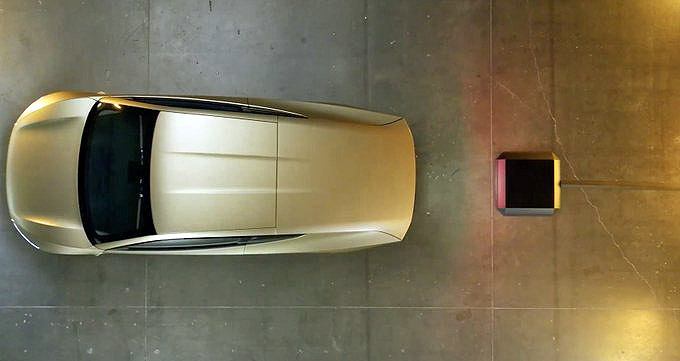
Tesla has made a significant breakthrough in wireless charging efficiency with their acquisition of a German engineering team from Wiferion in 2023. This partnership has resulted in the Tesla Robotaxi achieving an impressive 90%+ wireless charging efficiency, setting a new benchmark for the industry.
Tesla’s chief designer had hinted at the development of a wireless charging solution during a Cybertruck test ride with Jay Leno. Referred to internally as Project Garfield, the concept envisions a hassle-free experience where vehicle owners simply drive over a charging pad in their garage to recharge. The cutting-edge technology from Wiferion boasts 93% efficiency, countering claims of inefficiency with a promise of minimal energy loss.
Elon Musk himself has weighed in, emphasizing that when designed correctly, the efficiency difference between inductive and conductive charging is negligible. This level of precision in design ensures optimal performance, with the Tesla Robotaxi standing out as a testament to this engineering prowess.
Wiferion’s existing wireless charging solutions resemble Apple’s MagSafe, but are designed for industrial use, achieving efficiency rates of up to 93%. Their technology allows charging within seconds from any angle, a feature that’s likely to be adapted for the Robotaxi. Additionally, the IP68 water-resistance certification raises the possibility of outdoor use for these pads.
Though the current Wiferion pad delivers 3 kW, it seems Tesla’s version is set to be far more powerful. During a wireless charging demo for the Robotaxi, the pad demonstrated a 25 kW charging speed, meaning the Robotaxi’s 40 kWh battery could be recharged in less than two hours for a 200-mile range.
Interestingly, Wiferion remains tight-lipped about the proprietary technology that achieves such high efficiency levels. It will be intriguing to see which of the 4680 battery cell models Tesla equips the Robotaxi with. These cells are known for their superior lifespan, quick charging times, and exceptional recharge efficiency, making them ideal for Tesla’s fleet.
Mass production of these innovative 4680 cells is anticipated in 2026, aligning with Tesla’s projected launch window for the Robotaxi, pending regulatory approvals. Whether or not they can navigate the complex regulatory landscape, including recent investigations into Tesla’s Full Self-Driving capabilities, remains to be seen—but the future looks electrifyingly promising.