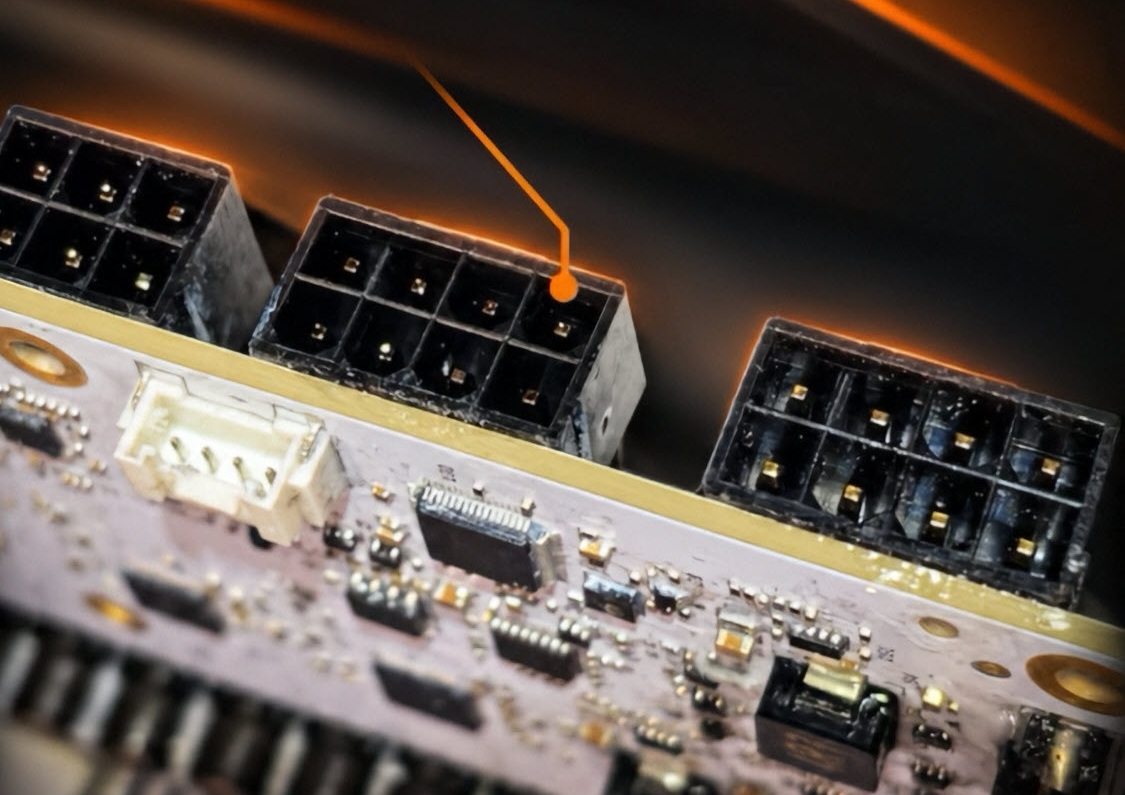
World’s First NVIDIA RTX 5090 Mod With 8-Pin Power Connectors Shows an Alternative to the 16-Pin Design
A group of hardware modders has demonstrated what many PC enthusiasts have been asking for: an NVIDIA GeForce RTX 5090 graphics card powered by traditional 8-pin connectors instead of the newer 16-pin power connector.
The custom project is not an official retail design, but it is an eye-catching proof of concept. It shows that even a flagship, power-hungry GPU like the RTX 5090 can operate using multiple standard 8-pin power connectors when the hardware is modified correctly.
The experiment arrives at a time when the 16-pin GPU power connector remains controversial. Since its introduction on high-end graphics cards, users have reported cases of melted connectors, damaged cables, and expensive GPUs failing due to power delivery problems. The issue has affected cards across multiple generations, including high-performance NVIDIA models and some AMD cards that use the same connector style.
A newer 12V-2×6 connector standard was introduced to improve reliability, power balancing, and safety. However, reports of overheating and connector damage have continued. Many power supply and graphics card manufacturers have also released updated or specialized cables designed to reduce risk, but the concerns have not completely gone away.
That ongoing frustration is what makes this RTX 5090 8-pin connector mod so interesting.
The modified RTX 5090 was based on a custom GALAX HOF OC LAB graphics card, a model originally designed with two 16-pin power connectors for extreme overclocking. The modders removed the original power connector setup and replaced it with three traditional 8-pin Mini-Fit Jr. connectors.
According to the team behind the project, the card may even be capable of running with only two 8-pin connectors under certain conditions. Earlier testing used XT90 connectors, which are designed to handle very high current loads, but the latest demonstration focused on standard 8-pin-style connectors to prove that the older connector format can still be practical for modern high-end GPUs.
To make the RTX 5090 recognize the new power configuration, the mod required hardware-level adjustments. The sense pins had to be rewired so the card could detect the available power and operate normally. Specifically, the Sense 0 and Sense 1 pins were interconnected to allow the GPU to run at its maximum available power target.
The mod did not require BIOS changes or software-level tweaks. Everything was handled physically on the graphics card’s power delivery system.
The custom connector setup was installed on the rear side of the PCB using copper plates. These copper plates were wrapped around the cable ends to improve power transfer. In total, 24 heavy-gauge cables were routed from the three 8-pin connectors to the front side of the PCB to deliver power to the GPU.
The final configuration included nine +12V lines, with each line carrying around 8 to 8.5 amps of current during operation.
To test the modified RTX 5090, the modders gradually increased the GPU’s power draw. They started at 400 watts, then moved to 500 watts, 600 watts, and eventually pushed the card up to a peak input power of around 900 watts through the three 8-pin connectors.
Throughout the tests, voltages and temperatures were closely monitored.
On paper, a standard 8-pin PCIe power connector is rated for 150 watts. However, that number is an official specification rather than a hard physical limit. In real-world use, the connector and cable quality, wire gauge, contact resistance, soldering, and cooling all influence how much power can be safely carried.
In this modified setup, the RTX 5090 was able to draw peak currents above 60 amps while reaching GPU frequencies of around 3400 MHz. That places the card firmly in high-overclocking territory.
More importantly, the cables and internal soldering handled the load without showing dangerous heat levels during the demonstration. The power delivery system remained within what the testers considered an acceptable electrical and thermal range.
The most extreme part of the test involved running the RTX 5090 at a load above 120 amps while maintaining clock speeds around 3400 MHz for more than an hour. Even under that heavy load, cable temperatures reportedly stayed low, barely exceeding 35°C.
The team then pushed the experiment further by removing connectors during testing.
With one of the three 8-pin connectors removed, the RTX 5090 continued running. It still maintained more than 66 amps of current and operated above 3200 MHz. Infrared temperature readings reportedly stayed under 25°C in that configuration.
The final test was even more surprising. Running through just one connector, the card maintained around 65 amps while operating between 3.1 GHz and 3.2 GHz. During the stress test, the connector area stayed around 45°C, while the hottest point on the cable reached approximately 65°C.
For a single-connector stress scenario on a card as powerful as the RTX 5090, those results are impressive.
This does not mean users should try to modify their graphics cards at home. The project involved advanced electrical work, custom wiring, PCB-level changes, and constant monitoring. Done incorrectly, this kind of modification could destroy a graphics card, damage a power supply, or create a serious safety risk.
However, the demonstration does make an important point: traditional 8-pin PCIe power connectors are still technically capable of powering even the fastest consumer graphics cards when implemented properly.
The bigger question is whether graphics card manufacturers will ever return to multi-8-pin designs on flagship GPUs. Given the industry’s investment in the 16-pin and 12V-2×6 ecosystem, that seems unlikely in the near term. Board partners, power supply makers, and standards groups have already committed heavily to the newer connector format.
Still, this RTX 5090 mod will likely fuel the ongoing debate among PC builders and enthusiasts. Many users continue to prefer the older 8-pin connector because it is familiar, widely supported, easier to inspect, and historically reliable when used with quality cables and proper installation.
The takeaway is clear: the 8-pin connector is far from obsolete. While the industry may continue pushing newer compact power standards, this custom RTX 5090 proves that a well-built multi-8-pin setup can still deliver massive amounts of power, support extreme GPU overclocking, and maintain safe temperatures under demanding loads.
For PC gamers, overclockers, and workstation users concerned about GPU power connector reliability, this project is a strong reminder that connector design, cable quality, and proper compliance matter just as much as raw wattage ratings.