TecLab Shows a Connector-Free GeForce RTX 5090 Setup by Soldering Power Cables Directly to the GPU
Concerns around melting 16-pin power connectors have become a major talking point among high-end GPU users, especially with power-hungry graphics cards like the GeForce RTX 5090. Now, Brazilian hardware enthusiast TecLab has demonstrated an extreme workaround: removing the connector from the equation entirely.
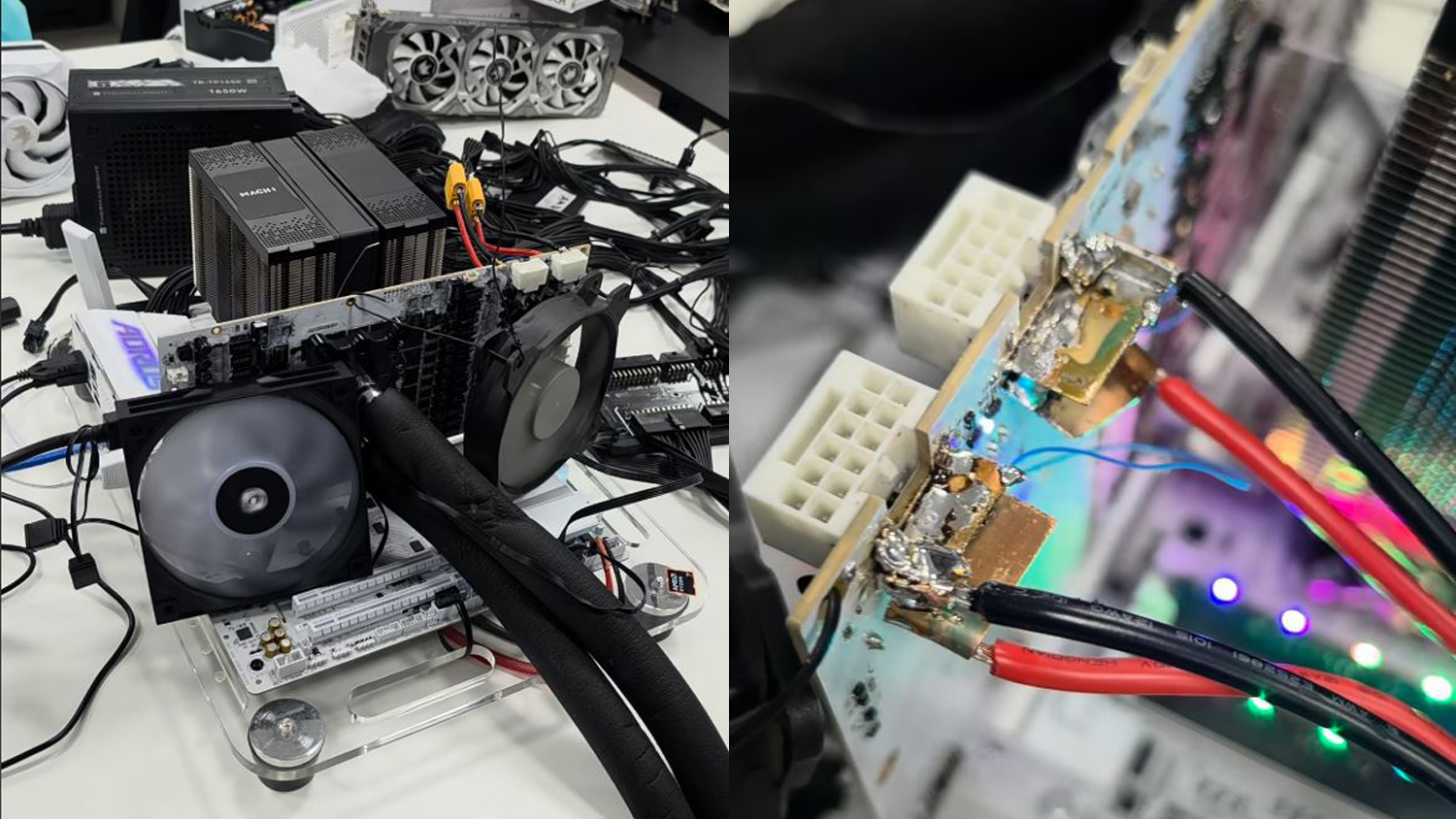
In a recent video, TecLab showcased a modified NVIDIA GeForce RTX 5090 D running without the usual 16-pin power connector setup. Instead of plugging power cables into the GPU as intended, he soldered the power wiring directly to the graphics card’s PCB, effectively bypassing the connector that has caused anxiety for some PC builders.
The card used in the demonstration was not a standard model. TecLab used a GALAX GeForce RTX 5090 D HOF OC LAB XOC, a high-end overclocking-focused graphics card equipped with dual 16-pin power inputs. However, rather than relying on one or both connectors, the modder decided to skip the connector system entirely and feed power directly into the board.
The setup appeared to involve adapter wiring from 16-pin cables, with multiple wire groups routed and soldered directly to the 16-pin connector traces on the GPU’s PCB. The soldering job looked rough and improvised, but TecLab seemed confident in the result and proceeded with the test.
To keep the graphics card stable during operation, he used an external cooling system aimed at the GPU substrate, along with additional fans blowing directly over the card’s components. After powering on the system, the PC successfully booted, and the GPU was able to run tests without immediately showing problems.
The demonstration was clearly aimed at highlighting frustration over ongoing worries about 16-pin GPU power connectors. TecLab even joked that this is “how it’s done,” presenting the mod as a direct response to the connector-melting debate surrounding modern flagship graphics cards.
That said, this is not a practical or recommended solution for regular PC users. Soldering power cables directly to a GeForce RTX 5090 is risky, difficult, and almost guaranteed to void the graphics card’s warranty. It could also cause permanent damage if done incorrectly, and even if it works in the short term, the long-term reliability of such a modification remains unknown.
For most users, safer options are a much better choice. Proper cable management, fully seated 16-pin connectors, avoiding sharp cable bends near the connector, and using monitoring accessories designed for GPU power connections are far more reasonable ways to reduce risk without modifying the PCB.
TecLab’s experiment is impressive from an enthusiast and extreme-modding perspective, but it is not something everyday gamers or PC builders should attempt. The demonstration does, however, underline how seriously some users are taking the issue of high-power GPU connectors as graphics cards continue to push power limits higher.