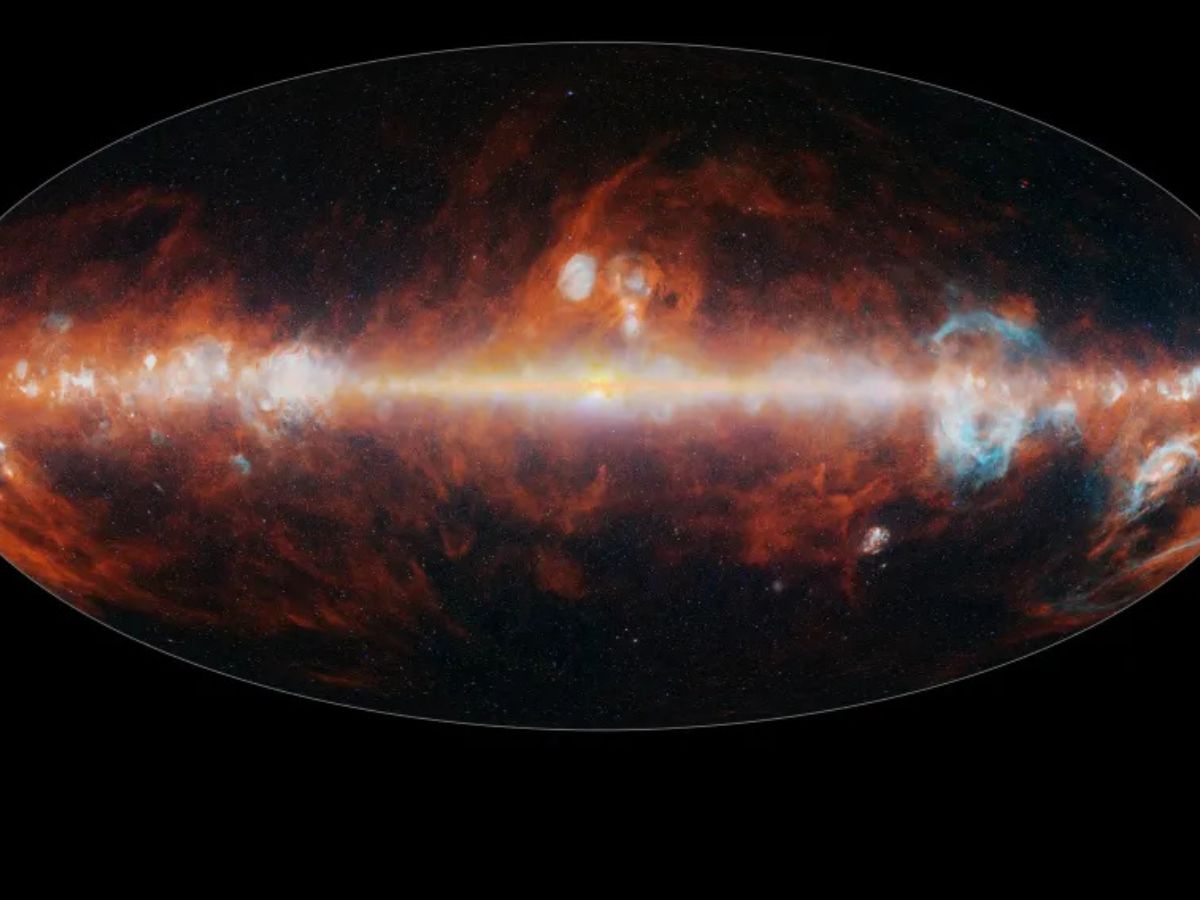
NASA’s SPHEREx Observatory has just delivered a major milestone in space science: its first full infrared map of the entire sky. What makes this achievement especially remarkable is how it was created—using 102 distinct “colors,” each representing a different wavelength of infrared light. It’s the most color-rich all-sky map ever produced, and it’s expected to unlock new clues about how the universe formed and evolved.
SPHEREx, short for Spectro-Photometer for the History of the Universe, Epoch of Reionization, and Ices Explorer, launched in March and completed this all-sky survey in only six months. Unlike maps that show the universe in visible light, SPHEREx observes in infrared, a range that can reveal details hidden from ordinary telescopes. Every infrared wavelength highlights different ingredients in space, helping scientists separate and study phenomena such as starlight, hot hydrogen gas, and clouds of cosmic dust.
One of the biggest scientific goals behind this sweeping infrared sky map is understanding cosmic inflation—an extremely brief moment right after the Big Bang when the universe expanded at a tremendous rate. By capturing the sky in so many infrared wavelengths, SPHEREx provides data that can help researchers test ideas about that early expansion and refine models of how the cosmos took shape.
Another major payoff is scale. The observatory’s 102-wavelength approach can help researchers estimate distances to hundreds of millions of galaxies, which is essential for building a more accurate 3D map of the universe. With better measurements across such a vast number of galaxies, scientists can study large-scale structure and track how the universe has changed across nearly 14 billion years of cosmic history.
While other observatories have conducted full-sky surveys before, SPHEREx stands out because of how much spectral detail it packs into every scan. This comes down to its design: the telescope uses six detectors, and each detector is paired with a specially engineered filter that contains a gradient of 17 infrared bands. Multiply that out, and every observation yields 102 infrared “colors” worth of information—effectively allowing SPHEREx to see the universe in an unusually detailed infrared spectrum.
Its fast surveying pace also played a key role in completing an all-sky map so quickly. SPHEREx circles Earth about 14.5 times per day and captures roughly 3,600 images daily, each covering a circular strip of the sky. Combined with its wide field of view, that steady rhythm allowed the observatory to stitch together a complete infrared portrait of the cosmos in half a year.
And this is only the beginning. SPHEREx’s primary mission is expected to last two years, meaning it should produce three more full-sky infrared maps. With multiple all-sky passes, scientists can improve accuracy, compare changes, and deepen the scientific value of one of the most colorful and information-rich surveys of the universe ever created.