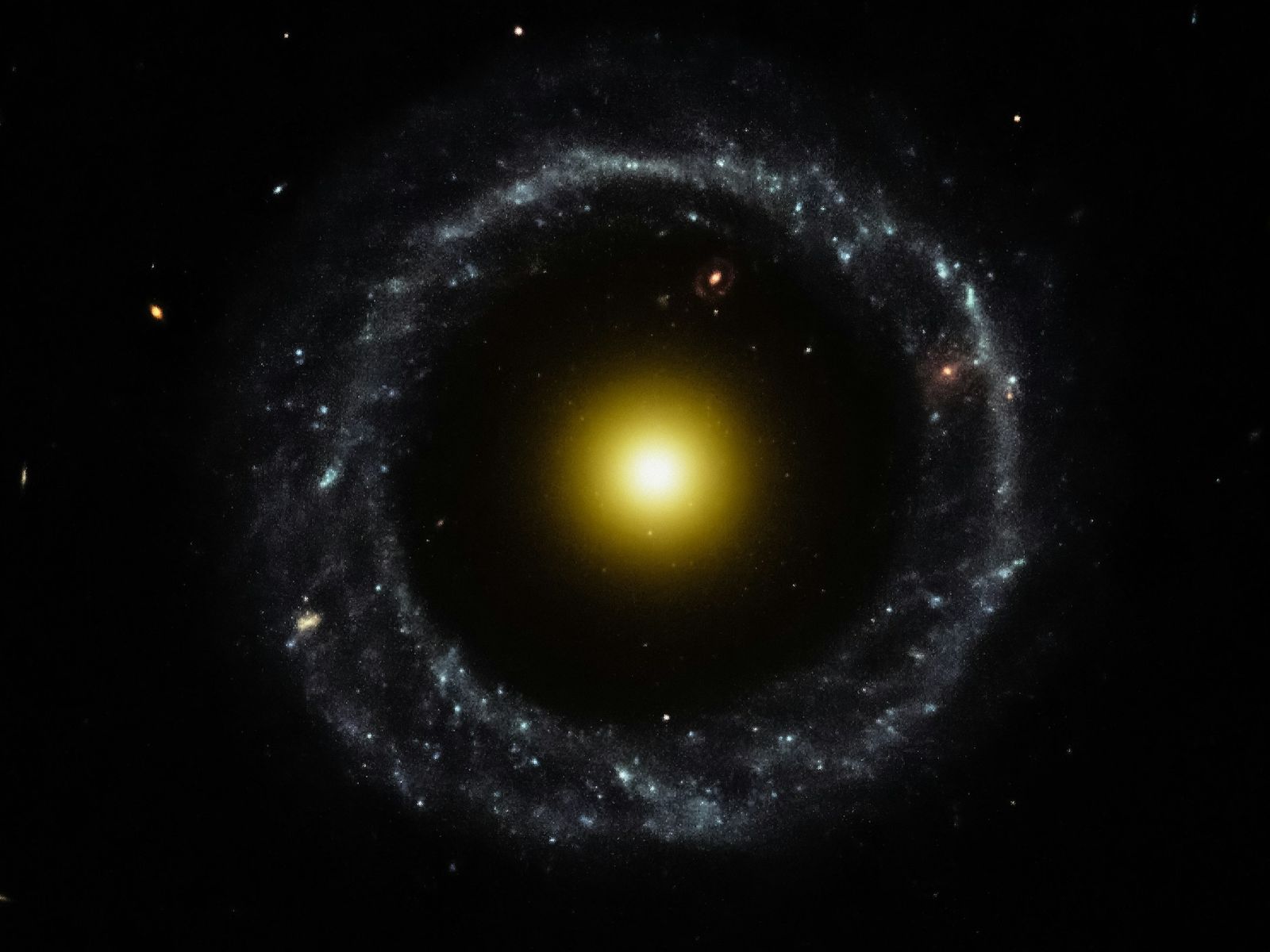
Astronomers have identified the most distant dormant black hole ever found, a hidden cosmic giant sitting roughly 10 billion light-years from Earth. The discovery is especially remarkable because this black hole is not actively feeding, making it extremely difficult to detect with traditional methods.
The black hole lies inside the galaxy MRG-M0138, a faraway system whose light has taken billions of years to reach us. Unlike active supermassive black holes, which pull in surrounding gas and dust and release enormous amounts of energy, this one appears to be quiet. Researchers found no sign of a bright quasar, meaning the object is not producing the intense radiation normally used to spot black holes across the universe.
To uncover it, astronomers relied on data from NASA’s James Webb Space Telescope and a powerful natural effect known as gravitational lensing. This happens when a massive galaxy between Earth and a more distant object bends and magnifies the light behind it. In this case, the lensing effect helped scientists observe the distorted image of MRG-M0138 and study the movement of stars near the hidden black hole.
By measuring how fast those stars were moving, researchers were able to estimate the black hole’s mass. The result is astonishing: the dormant black hole appears to be about 6 billion times more massive than the Sun.
This discovery could have major implications for the study of black hole formation and evolution. Dormant black holes are difficult to find because they do not shine brightly or consume nearby matter in a noticeable way. Yet they may be common across the universe, quietly shaping the galaxies around them without revealing themselves through dramatic bursts of energy.
The James Webb Space Telescope is giving astronomers a new way to search for these invisible giants. By combining its infrared vision with gravitational lensing, scientists can study distant galaxies in far greater detail and detect the subtle motion of stars influenced by hidden black holes.
Understanding dormant supermassive black holes may help answer one of astronomy’s biggest questions: how did black holes grow so large so early in the history of the universe? Since this newly studied object existed when the universe was much younger, it offers a valuable clue about how massive black holes formed and developed over cosmic time.
Researchers hope that this discovery is only the beginning. If more distant dormant black holes can be found, astronomers may finally build a clearer picture of how these mysterious objects evolve, how they affect their host galaxies, and how common they are in the early universe.


