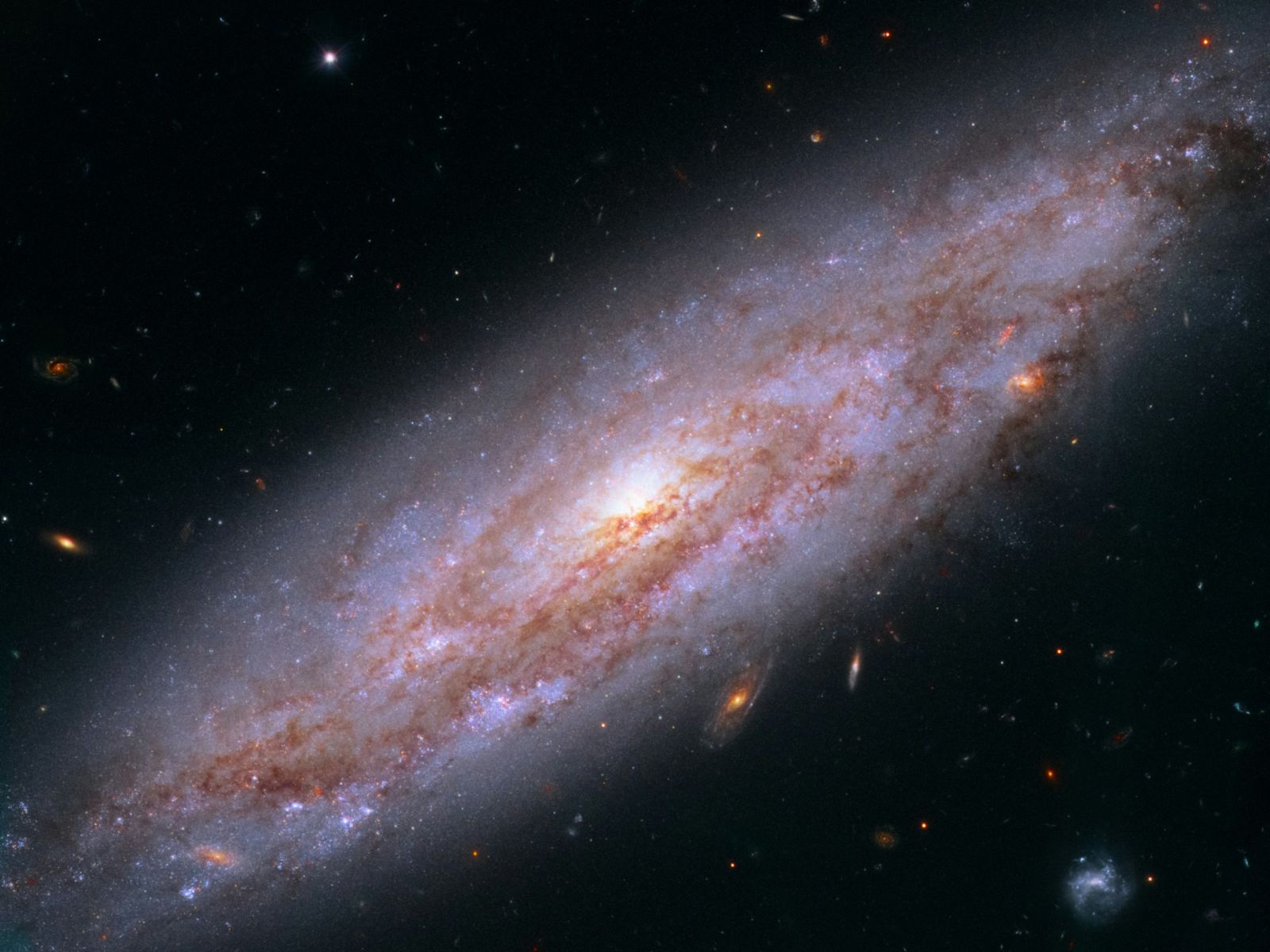
Hubble Captures a Stunning View of Spiral Galaxy M88, a Cosmic Beauty Facing a Dramatic Future
The Hubble Space Telescope has delivered another breathtaking look into deep space, revealing the spiral galaxy M88 in remarkable detail. Located about 63 million light-years from Earth, M88 is a vast and elegant galaxy packed with glowing stars, dusty spiral arms, and a powerful supermassive black hole at its center.
M88 stretches roughly 121,000 light-years across, making it slightly larger than the Milky Way. It belongs to the Virgo Cluster, one of the most important galaxy groups in the nearby universe. This enormous cluster contains more than 1,000 galaxies bound together by gravity, creating a crowded cosmic environment where galaxies can interact, shift, and transform over time.
In Hubble’s latest image, M88 stands out with a bright central glow. This intense light comes from a dense population of reddish stars orbiting the galaxy’s core. Hidden within that brilliant center is a supermassive black hole estimated to be around 100 million times more massive than the Sun.
Surrounding the core are beautifully structured spiral arms filled with young blue stars, pink star-forming regions, and thick lanes of cosmic dust. These features make M88 a classic example of a spiral galaxy, offering astronomers a valuable opportunity to study how stars form and how galaxies evolve inside dense galaxy clusters.
But while M88 appears calm and graceful in the Hubble image, its future may be far more turbulent.
Astronomers believe M88 is moving through the Virgo Cluster and will eventually pass close to M87, a massive elliptical galaxy near the cluster’s center. M87 is famous for hosting an enormous supermassive black hole with a mass of about 6.5 billion Suns.
This close encounter is expected to happen in roughly 200 to 300 million years. When it does, M88 could lose large amounts of gas as it moves through the cluster environment and approaches the gravitational influence of M87. That gas is essential for creating new stars, so losing it could significantly reduce M88’s ability to form future generations of stars.
The interaction may also alter the galaxy’s shape. Its carefully arranged spiral structure could become distorted, and its appearance may change dramatically over cosmic time. What we see today as a balanced and luminous spiral galaxy may one day become a far different object, reshaped by gravity and stripped of some of the material that fuels its stellar life cycle.
Hubble’s image of M88 is more than just a beautiful portrait of a distant galaxy. It is also a snapshot of a galaxy in motion, caught during one chapter of a much longer cosmic story. By studying galaxies like M88, scientists can better understand how galaxy clusters influence their members and how powerful gravitational encounters shape the universe over billions of years.
For now, M88 remains one of the most striking spiral galaxies in the Virgo Cluster, glowing across space as a reminder that even the most graceful cosmic structures are constantly changing.