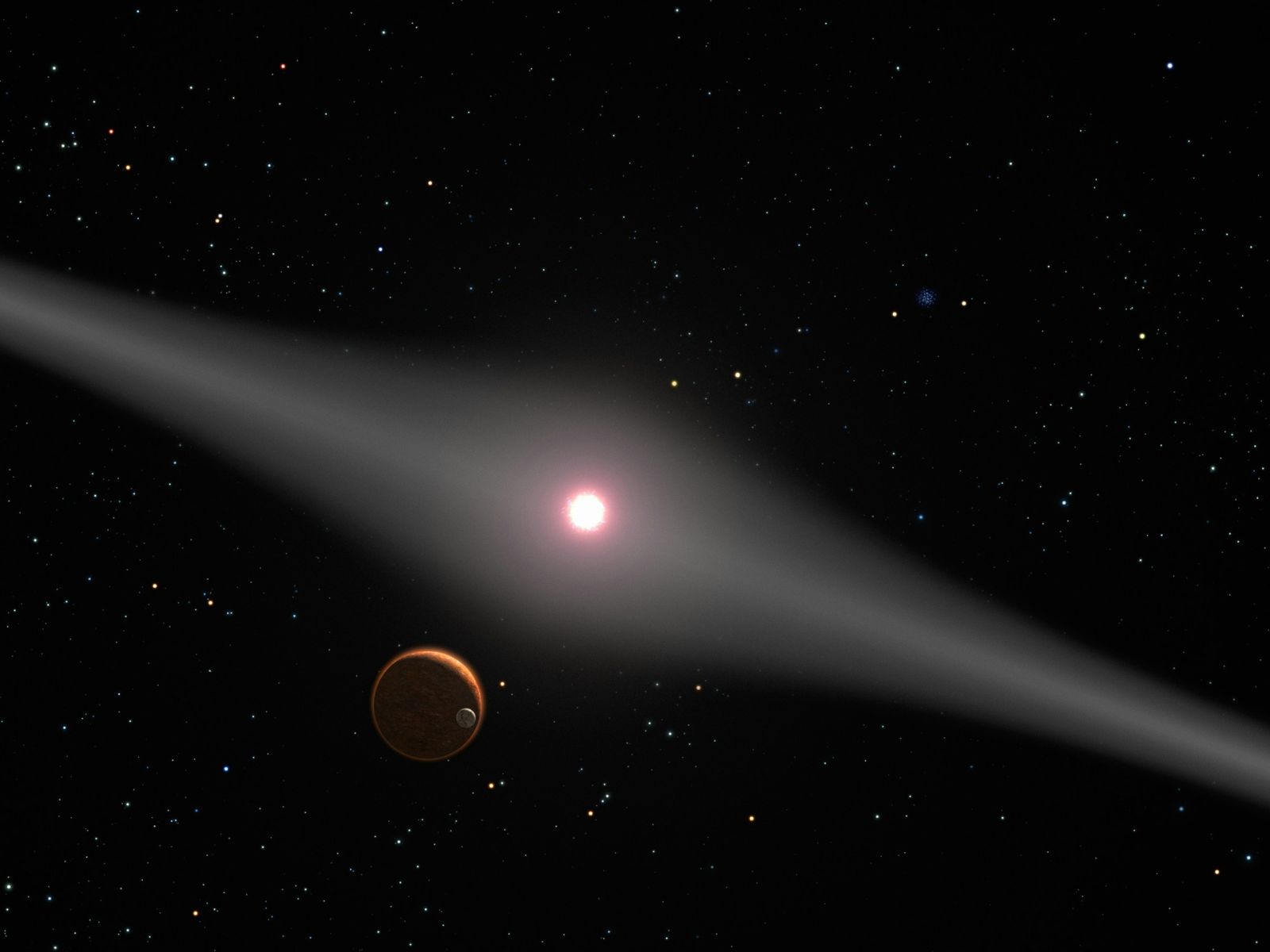
Astronomers Spot a Wandering Black Hole Ripping Apart a Star on the Edge of a Galaxy
Astronomers have detected a rare and dramatic cosmic event: a black hole far from the center of its galaxy tearing a star apart. The discovery is unusual because massive black holes are typically found in galactic cores, not wandering near the outskirts.
The event was first identified in November 2025 by the Zwicky Transient Facility, a sky survey that scans the night sky for sudden changes in brightness. Researchers noticed an intense flare coming from the outer region of a galaxy known as WISEA J014656.04-152214.7, located roughly 750 million light-years from Earth.
The flare was extraordinarily powerful. At its peak, it outshone the entire host galaxy and released light estimated to be around 10 billion times brighter than the Sun. Astronomers believe the burst was caused by a tidal disruption event, which happens when a star passes too close to a black hole and is stretched, shredded, and consumed by its immense gravity.
The black hole responsible is estimated to have a mass around one million times that of the Sun. While that makes it massive, its location is what truly makes the discovery stand out. Most black holes of this size are expected to sit near the centers of galaxies, where they grow over billions of years by consuming gas, dust, stars, and sometimes merging with other black holes.
In this case, however, the black hole appears to be positioned near the edge of its galaxy. That raises a major question: how did it get there?
One possible explanation is that the black hole once belonged to a smaller galaxy that merged with the larger galaxy now hosting it. During such a merger, the smaller galaxy may have been stripped apart, leaving its central black hole behind in an unusual location. Another possibility is that gravitational interactions pushed the black hole away from the galactic center, turning it into a wandering black hole.
Researchers used artificial intelligence to help spot the flare among hundreds of thousands of nightly detections. The system recognized that the bright outburst resembled a tidal disruption event, even though its position in the galaxy was unexpected.
The discovery gives astronomers an important opportunity to study black holes that do not follow the usual pattern. Wandering black holes may be more common than currently known, but they are extremely difficult to detect unless they interact with nearby material, such as a doomed star.
For now, the origin of this black hole remains uncertain. Scientists will need more observations to determine whether it is the remnant of a galactic merger, a displaced supermassive black hole, or part of a larger population of hidden black holes drifting through galaxies.
What is clear is that this event offers a rare glimpse into one of the universe’s most extreme phenomena. A star was destroyed in a burst of light powerful enough to be seen from hundreds of millions of light-years away, revealing a mysterious black hole in a place astronomers did not expect to find one.