SK Hynix is preparing to stretch the lifespan of its current 6F2 DRAM cell architecture by leaning more heavily on extreme ultraviolet lithography, better known as EUV, along with a series of process refinements designed to improve scaling, efficiency, and production viability.
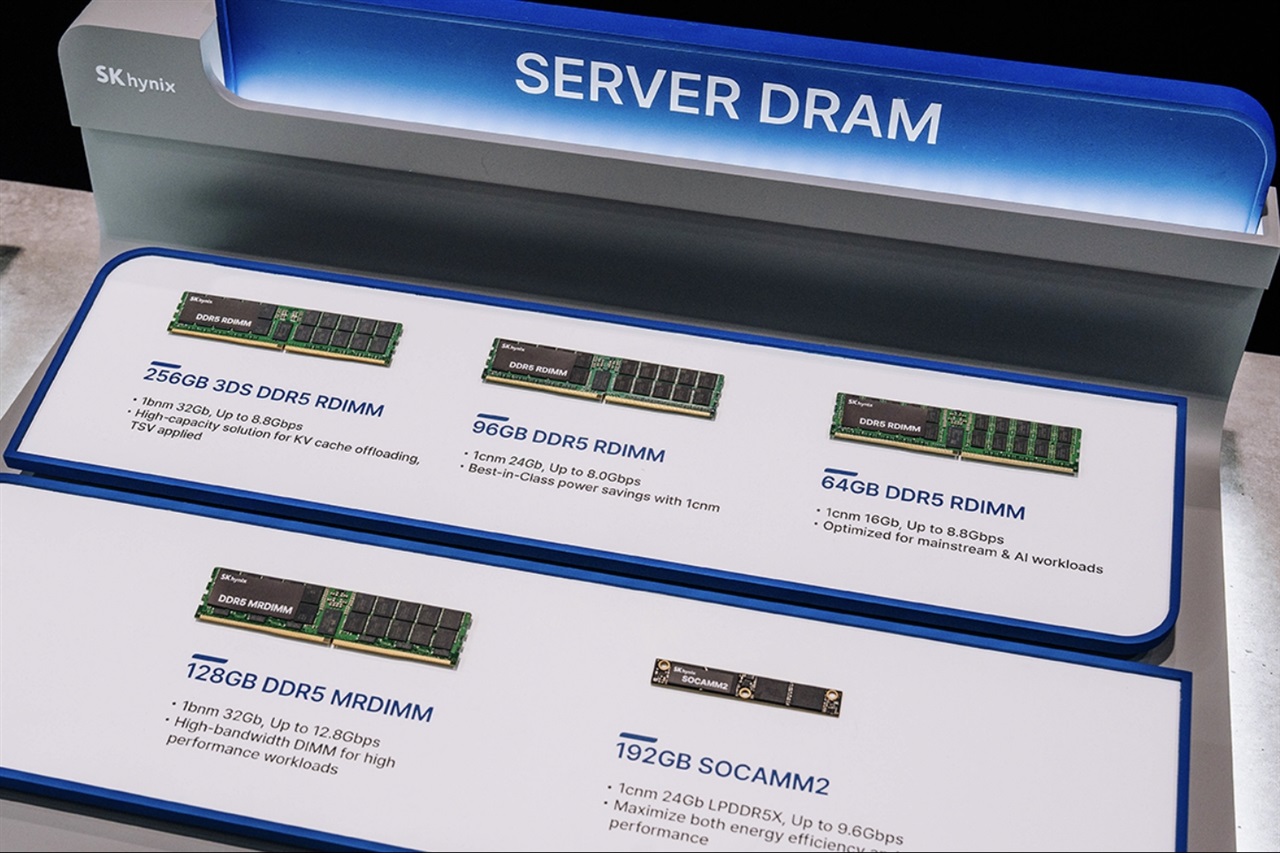
The company showcased its server DRAM lineup at the OCP Global Summit 2026, signaling that conventional DRAM still has room to evolve before the industry fully transitions to more advanced cell structures. While 4F2 DRAM and three-dimensional DRAM remain part of SK Hynix’s long-term technology roadmap, the company appears focused on extracting more value from its existing 6F2 design in the near term.
DRAM manufacturers are under growing pressure to increase memory density while managing power consumption, cost, and manufacturing complexity. The 6F2 cell structure has been widely used across the industry, but as process nodes shrink, continuing to scale this design becomes increasingly difficult. EUV lithography offers a way to create finer patterns with greater precision, which could help SK Hynix push 6F2 DRAM further than previously expected.
By improving the manufacturing process and adopting EUV more aggressively, SK Hynix may be able to delay the need for a rapid shift to more complex architectures. This strategy could help the company maintain strong output for high-demand markets such as servers, artificial intelligence infrastructure, cloud computing, and enterprise data centers.
The broader DRAM market is also becoming more competitive. China’s ChangXin Memory Technologies continues to advance its own memory production capabilities, adding pressure on established players to stay ahead in both technology and manufacturing efficiency. For SK Hynix, extending 6F2 DRAM with EUV could provide a practical balance between innovation and cost control while keeping future options open.
The move does not mean SK Hynix is stepping away from next-generation DRAM. Instead, 4F2 and 3D DRAM remain important parts of the company’s future plans. These technologies are expected to play a major role as traditional two-dimensional scaling reaches its limits. However, bringing them into mass production at competitive yields and costs will likely require more time.
For now, SK Hynix’s strategy suggests a phased approach: improve today’s DRAM technology with EUV and process optimization, while continuing to prepare for the eventual shift to more advanced memory architectures. This could allow the company to meet rising demand from AI servers and data center customers without rushing into a costly and complex technology transition.
As memory requirements continue to climb, especially in AI and high-performance computing, DRAM makers need to deliver higher capacity, faster speeds, and improved energy efficiency. SK Hynix’s decision to extend 6F2 DRAM shows that the race for next-generation memory is not only about new architectures, but also about maximizing the potential of proven technologies.