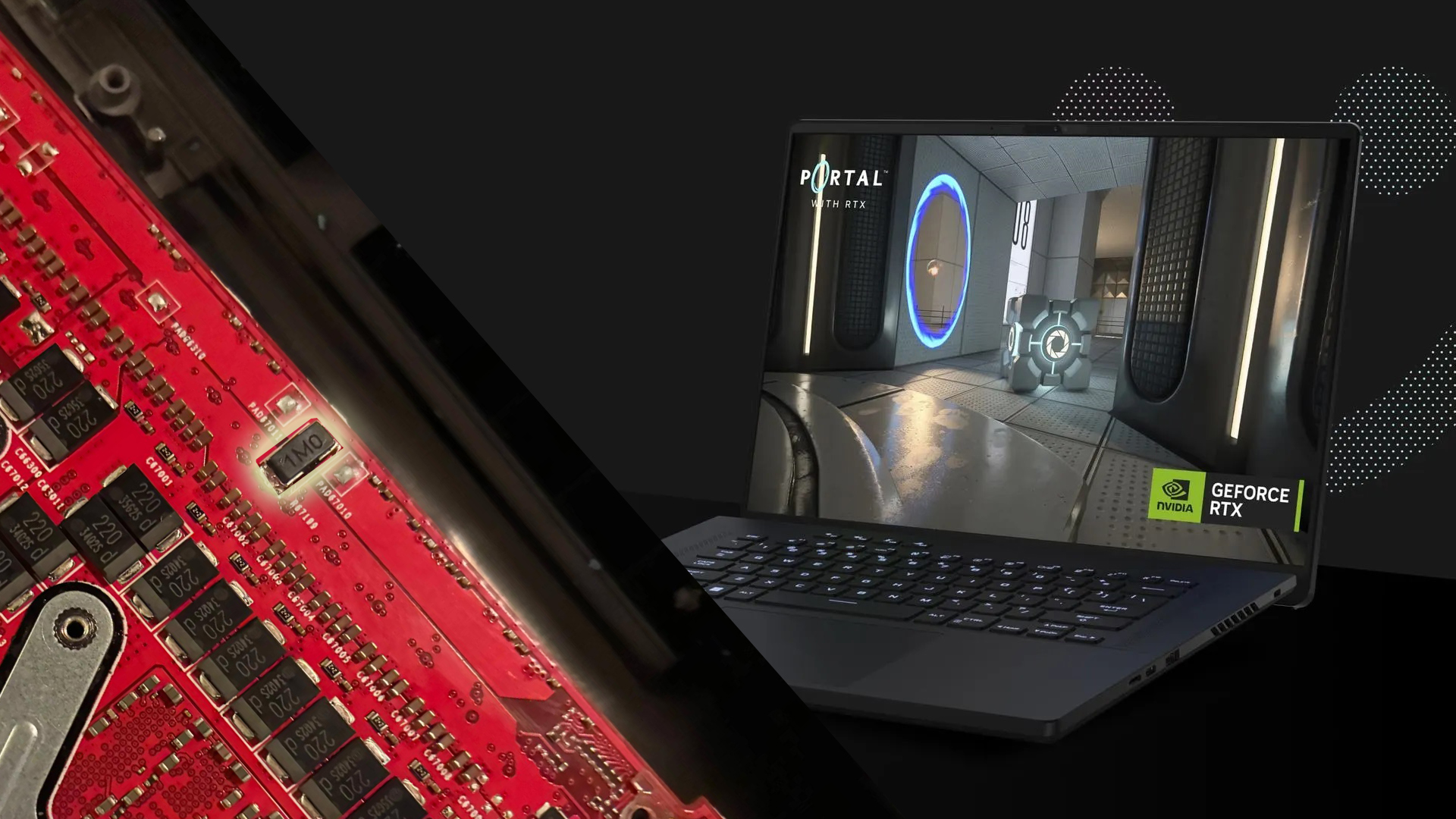
A simple shunt mod has pushed a GeForce RTX 4090 laptop GPU to performance levels usually reserved for next‑gen hardware, with gains rivaling an RTX 5090 laptop chip in synthetic benchmarks.
The mod comes from a Reddit user who experimented with an RTX 4090 inside an Asus ROG Zephyrus M16 (GU604VY). By stacking a 1 mΩ resistor on top of the GPU’s existing 5 mΩ shunt, the total resistance dropped to roughly 0.83 mΩ. Because the power controller infers power draw from this resistance, the GPU effectively “thought” it was consuming far less power than it really was. Monitoring tools reported around 40–45 W, while the actual draw was estimated near 240 W—well above stock behavior and enough headroom to unleash significant performance.
This kind of shunt mod is a known tactic among overclocking enthusiasts. Lowering the sense resistance coaxes the GPU into allowing higher current, which translates to more sustained boost clocks and better scores. However, dramatically increasing power on a thin‑and‑light chassis comes with one major trade‑off: heat.
To cope with the extra thermal load, the user refreshed the liquid metal on the GPU and added Honeywell PTM 7950, a highly regarded phase‑change thermal interface material. VRM thermal pads were also upgraded to Upisren UX Pro Ultra. These changes were necessary because the Zephyrus M16’s cooling system isn’t designed to handle such elevated power levels out of the box.
While the post didn’t include exact temperature readings, it did share benchmark results. The numbers show up to a 35.5% uplift compared to the unmodified configuration, with more than 20% gains in most 3DMark tests. In several runs, performance aligned closely with results from laptops equipped with an RTX 5090, underscoring how much power limits can bottleneck mobile GPUs.
Important caveats apply. This kind of hardware modification is not recommended for most users. It carries a high risk of overheating, potential damage to components, and will almost certainly void your warranty. Laptops have tight thermal and power budgets, and pushing well beyond rated limits can shorten component lifespan, trigger throttling or shutdowns, and cause instability.
Still, the experiment is a striking proof of concept. It highlights how aggressively power‑constrained today’s flagship laptop GPUs are, and how much performance sits on the table when cooling and power limits are lifted. For those who want safer gains, consider undervolting, fine‑tuning fan curves, using a cooling pad, or waiting for officially higher‑power designs in future generations.