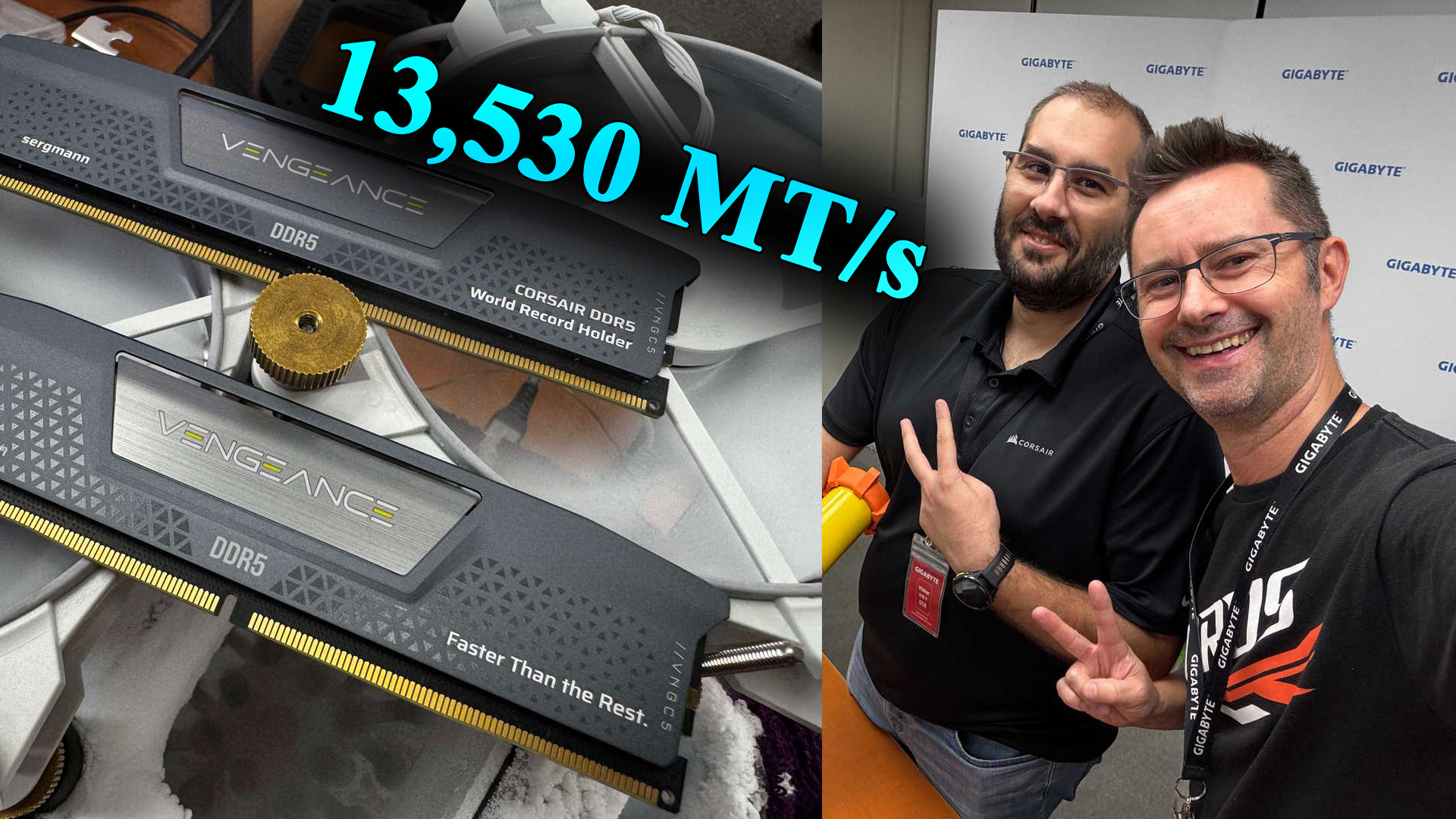
The battle for the DDR5 memory speed world record just got even more intense, and it all happened in a single day.
Popular overclocker Saltycroissant recently climbed to the top of the leaderboard again by setting a new DDR5 frequency record, only to have fellow overclocking star Sergmann answer back hours later with an even faster result. The quick turnaround shows just how competitive extreme memory overclocking has become, especially now that top-tier DDR5 kits and enthusiast motherboards are pushing into territory that once seemed out of reach.
Saltycroissant’s record run delivered an impressive 6703.9 MHz, translating to 13,407 MT/s. The overclock was achieved using a Corsair Vengeance 24GB DDR5 memory module paired with the GIGABYTE Z890 AORUS Tachyon ICE motherboard, a platform that has become a go-to choice for memory frequency chasers thanks to its overclocking-focused design and strong presence in top ranking results. With a liquid nitrogen cooling setup to keep temperatures under control, the result cleared the 13,400 MT/s barrier and edged past the prior record by 85 MT/s.
In Saltycroissant’s run, timings remained at CL68-127-127-127-2. The configuration also relied on a high UCLK to MCLK ratio (3:196), which is common for extreme DDR5 records because attempting similar speeds at lower ratios typically runs into major stability limitations.
But the spotlight didn’t stay in one place for long.
On the very same day, Sergmann reclaimed the crown by pushing the same Corsair Vengeance DDR5 module on the same GIGABYTE Z890 AORUS Tachyon ICE motherboard even further, reaching 6765.2 MHz, or 13,530 MT/s. One of the most notable differences in Sergmann’s achievement was improving the UCLK:MCLK ratio down to 3:192 while still increasing the overall memory frequency—an impressive feat given how razor-thin stability margins become at these speeds.
The CPU choice also differed between the two record attempts. Sergmann’s setup used an Intel Core Ultra 9 285K, while Saltycroissant’s record was achieved with the Intel Core Ultra 7 265K. While DDR5 overclocking results depend on many factors—IMC quality, motherboard tuning, memory binning, BIOS behavior, and extreme cooling—CPU selection can still play a meaningful role when pushing into world record territory.
With DDR5 now hitting 13,530 MT/s, the next major milestone is clear. A 14,000 MT/s DDR5 speed record no longer sounds like a distant dream—it feels like the next logical step. The only question is which overclocker gets there first.


