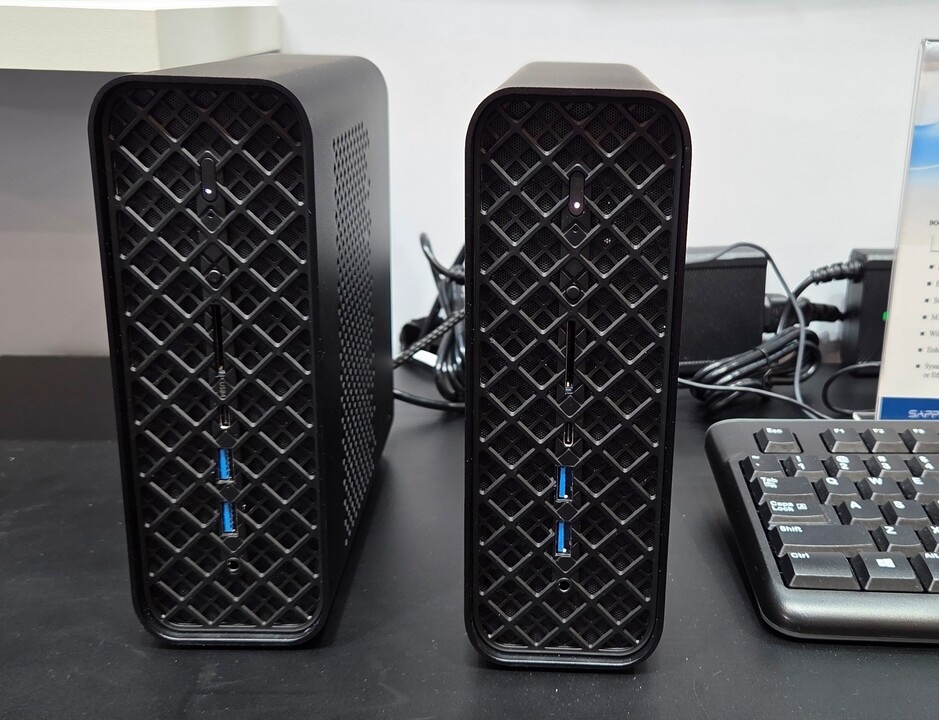
Sapphire is teasing a new powerhouse mini PC that blurs the line between compact desktops and full-size gaming rigs. The latest addition to its Edge AI lineup, called the Sapphire Edge AI Max+ 395, is built around AMD’s Ryzen AI Max+ 395 “Strix Halo” APU—an advanced Zen 5-based chip designed to deliver high-end CPU performance and unusually strong integrated graphics in a small form factor. For anyone watching the rise of gaming mini PCs and local AI computing, this is shaping up to be one of the most interesting upcoming releases.
At the heart of the system is a 16-core, 32-thread Ryzen AI Max+ 395 processor. With sufficient cooling, this class of high-core-count mobile silicon can compete with top-tier laptop CPUs, making the Edge AI Max+ 395 a serious option not only for gaming, but also for demanding workloads like content creation, heavy multitasking, and compute-intensive development tasks.
The real headline, though, is the graphics. Strix Halo APUs stand out because their integrated GPU is far more capable than what most people expect from “iGPU” performance. The Ryzen AI Max+ 395 includes the Radeon 8060S, featuring 40 compute units based on RDNA 3.5 architecture. In practical terms, that puts this integrated solution in the same conversation as strong discrete laptop GPUs, making it a compelling choice for a compact gaming PC where space, power, and thermals are always a balancing act.
Memory and AI capability are also central to the pitch. The Sapphire Edge AI Max+ 395 can be configured with up to 128 GB of LPDDR5X RAM, and because the integrated GPU can tap into that system memory, it opens the door to workloads that typically get blocked by limited VRAM on many consumer graphics cards. That’s especially relevant for people experimenting with running large language models locally, where memory capacity can matter as much as raw compute.
Sapphire also demonstrated using two of these mini PCs together, connected via USB-C, to pool resources for larger local AI workloads. While the company hasn’t detailed the exact USB-C specification on this model, similar Strix Halo systems have appeared with very high-bandwidth USB4 v2 implementations, which would make this kind of setup far more practical than relying on network connections—particularly since the device is said to include only a single Ethernet port. The idea can scale further, too: multiple units could potentially be chained for even larger local AI deployments, a concept likely to appeal to developers, researchers, and enthusiasts looking for a modular alternative to traditional workstation builds.
Pricing and availability haven’t been announced yet, but Sapphire plans to officially unveil the Strix Halo-powered Edge AI mini PC at Computex 2026. Based on where comparable high-end Strix Halo mini PCs have landed in the market, expectations are that this won’t be a budget-friendly system—especially with top configurations and the kind of performance it’s aiming to deliver.
For gamers who want a small desktop without giving up serious graphics capability, and for creators and AI tinkerers who want big memory in a compact machine, the Sapphire Edge AI Max+ 395 looks positioned to be one of the most talked-about gaming mini PCs of 2026.