VZMORE AX9 Max Mini PC: A Premium Ryzen AI Desktop Built for High Performance
The VZMORE AX9 Max enters the Mini PC market with a clear goal: deliver serious desktop-class performance in a compact chassis. Priced at $1,499 and positioned as a premium Mini PC, this system is built around AMD’s Ryzen AI 400 platform and combines high-end processing power, strong integrated graphics, AI acceleration, expandable memory, fast storage, and a cooling design that aims to push well beyond typical compact PC limits.
VZMORE is a Hong Kong-based company and one of the newer names in the Mini PC space. Its systems focus on several in-house technologies, with V-Cooling and V-Boost being the most important. These are designed to improve thermal performance and power delivery, allowing the hardware to sustain higher speeds for longer. The AX9 Max is the company’s flagship-style offering, and its biggest highlight is the use of a vapor chamber cooler paired with a power target that can reach up to 80W in real-world testing.
At the heart of the VZMORE AX9 Max is the AMD Ryzen AI 9 HX 470 processor. This is one of the fastest chips in AMD’s Ryzen AI 400 “Gorgon Point” mobile family and is designed for demanding multitasking, content creation, AI workloads, and even light-to-moderate gaming without needing a dedicated GPU.
The Ryzen AI 9 HX 470 features 12 cores and 24 threads. Its hybrid Zen 5 design includes four standard Zen 5 cores and eight compact Zen 5c cores. The chip runs at a 2.0 GHz base clock, while boost speeds reach up to 5.2 GHz on the standard Zen 5 cores and up to 3.3 GHz on the Zen 5c cores. It also includes 24 MB of L3 cache and 12 MB of L2 cache.
Officially, the processor is configurable between 15W and 54W, with a default TDP of 28W. However, the VZMORE AX9 Max is tuned more aggressively. While the BIOS lists 65W as the performance mode target, testing showed the system can push the chip as high as 80W. That gives this Mini PC a performance advantage over many Ryzen AI systems that run at more conservative power limits.
Graphics are handled by AMD’s Radeon 890M integrated GPU. This is currently one of the strongest integrated graphics solutions available in a Mini PC. It features 16 compute units, 1,024 stream processors, and clocks up to 3.1 GHz. The Radeon 890M is based on RDNA 3.5 graphics architecture and supports modern gaming technologies, including FSR upscaling, frame generation, AFMF2, and Anti-Lag 2.
While the VZMORE AX9 Max is not a replacement for a desktop gaming PC with a high-end dedicated GPU, it is powerful enough for esports titles, lighter AAA gaming, emulation, media editing, and GPU-accelerated everyday workloads. For users who want a compact PC that can handle productivity and casual gaming without a bulky tower, the Radeon 890M gives this machine a major advantage.
The Ryzen AI 9 HX 470 also includes AMD’s XDNA 2 NPU, rated at up to 55 TOPS. Combined with the CPU and GPU, the chip reaches a total AI performance rating of 86 TOPS. This makes the AX9 Max a capable option for AI-enhanced workflows, Windows AI features, image processing, video tools, and supported productivity applications that can take advantage of local AI acceleration.
Memory support is another strong point. The VZMORE AX9 Max comes with 32 GB of DDR5-5600 SO-DIMM memory, using two 16 GB Micron modules. Unlike many compact systems with soldered memory, this Mini PC allows upgrades. It can support up to 256 GB of RAM, making it suitable for heavy multitasking, virtual machines, development environments, large creative projects, and professional workloads.
Storage is also flexible. The included drive is a 1 TB PCIe Gen 4×4 SSD, also from Micron, with speeds exceeding 7 GB/s. Inside the chassis, there are two M.2 slots. One supports a full-size 2280 SSD with up to 4 TB capacity, while the second supports a shorter 2230 SSD with up to 1 TB capacity. This gives users room to expand storage without relying on external drives.
Connectivity is one of the AX9 Max’s strongest areas. On the front, the system includes four USB 3.2 Gen 2 Type-A ports, with one supporting S5 power delivery, plus a 3.5 mm headset jack and the power button. The power button lights up when the system is running.
The rear I/O is even more impressive. It includes two USB4 Type-C ports rated at 40 Gbps, one USB 3.2 Gen 2 Type-A port, one USB 2.0 Type-A port, two HDMI 2.1 outputs, dual 2.5GbE LAN ports, and the DC-in power connector. One of the USB4 ports also supports 100W power delivery input. An SD 4.0 card reader is positioned on the side, which is useful for photographers, video editors, and content creators.
For a Mini PC, this is a very complete port selection. Dual HDMI 2.1 and USB4 make it easy to connect multiple high-resolution displays, fast external storage, docks, capture devices, and other professional accessories. Dual 2.5GbE LAN also makes the AX9 Max attractive for home lab users, network-heavy workflows, NAS setups, and advanced office environments.
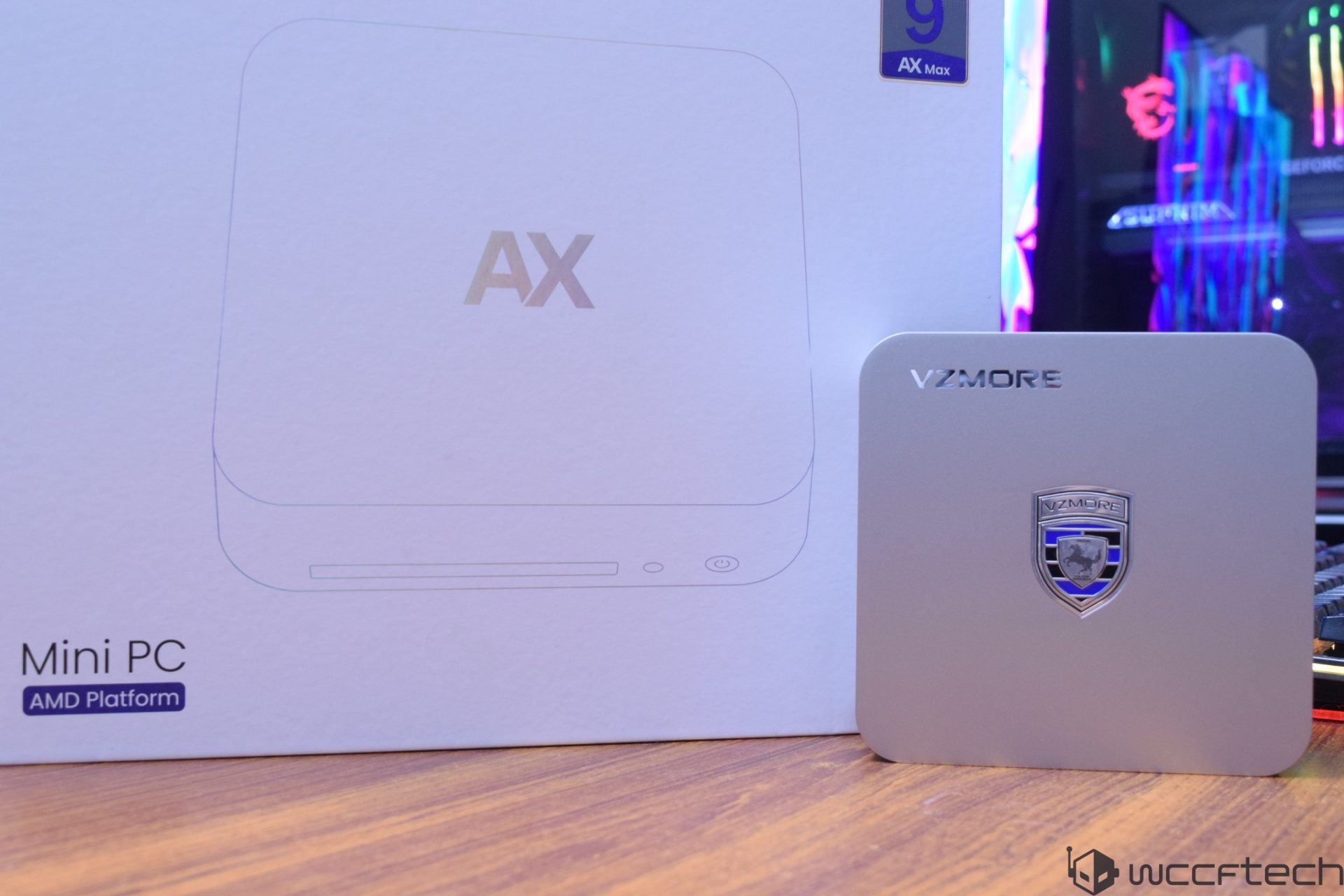
The design of the VZMORE AX9 Max is clean and compact. It uses a square chassis with a polished aluminum front panel, a centered VZMORE badge, and subtle branding at the top. The top and sides are mostly enclosed, while airflow is managed through the bottom and rear sections of the chassis.
Cooling is where this Mini PC stands out. The AX9 Max uses a vapor chamber cooling system rather than a traditional compact heatsink. According to VZMORE, the vapor chamber is 40% larger and offers 50% better heat dissipation efficiency compared with conventional copper heatsinks. A main fan pulls air through the chassis and directs heat away from the processor. The system is designed to cool a 65W load at around 38 dB, which is reasonable for a performance-focused Mini PC.
In practice, the cooling solution is important because the Ryzen AI 9 HX 470 can be pushed beyond typical Mini PC power limits. Higher sustained wattage usually means better multi-core performance, but only if the cooling system can keep temperatures under control. The AX9 Max’s vapor chamber gives it an edge in this area and helps explain why it performs so well against other compact PCs using similar hardware.
The BIOS is fairly basic in design, but it includes several useful tuning options. The most important setting is Power Limit Select. Users can choose between Performance mode, Balanced mode, and Quiet mode. Performance mode is listed at 65W, Balanced mode at 54W, and Quiet mode at 45W. For users who want maximum speed, Performance mode is the obvious choice. Those who prefer lower fan noise or reduced power draw can switch to the quieter profiles.
The unboxing experience is simple and tidy. The VZMORE AX9 Max comes in a large white cardboard box with a clean design and an outline of the Mini PC on the front. Inside, the system is packaged neatly with its accessories. The box includes the Mini PC, a 120W power adapter, a user manual, and an HDMI cable. The included power adapter gives the system enough headroom for high-performance operation.
In CPU performance testing, the AX9 Max makes a strong impression. In 3DMark CPU Profile, it performs surprisingly close to systems using higher-core-count Intel chips and shows a clear lead over Mini PCs powered by the Ryzen AI 9 HX 370. In multi-threaded workloads, the AX9 Max can be up to 25% faster than Ryzen AI 9 HX 370-based systems, largely thanks to the newer Ryzen AI 9 HX 470 processor and the higher sustained power limit.
Blender performance is also strong. The AX9 Max performs ahead of newer compact systems in several rendering tests and demonstrates that its 12-core Zen 5-based processor is not just fast on paper. For creators working with CPU rendering, 3D workloads, encoding, or productivity applications, the extra power budget and vapor chamber cooling help the system maintain strong performance over longer sessions.
The VZMORE AX9 Max is not just another small desktop. It is a premium Mini PC designed for users who want high-end mobile-class hardware in a compact form factor. Its strengths are clear: a powerful Ryzen AI 9 HX 470 processor, Radeon 890M integrated graphics, a strong AI engine, upgradeable DDR5 memory, dual Gen 4 SSD support, USB4 connectivity, dual 2.5GbE networking, HDMI 2.1 display output, and an advanced vapor chamber cooling system.
At $1,499, the AX9 Max is not a budget Mini PC. It targets buyers who want performance, expandability, and premium features in a small footprint. For office users, it may be more power than necessary. But for creators, developers, power users, AI enthusiasts, and anyone looking for a compact workstation-style desktop, the VZMORE AX9 Max has a lot to offer.
The biggest reason to consider this Mini PC is its ability to push the Ryzen AI 9 HX 470 harder than many competing systems. The 80W observed power behavior gives it a performance ceiling that is unusual for this category, and the vapor chamber cooler helps make that possible. Combined with modern connectivity and upgrade-friendly internals, the AX9 Max stands out as one of the more ambitious Ryzen AI Mini PCs in the premium compact desktop market.VZMORE AX9 Max Mini PC Benchmark Preview: Ryzen AI 9 HX 470 Shows Strong CPU and AI Performance
The VZMORE AX9 Max Mini PC is shaping up to be one of the more interesting compact systems for users who want desktop-class responsiveness in a small form factor. Powered by the AMD Ryzen AI 9 HX 470, this machine targets a demanding audience: office users, creators, AI enthusiasts, and anyone looking for a fast mini PC without moving to a large desktop tower.
Across multiple benchmark suites, the Ryzen AI 9 HX 470 delivers a strong showing against competing chips, including Intel’s Core Ultra X7 358H, Core Ultra 9 285H, and AMD’s previous Ryzen AI 9 HX 370. The results suggest that AMD’s latest mobile processor brings meaningful gains in CPU performance, compression workloads, and AI acceleration.
In CPU-Z, the Ryzen AI 9 HX 470 performs ahead of the Intel Core Ultra X7 358H in both single-core and multi-core testing. The multi-core result is especially notable, with performance landing around 23% higher than systems powered by the Ryzen AI 9 HX 370. That kind of uplift is important for users who regularly run multitasking workloads, productivity software, code compilation, file conversion, or content creation tools.
Cinebench 2024 and Cinebench 2026 show a similar trend. The Ryzen AI 9 HX 470 remains highly competitive across both single-core and multi-core tests, confirming that the chip is not just strong in one benchmark but consistent across different CPU-heavy scenarios. This matters because Cinebench is often a good indicator of how a processor behaves under sustained rendering and workstation-style workloads.
Geekbench 6 tells a slightly different story, with the Core Ultra X7 358H taking the lead in both single-core and multi-core results. Even so, the Ryzen AI 9 HX 470 remains close enough to be considered a high-end performer in the mini PC category. Depending on the application, users may see leadership shift between AMD and Intel platforms, especially as power limits, cooling design, memory configuration, and firmware tuning can heavily influence compact PC performance.
For everyday office work, the Ryzen AI 9 HX 470 proves to be a very fast processor. In productivity-focused workloads, it performs well across common office applications and offers the kind of smooth response users expect from a premium mini PC. Whether handling large spreadsheets, browser-heavy workflows, video calls, document editing, or multitasking between several apps, the VZMORE AX9 Max appears well equipped for modern productivity.
The Ryzen AI 9 HX 470 also performs strongly in WinRAR compression testing. Despite the Intel Core Ultra X7 358H system using faster LPDDR5X memory, the AMD chip still comes out ahead in this workload. That is a useful result for users who frequently compress or extract large files, work with backups, manage archives, or move large project folders.
The system was also tested in SPECviewPerf across 11 workloads, giving a broader look at professional graphics and workstation-style performance. While the provided data focuses mainly on rankings rather than detailed scores, this type of testing is valuable for users working with CAD, 3D visualization, engineering, modeling, and viewport-heavy applications.
AI performance is another major area of interest for the VZMORE AX9 Max. With modern PCs increasingly relying on local AI acceleration, the Ryzen AI 9 HX 470 brings AMD’s latest Ryzen AI platform into a compact desktop design.
In Geekbench AI, the VZMORE AX9 Max posts strong results and sits near the upper end of the tested systems. The processor’s combination of CPU, GPU, and NPU resources helps it handle AI workloads more efficiently than older-generation chips. Systems based on higher-power Ryzen AI MAX processors still lead overall, but the Ryzen AI 9 HX 470 remains a capable option for a small PC.
UL Procyon testing also highlights AMD’s XDNA AI acceleration. The NPU works alongside the integrated GPU to provide solid AI compute capability. With up to 86 TOPS available from the combined AI resources, the Ryzen AI 9 HX 470 platform meets Copilot+ PC requirements. However, newer and more powerful platforms offering over 100 TOPS still have an advantage in heavier AI workloads.
Local AI model testing was also carried out using LM Studio. The VZMORE AX9 Max was able to run several AI language models in the 7B to 20B range with decent performance. This makes the machine useful for users who want to experiment with local AI assistants, coding tools, summarization models, research workflows, or private offline AI tasks without depending entirely on paid cloud services.
AMD’s software ecosystem adds extra value here. Users can access a range of AI-related tools through Radeon Adrenalin Software, helping make the platform more flexible for local AI experimentation and optimization.
On the graphics side, the VZMORE AX9 Max relies on AMD Radeon integrated graphics. Before looking at gaming results, synthetic GPU performance gives a useful baseline. Integrated GPUs from AMD Radeon and Intel Arc use very different architectures, so raw FLOPS figures do not always translate directly into real-world gaming performance. Even when one iGPU has higher theoretical compute, actual results can vary depending on drivers, memory bandwidth, game engine behavior, power limits, and cooling.
Still, the Radeon iGPU inside the Ryzen AI 9 HX 470 gives the VZMORE AX9 Max a strong foundation for light gaming, GPU-accelerated workloads, media tasks, and AI-assisted applications. It is not designed to replace a full desktop graphics card, but for a mini PC, it offers a compelling balance between efficiency and performance.
Overall, the VZMORE AX9 Max Mini PC looks like a powerful compact system built around one of AMD’s most capable new mobile processors. The Ryzen AI 9 HX 470 performs well in CPU benchmarks, leads in several productivity and compression workloads, and delivers useful local AI acceleration through its NPU and integrated GPU.
The biggest highlights are its strong multi-core performance, 23% uplift over Ryzen AI 9 HX 370 in CPU-Z multi-core testing, capable office performance, impressive WinRAR result, and practical local AI support for 7B to 20B language models.
For users searching for a high-performance mini PC for productivity, AI workloads, light creator tasks, and everyday multitasking, the VZMORE AX9 Max with Ryzen AI 9 HX 470 is a strong contender. It may not win every benchmark against Intel’s latest Core Ultra chips or AMD’s higher-end Ryzen AI MAX processors, but it delivers a well-rounded mix of CPU speed, AI capability, and compact efficiency.VZMORE AX9 Max Mini PC Performance: Radeon 890M Gaming and Benchmark Results
The VZMORE AX9 Max arrives as another powerful compact PC built around AMD’s Ryzen AI platform, pairing the Ryzen AI 9 HX 470 with the Radeon 890M integrated GPU. For users looking for a mini PC that can handle everyday productivity, media work, AI-assisted tasks, and light-to-medium 1080p gaming without a dedicated graphics card, this system is an interesting contender.
Its biggest selling point is the Radeon 890M, based on AMD’s RDNA 3.5 iGPU architecture. While RDNA 3.5 has already been available for some time and has not received a major graphics architecture refresh, it still delivers strong integrated graphics performance in rasterized gaming. Ray tracing, however, remains one of its weaker areas, especially when compared with dedicated GPUs.
In benchmark testing, the VZMORE AX9 Max was compared against several other mini PCs and compact systems, including models equipped with Radeon 890M, Radeon 8060S, Intel Arc B390, Arc 140V, and Arc 140T graphics. The comparison gives a clearer picture of where the Ryzen AI 9 HX 470 and Radeon 890M combination stands in today’s mini PC market.
Synthetic benchmark performance
In 3DMark Steel Nomad, the Radeon 890M inside the Ryzen AI 9 HX 470 shows a small but noticeable improvement over Radeon 890M configurations based on Ryzen AI 9 HX 370 chips. The gain is not dramatic, but it does suggest that the newer APU can squeeze a little more performance out of the same integrated graphics class.
In 3DMark Port Royal, which focuses more heavily on ray tracing performance, the Radeon 890M lands close to Intel’s Xe-based Alchemist-style integrated graphics solutions. This result reinforces the current state of AMD’s RDNA 3.5 iGPU: strong for standard gaming workloads, but not especially impressive for ray tracing-heavy tests.
3DMark Time Spy shows solid overall graphics performance from the Radeon 890M, though the biggest improvement appears on the CPU side. This is important because mini PCs are often used for more than gaming. A stronger CPU score means smoother multitasking, faster application performance, and better responsiveness in demanding workloads.
In 3DMark Fire Strike, AMD’s latest APU platform again posts respectable gains across both GPU and CPU tests. This benchmark tends to favor traditional rasterized graphics performance, where the Radeon 890M is much more comfortable.
3DMark Night Raid is another strong result for the Radeon 890M. With the GPU clocking up to around 3.1 GHz, the score passes the 30,000-point mark, showing that this integrated GPU can perform very well in lighter graphics workloads and esports-style scenarios.
1080p gaming performance
After the synthetic benchmarks, the real question is how the VZMORE AX9 Max performs in actual games. The tests focused on 1080p gaming using a mix of medium, high, and quality-focused presets, often with FSR or XeSS upscaling depending on the hardware.
Cyberpunk 2077 was tested at 1080p using the Medium preset with Balanced upscaling. This is a demanding title, but with upscaling enabled, the Radeon 890M can deliver a playable experience. It is not a max-settings GPU, but for a mini PC without discrete graphics, the performance is respectable.
Forza Horizon 5 was tested at 1080p using the Medium preset with Quality upscaling. This game is generally well-optimized, and the Radeon 890M handles it better than many heavier AAA titles. It remains one of the more enjoyable racing games to play on integrated graphics, especially when upscaling is used wisely.
F1 24 was tested at 1080p on the High preset. Racing games often scale well on modern iGPUs, and the VZMORE AX9 Max delivers a strong enough experience for users who want smooth gameplay without needing a full-sized gaming desktop.
Horizon Zero Dawn was tested using the “Favor Quality” preset with FSR 2 set to Balanced. The Radeon 890M is capable of running the game at 1080p with tuned settings, though users should rely on upscaling to keep frame rates comfortable.
Metro Exodus remains a much heavier challenge. In testing, performance hovered around the 30 FPS range, which is expected for a demanding game of this type. This title pushes integrated graphics hard, so users should lower settings if they want a smoother experience.
The Callisto Protocol produced a more surprising result. The Ryzen AI 9 HX 470 system in the VZMORE AX9 Max performed worse than some other Radeon 890M-based setups in this specific title. Considering the hardware class, closer results were expected. This could be related to tuning, power behavior, drivers, game optimization, or thermal limits under sustained load.
Entry-level integrated GPUs in the comparison struggled more heavily, with some barely reaching around 30 FPS even when frame generation was enabled at similar settings. This highlights the advantage of higher-end iGPU options like the Radeon 890M, especially for compact systems designed for light gaming.
1080p gaming at higher settings
The testing also included a round of 1080p gaming using higher or maximum settings in several titles, with a mix of FSR, FSR 4, quality upscaling, balanced upscaling, and frame generation.
Games tested in this category included Cyberpunk 2077 at High settings with FSR 4 Quality and frame generation, F1 24 at Ultra High with FSR Quality and frame generation, Forza Horizon at High with FSR 4 Balanced, Forza Horizon 5 at Ultra with FSR Quality, Horizon Zero Dawn at Ultimate Quality, Resident Evil Requiem at High with FSR 4 Balanced and frame generation, and The Callisto Protocol at max settings with FSR Quality.
These results show that the VZMORE AX9 Max can stretch beyond basic 1080p gaming when upscaling and frame generation are used. However, expectations need to be realistic. The Radeon 890M is one of the stronger integrated GPUs available, but it is still an iGPU. High settings are possible in some games, while more demanding titles require compromises.
Power and thermal behavior
Power consumption is an important part of any mini PC review because compact systems have limited cooling space. The VZMORE AX9 Max was tested against other modern mini PCs using AMD Ryzen AI and Intel Core Ultra platforms.
The Radeon 890M configuration in the VZMORE AX9 Max can operate at a relatively high power target compared with some competing mini PCs. Higher power limits can help performance, especially in CPU-heavy and mixed workloads, but they also increase heat output and fan demand.
In compact machines, thermal tuning matters almost as much as the processor itself. A mini PC with strong cooling can maintain higher clock speeds for longer, while a thinner or quieter design may reduce performance under sustained loads. For gaming, this can affect frame rate consistency more than peak benchmark scores.
Overall impression
The VZMORE AX9 Max is a capable mini PC for users who want a compact desktop powered by the Ryzen AI 9 HX 470 and Radeon 890M graphics. Its benchmark performance is solid, with good results in 3DMark Steel Nomad, Fire Strike, Time Spy, and Night Raid. Ray tracing performance remains limited, but that is expected from RDNA 3.5 integrated graphics.
For gaming, the Radeon 890M performs best at 1080p with optimized settings and upscaling enabled. Titles like Forza Horizon 5, F1 24, Cyberpunk 2077, and Horizon Zero Dawn are playable with the right balance of image quality and performance. Heavier games such as Metro Exodus and The Callisto Protocol are more demanding and may require lower settings for smoother gameplay.
The key takeaway is simple: the VZMORE AX9 Max is not a replacement for a dedicated gaming PC, but it is a strong all-around mini PC with surprisingly capable integrated graphics. For users who want a small, efficient system for productivity, entertainment, and casual 1080p gaming, the Ryzen AI 9 HX 470 and Radeon 890M combination makes it a compelling option.VZMORE AX9 Max Mini PC Review: Vapor Chamber Cooling Gives Ryzen AI a Serious Boost
The VZMORE AX9 Max enters the premium mini PC market with a clear goal: deliver strong Ryzen AI performance in a compact chassis while keeping temperatures under control. With a Ryzen AI 9 HX 470 running at up to 80W, 32GB of upgradeable DDR5 memory, dual NVMe storage support, dual 2.5GbE LAN, and dual USB4 ports, this system is designed for users who want desktop-class flexibility in a much smaller footprint.
What makes the AX9 Max especially interesting is its vapor chamber cooling system. Mini PCs often struggle with heat when powerful laptop-class processors are pushed to higher power limits, but VZMORE’s cooling design appears to make a real difference. Compared with similar mini PCs using the same class of chip, the AX9 Max showed around a 10C temperature drop despite operating at a higher TDP. That is a major advantage for sustained performance, long-term reliability, and quieter operation.
In CPU-heavy workloads, the VZMORE AX9 Max performs very well. The Ryzen AI 9 HX 470 benefits from the higher 80W power target, allowing the chip to stretch its legs in demanding productivity tasks, multitasking, content creation, and everyday computing. For users looking for a compact system that can handle serious workloads without taking up much desk space, this mini PC makes a strong impression.
The integrated Radeon 890M graphics remain capable, especially for casual gaming, esports titles, media work, and GPU-accelerated tasks. Running at up to 3.1 GHz, it can still deliver a good experience when expectations are realistic. However, the iGPU is beginning to show its age against newer integrated graphics solutions. It is still useful and efficient, but users focused mainly on gaming may want to wait for AMD’s next major integrated graphics upgrade.
AI performance is another important part of the AX9 Max’s appeal. With its built-in NPU, the system is suitable for entry-level local AI workloads, including smaller language models and agent-based tools. It is not a replacement for a high-end desktop GPU in serious AI development, but for experimenting with local AI applications, lightweight LLMs, productivity tools, and AI-assisted workflows, it is a capable and efficient platform.
The memory and expansion options help make the system more versatile. The included 32GB of DDR5 memory is a good starting point, and because the memory is upgradeable, users have room to expand later. Being able to allocate a larger portion of system memory to the integrated GPU can also help improve performance in games and AI-related tasks.
Connectivity is one of the strongest parts of the VZMORE AX9 Max. Dual NVMe slots give users plenty of storage flexibility, whether they want a fast boot drive, a large secondary SSD, or a dedicated drive for projects and games. Dual 2.5GbE LAN ports are excellent for networking, home servers, NAS setups, and high-speed local transfers. Dual USB4 ports add even more value, supporting fast external storage, docks, displays, and other high-bandwidth accessories.
The design also stays true to what buyers expect from a modern mini PC. It is compact, efficient, and easy to place in a workspace, entertainment setup, or small office environment. The improved cooling system does not turn it into a bulky machine, which makes the thermal performance even more impressive.
Pricing is where the AX9 Max becomes more complicated. The tested configuration is priced around $1499, which places it firmly in the premium mini PC category. That is not cheap, especially when memory and component costs remain high. Still, it is roughly $500 less than some competing high-end systems using newer flagship platforms, making it a more affordable option for users who want strong CPU performance, AI features, and excellent connectivity without jumping to the most expensive tier.
Overall, the VZMORE AX9 Max is a strong premium mini PC that improves the Ryzen AI 400 experience through better cooling, higher power limits, and a well-rounded feature set. Its vapor chamber cooler is the standout upgrade, delivering noticeably lower temperatures while allowing the processor to run at a higher TDP. CPU performance is strong, efficiency is impressive, and the connectivity package is excellent.
The main drawback is graphics performance. The Radeon 890M is still useful, but it no longer feels cutting-edge compared with newer integrated GPU options. The price is also high, though that is partly due to broader component cost increases.
For users who want a compact Ryzen AI mini PC with strong productivity performance, upgradeable memory, dual NVMe storage, dual USB4, dual 2.5GbE LAN, and excellent thermals, the VZMORE AX9 Max is a compelling choice. It is not perfect, but its vapor chamber cooling gives it a real advantage in one of the biggest problem areas for powerful mini PCs: heat.
Pros:
Strong CPU performance
Vapor chamber cooling reduces temperatures by around 10C
Efficient operation for a high-performance mini PC
Compact design
32GB upgradeable DDR5 memory
Dual NVMe slots
Dual USB4 ports
Dual 2.5GbE LAN
Good platform for entry-level local AI workloads
Cons:
High price
Integrated GPU performance is starting to fall behind newer solutions