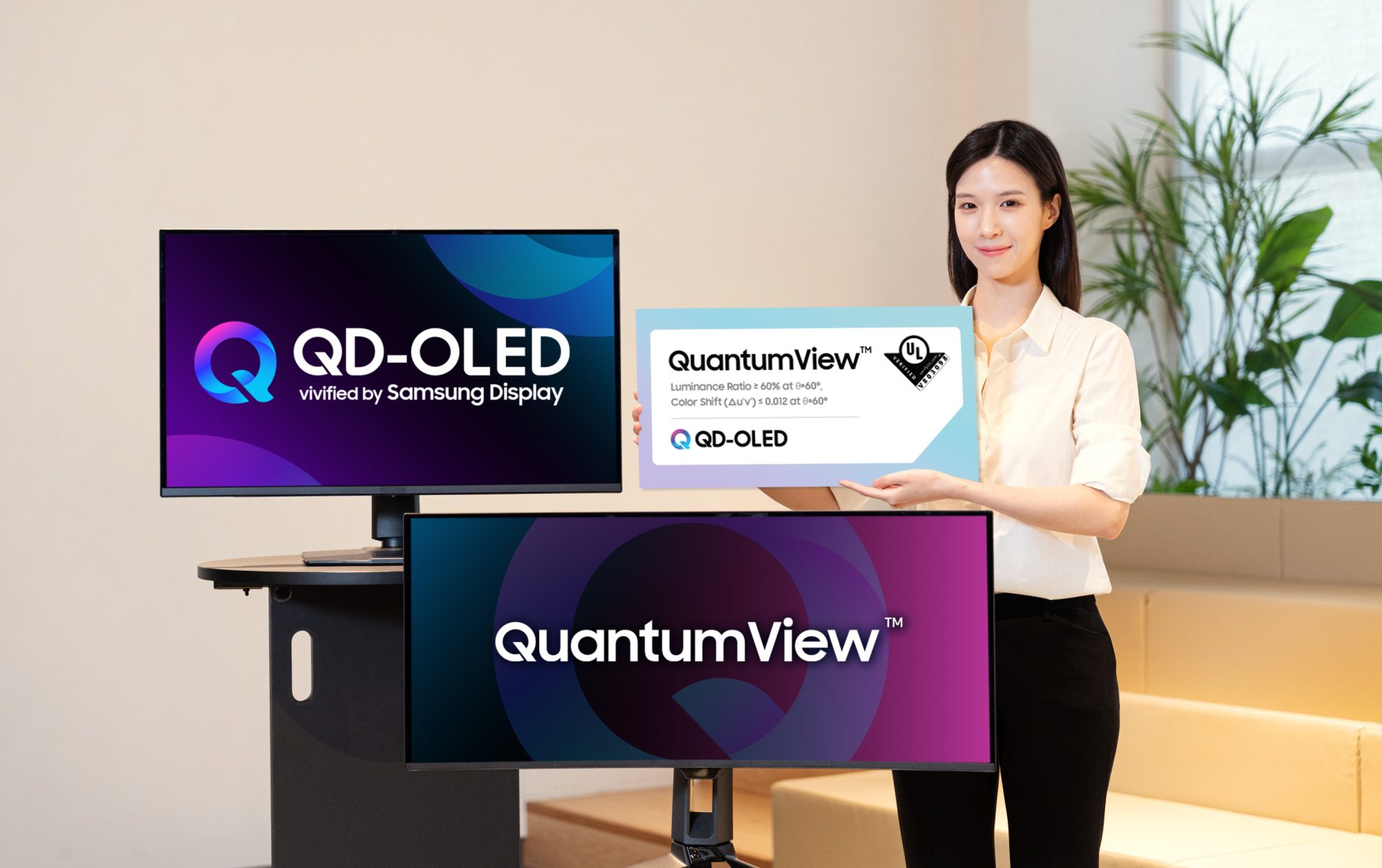
Samsung Display has earned a fresh vote of confidence for its QD-OLED panels, after the company’s TV and monitor lineup successfully passed UL Solutions’ QuantumView verification for viewing angle performance. The results highlight a key reason QD-OLED has become a top choice for premium screens: it keeps brightness and color remarkably consistent even when you’re not sitting directly in front of the display.
QuantumView is designed to measure what actually happens to image quality as you move off-center. The program evaluates changes in luminance (brightness) and color coordinates as the viewing angle shifts away from the front in 10-degree steps, out to 60 degrees. In UL Solutions’ assessment, Samsung Display’s QD-OLED panels maintained more than 60% of their front-facing brightness even at a 60-degree angle, while keeping color shift below 0.012, signaling very little visible change in color accuracy.
That’s a notable advantage compared with typical LCD panels. LCD displays are widely known to suffer significant brightness loss when viewed from the side, with luminance often dropping below 20% at 60 degrees. Color consistency can also degrade more quickly, with reported color shift reaching up to 0.025—roughly double the level measured on QD-OLED in this verification.
Wide viewing angles have always mattered for TVs, especially in living rooms where multiple people watch from different seats and where bigger screens make off-angle viewing more common. But Samsung Display points out that the need for strong viewing angle performance is expanding well beyond televisions. More users now rely on dual-monitor and triple-monitor setups, and in professional environments—such as studios or offices—multiple people may need to evaluate the same screen at the same time. That makes viewing angle stability a practical requirement, not just a nice-to-have.
Samsung Display credits QD-OLED’s strong performance to two main factors: its proprietary front emission structure and the optical behavior of quantum dots. Light naturally tends to be directional, which is why many displays can look dimmer or shift in color when viewed off-center. Quantum dots, however, exhibit a Lambertian-like emission pattern that spreads light more evenly in all directions.
In QD-OLED, quantum dots absorb blue OLED light and re-emit it as red and green. During that conversion, the nanometer-scale quantum dot particles produce a spherical light distribution—helping maintain brightness uniformity and stable color across wider angles. Samsung also notes that unlike other large OLED approaches, QD-OLED produces pure, vivid colors directly from the front surface, which supports high color accuracy while also improving optical efficiency.
With these strengths—consistent viewing angles and strong color reproduction—Samsung Display says it’s pushing its OLED monitor business beyond gaming and general consumer use into professional markets that demand precision. That includes video production, graphic design, content creation, and even financial trading, where accurate color and consistent visibility matter throughout long workdays and collaborative workflows.
The broader monitor market is already moving in that direction. Professional creator displays featuring QD-OLED have started appearing from major PC brands, and more manufacturers are preparing their own QD-OLED-based professional monitor lineups. As adoption spreads, QuantumView verification strengthens the case that QD-OLED isn’t just about wow-factor contrast—it’s also built for real-world viewing conditions where people don’t always sit perfectly centered in front of the screen.