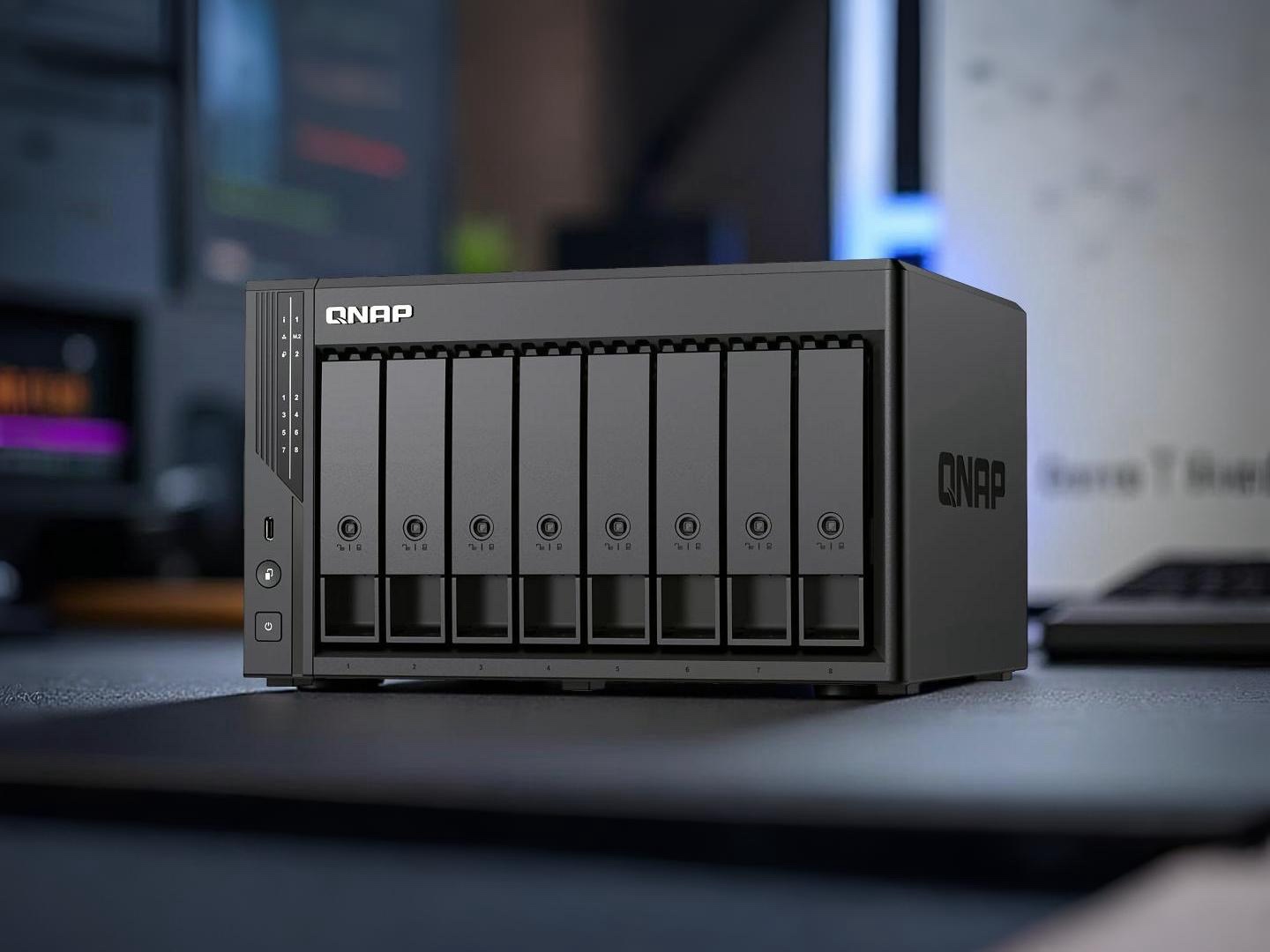
Looking for a budget-friendly NAS with modern performance and plenty of room to grow? QNAP’s new QuNAS lineup aims squarely at home users and small offices, combining efficient Intel silicon with flexible storage options and speedy connectivity.
At the heart of these models is Intel’s Twin Lake platform. The higher-tier versions use the Intel Core 3 N355, an octa-core processor built entirely on Gracemont efficiency cores. It’s not a powerhouse, but it’s more than capable for typical NAS workloads like media streaming, backups, file sharing, and light containerized apps. QNAP is also offering cost-cutting “Lite” configurations based on the quad-core Intel N150. In synthetic benchmarks, the N355 is roughly twice as fast as the N150, which makes it the safer bet if you plan to run multiple services or transcode media.
The series includes three chassis sizes to match different storage needs:
– Qu405: 4 drive bays
– Qu605: 6 drive bays
– Qu805: 8 drive bays
Each system supports up to 16 GB of DDR5 memory, giving you headroom for heavier multitasking and more responsive app performance. For flash acceleration, there are dual M.2 2280 NVMe slots (PCIe 3.0 x1), ideal for SSD caching or light app storage—great for speeding up metadata, thumbnails, and frequently accessed files.
Connectivity is strong for a value-focused NAS. Expect:
– Dual 2.5GbE ports for faster-than-gigabit networking and link aggregation
– Dual HDMI 2.1 outputs on N355 models for direct-display setups
– Dual USB 3.2 Gen 2 Type-A ports
– One USB 3.2 Gen 2 Type-C port
Availability starts in China, with global release details yet to be announced. For reference, the top-end Qu805 with eight bays, 16 GB of RAM, and the N355 CPU is priced at 3,799 yuan, roughly $534 at current exchange rates. Drives aren’t included, so you’ll need to add your own HDDs or SSDs depending on whether you favor capacity, speed, or a mix of both.
Who should buy which model?
– Choose the N355 variants if you want smoother multi-user performance, plan to run several apps, or anticipate media transcoding.
– Consider the N150 Lite versions if your needs are mostly file storage, simple backups, and basic streaming.
– Pick 4, 6, or 8 bays based on your growth plans; larger enclosures make it easier to scale capacity without replacing drives.
Key takeaways
– Budget-friendly NAS family with a modern efficiency-focused Intel platform
– Three bay counts for flexible capacity planning
– Up to 16 GB DDR5 and dual NVMe slots for responsive caching
– Dual 2.5GbE networking and HDMI 2.1 outputs on N355 models
– Launching in China first; broader availability not yet confirmed
The QuNAS lineup hits a sweet spot for users who want a capable, energy-efficient NAS with enough performance to handle daily tasks and room to expand as needs evolve.