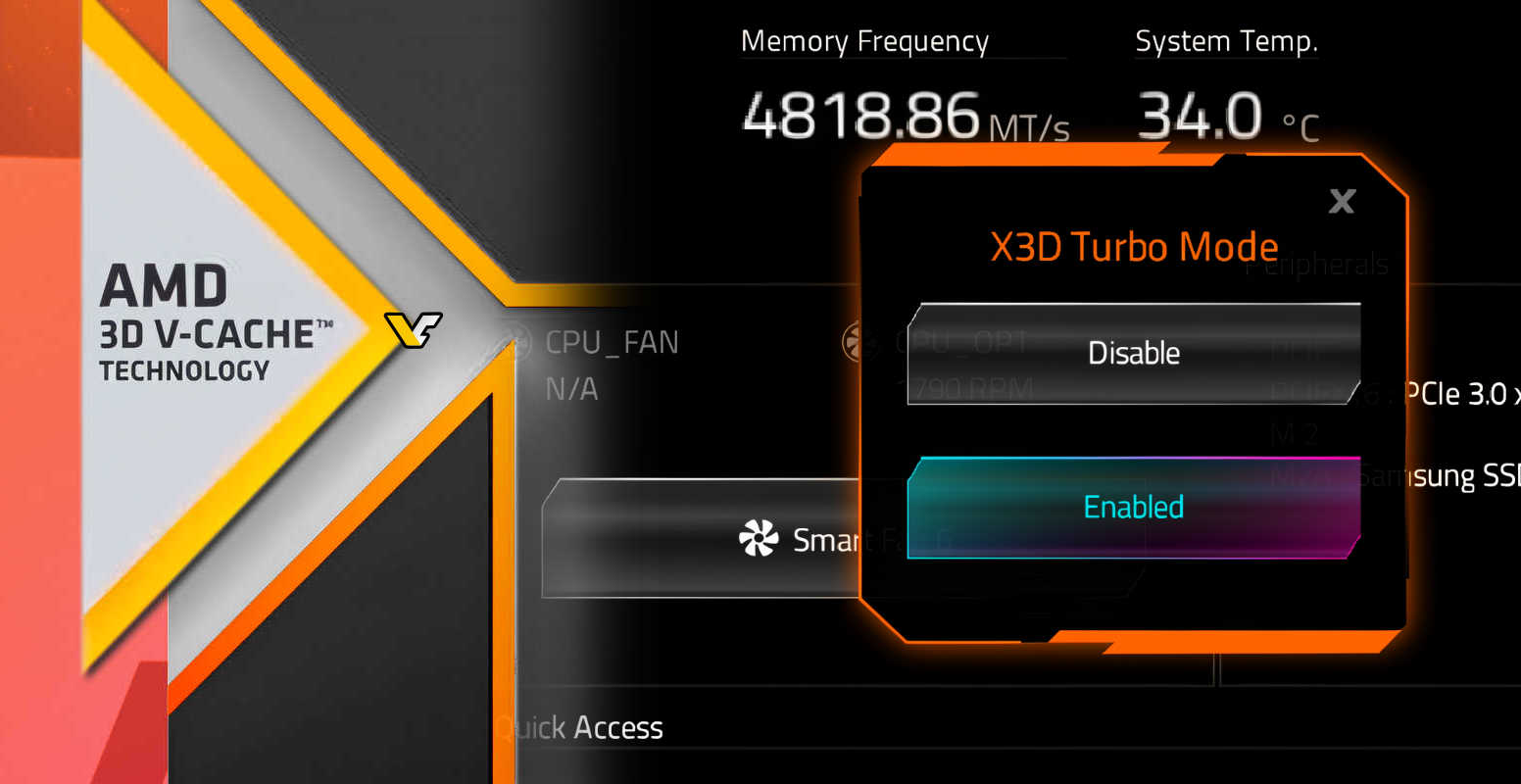
In an unexpected revelation, Gigabyte has unveiled the upcoming Ryzen 9000X3D series, even ahead of any announcements by AMD itself. This intriguing disclosure came through a press release, introducing Gigabyte’s latest innovation: the “X3D Turbo Mode.” This cutting-edge feature is integrated into AMD’s newest X870/X870E motherboards, as well as existing 600-series boards, and is designed to optimize both Ryzen 7000 X3D and the soon-to-be-released Ryzen 9000 processors.
Interestingly enough, while the initial description hesitates to directly connect the X3D feature, an explicit mention follows shortly after. Despite only illustrating the X870 AORUS Master and a Ryzen 5 9600X non-X3D CPU in the associated image, the X3D Turbo Mode promises striking performance enhancements.
This trailblazing BIOS feature, as revealed through the press release, promises to revolutionize gaming experiences. By harnessing the full potential of the Ryzen™ 9000 X3D processors, users can relish up to a staggering 35% increase in performance. Even those with Ryzen™ 9000 non-X3D processors can enjoy a 20% performance uplift. These enhancements translate to ultra-smooth gameplay, higher frame rates, and minimized latency, all thanks to Gigabyte’s innovative BIOS design.
What’s captivating is the fact that the X3D Turbo Mode caters to both 3D V-Cache-enhanced CPUs and traditional models. This compatibility propels the non-X3D variants closer to the performance league of their X3D siblings, offering a generous lift that gamers are bound to appreciate. This development, however, leaves more to be desired, as Gigabyte remains tight-lipped about the specifics of this “revolutionary BIOS feature.”
The X3D Turbo Mode will roll out with AGESA 1.2.0.2a, working in tandem with the AORUS AI Snatch software, promising a new era of gaming prowess. As the tech community eagerly awaits further details, this release undoubtedly stirs excitement and speculation over what else the Ryzen 9000 series might hold.