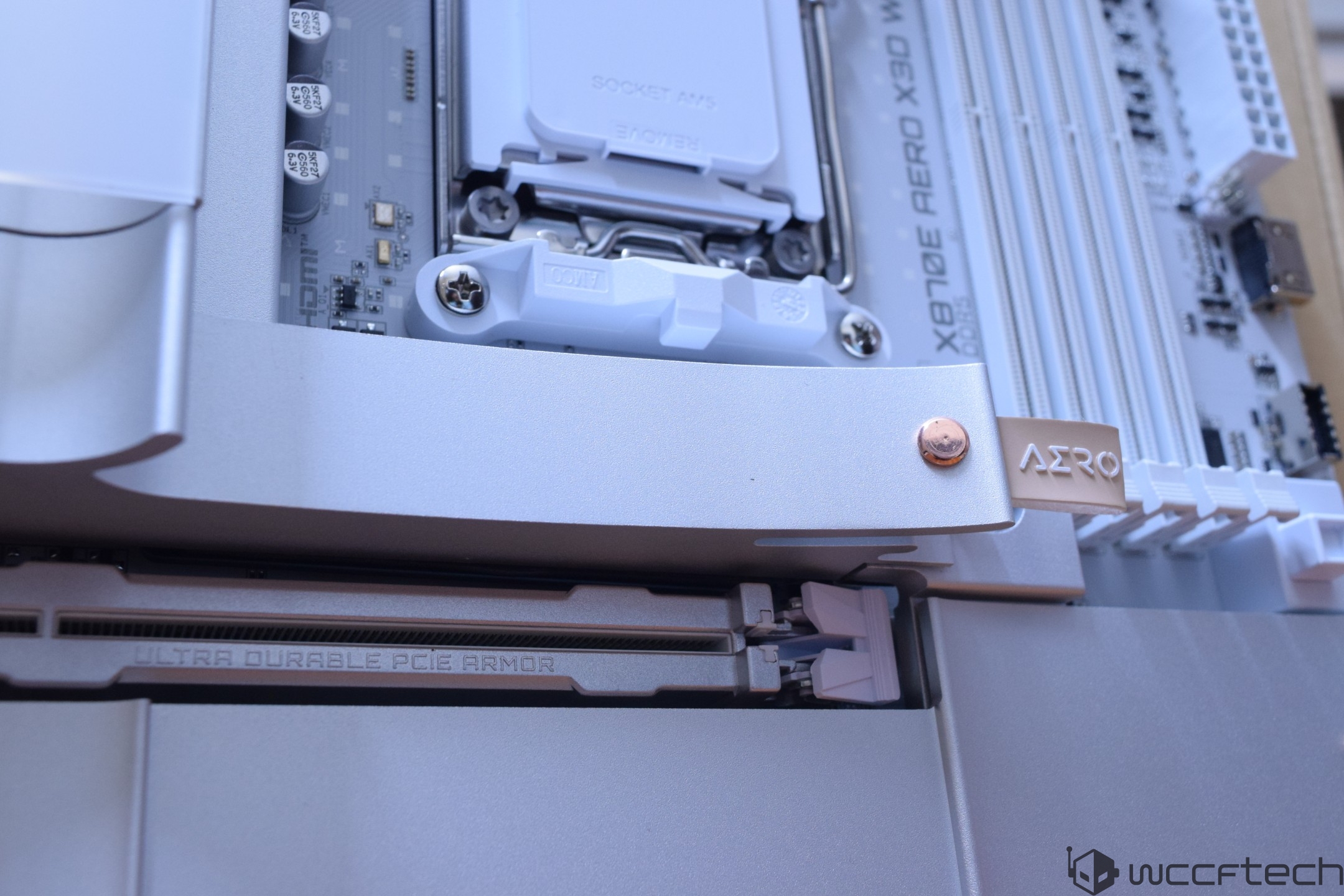
Gigabyte is kicking off 2026 with a premium AM5 motherboard that’s clearly designed for builders who want their PC to look as good as it performs. The Gigabyte X870E AERO X3D WOOD arrives as part of AMD’s newer 800-series motherboard wave and leans hard into a distinctive aesthetic, pairing clean “AERO” styling with eye-catching wood-like textures. It’s positioned squarely in the high-end category, carrying a $499 US price tag and aiming at gamers and creators who want modern connectivity, fast storage support, and strong memory tuning potential.
It’s also arriving at a notable moment for AMD’s desktop ecosystem. AM5 has now had time to mature, with multiple CPU generations already on the socket, including Ryzen 7000, Ryzen 8000, and Ryzen 9000 families. While many 600-series boards still offer excellent compatibility—even with newer Zen 5 chips—AMD and motherboard makers are using the 800-series refresh to push newer standards and a smoother “out of the box” experience for enthusiasts.
What AMD’s 800-series chipsets bring to AM5 builders
AMD’s latest chipset lineup expands the AM5 platform with new options at the top end and in the mainstream. The initial spotlight is on X870E and X870, designed for enthusiasts who want the newest I/O features, next-gen PCIe support, and better DDR5 tuning headroom. Alongside those, AMD also introduces B850 and B840 for more affordable builds, with a clear step-down in features depending on the chipset tier.
Key upgrades that define X870E and X870 motherboards include:
USB4 as a standard feature across X870 and X870E boards
PCIe Gen5 support for both graphics and NVMe storage on X870 and X870E
Improved EXPO memory overclocking support and higher potential DDR5 speeds on many premium designs
AMD has also discussed updated Precision Boost Overdrive (PBO) and Curve Optimizer (CO) behavior for Ryzen 9000 CPUs, with X870E/X870 boards built to support these features right away. For users who like to tune performance—whether for gaming frame rates or creator workloads—this is one of the practical reasons the new chipset generation can be more appealing than simply dropping a new CPU into an older motherboard.
X870E vs X870 vs B850 vs B840: what’s the difference?
At a high level, AMD is splitting the 800-series into enthusiast and mainstream segments:
X870E is the top-tier option, using two chipset dies (Promontory 21 x2). It’s designed for maximum I/O capability, with USB4 and broad PCIe Gen5 support for both GPU and SSD.
X870 uses a single Promontory 21 die. It retains USB4 and PCIe Gen5 for GPU and NVMe, but with fewer lanes available compared to X870E.
B850 targets mainstream builds. It uses the Promontory 21 die but lacks native USB4. It can support Gen5 graphics, while Gen5 M.2 support is optional depending on the motherboard model.
B840 is the entry point in the 800-series, based on an older Promontory 19 die. This tier focuses on affordability, typically dropping to Gen4-class support for GPU and SSD, removing CPU overclocking support (memory tuning remains), and trimming overall connectivity to hit lower price points.
In short: X870E is the “all the features” platform, X870 keeps most of the headline standards but with fewer lanes, B850 is the practical midrange choice, and B840 is built to compete on price for budget AM5 systems.
DDR5 speeds and what to expect on 800-series boards
DDR5 support continues to mature on AM5. Native DDR5-5600 is part of the baseline expectation, while higher-end enthusiast boards are increasingly tuned for much faster overclocked memory. Some premium models are expected to reach beyond 8000 MT/s depending on the motherboard design, memory kit quality, and CPU memory controller behavior. For gamers chasing low latency and creators pushing bandwidth-heavy tasks, memory headroom can be a major reason to shop the higher tiers.
AM5 socket and platform longevity: LGA 1718 and a 2027+ roadmap
AM5 also represents a major physical shift from the old AM4 era. Instead of PGA pins on the CPU, AM5 moves to an LGA (Land Grid Array) design, specifically LGA 1718. The extra contact points improve communication between the processor and motherboard and help enable the platform’s expanded feature set.
For buyers thinking long term, AMD has publicly committed to supporting AM5 through 2027 and beyond. That matters if you want a motherboard purchase to last across multiple CPU upgrades—one of the reasons AMD platforms have historically attracted builders who don’t want to replace everything every generation.
Cooler compatibility: good news for upgraders
Despite changes to the socket and CPU package, cooler compatibility remains friendly for many upgraders. Ryzen 7000, 8000, and 9000 desktop processors keep the same overall CPU dimensions, and AMD’s approach allows many existing coolers to work on AM5. The chips do use a thicker integrated heat spreader (IHS), but the key takeaway is that you typically won’t be forced into buying a brand-new cooler just because you moved to AM5.
Where the Gigabyte X870E AERO X3D WOOD fits
With its $499 price and standout “WOOD” styling, the Gigabyte X870E AERO X3D WOOD is clearly aimed at premium builds that combine performance, connectivity, and visual design. It lands at the top end of AMD’s 800-series ecosystem, targeting users who want USB4 as standard, PCIe Gen5 readiness for both GPU and storage, and a motherboard built to pair neatly with Ryzen 9000 and whatever comes next on AM5.
For anyone planning a high-end AMD gaming PC or a creator workstation in 2026, boards like this show exactly what the X870E platform is about: maxed-out modern I/O, next-gen expansion support, and a more refined enthusiast experience—without giving up the upgrade path that’s become a hallmark of AMD’s desktop strategy.


