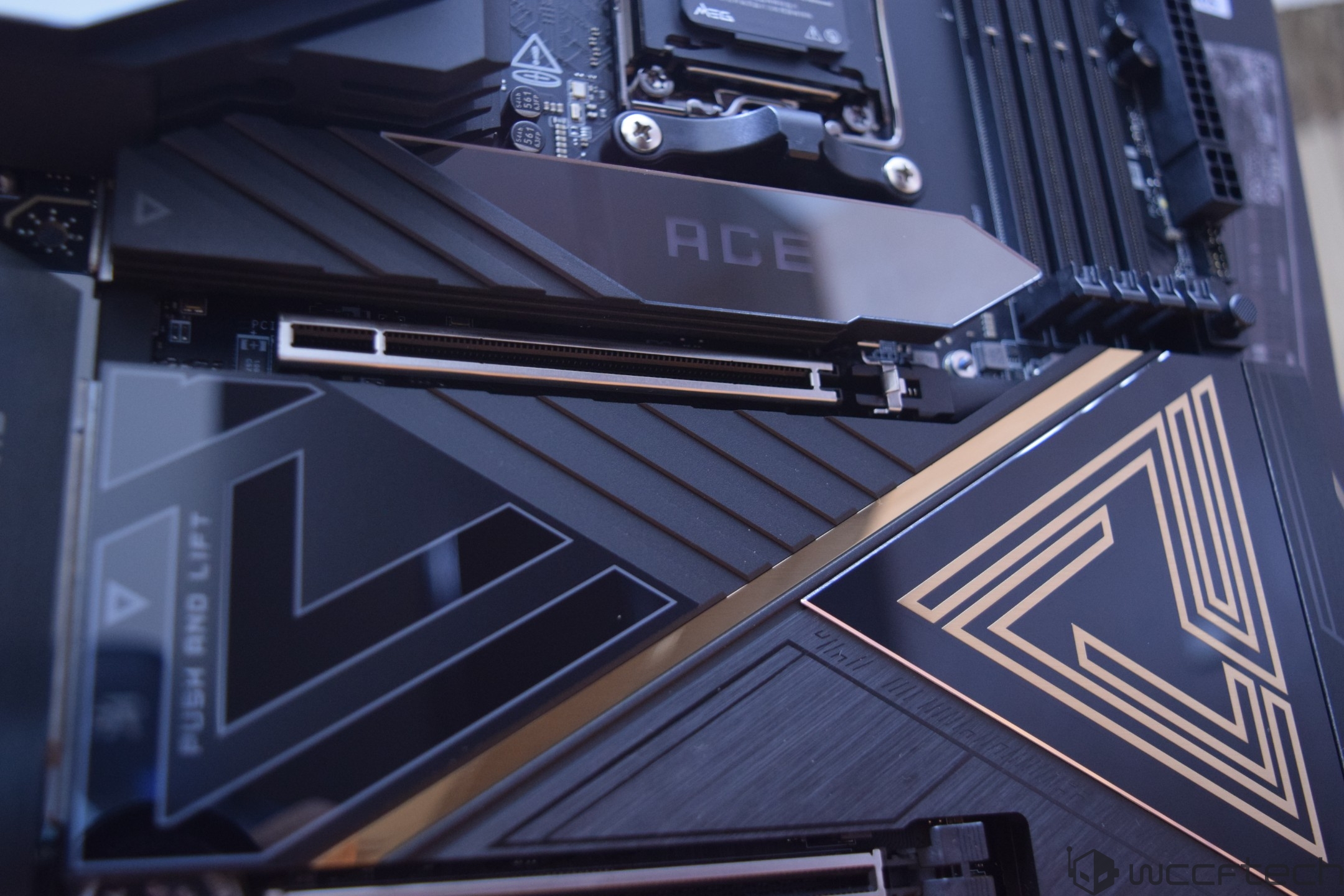
Product Info: MSI MEG X870E ACE MAX (2025) Motherboard, $699 US
AMD’s AM5 platform has come a long way since the first 600-series motherboards arrived. In just three years, it’s played host to multiple CPU generations across Ryzen 7000, Ryzen 8000, and Ryzen 9000, giving builders a clear upgrade path without constantly replacing the entire system. The 600-series boards still offer strong compatibility even with newer Zen 5 processors, but motherboard design moves quickly—and AMD’s new 800-series chipset family is meant to push AM5 into its next phase with more modern connectivity, faster storage support, and better “out of the box” features.
That new lineup includes X870 and B850 chipsets aimed at high-end and mainstream PC builds. The goal is simple: make the platform more appealing for new AMD builders, and give longtime AM4 owners a compelling reason to finally jump to AM5 for gaming rigs, streaming setups, and content creation PCs.
To see what this refresh looks like in practice, this review focuses on MSI’s MEG X870E ACE MAX, part of the company’s updated “MAX” lineup. The ACE branding returns to the AM5 ecosystem after skipping the initial X870E wave, and it comes positioned as a flagship-class option built to match premium Ryzen systems with a bold design and enthusiast-grade features.
Why AMD’s 800-series AM5 chipsets matter
AM4 has been one of the longest-lasting modern desktop platforms, first introduced in 2017 and still selling strongly even into 2025 thanks to ongoing CPU releases. But AM5 is now firmly the future-facing socket, and AMD’s 800-series is presented as the second major stage of AM5 with improvements aimed at today’s high-performance workloads and tomorrow’s upgrades.
X870E and X870 are the initial focus for enthusiasts, bringing updates that target better I/O, stronger memory support, and more complete support for Ryzen overclocking tools—especially for Ryzen 9000 “Granite Ridge” CPUs and whatever comes next.
Key upgrades commonly associated with X870E and X870 motherboards include:
1) USB4 as a standard feature across X870 and X870E boards
2) PCIe Gen5 support for both graphics and NVMe storage on X870 and X870E
3) Higher EXPO memory overclocking potential on many X870E/X870 designs
AMD has also discussed new Precision Boost Overdrive (PBO) and Curve Optimizer (CO) behavior tied to Ryzen 9000, and these new motherboards are built to support those features without extra tinkering.
X870E vs X870: what’s the difference?
Both chipsets are designed for high-end AM5 systems, but X870E is the more fully loaded option. In broad terms, X870E boards use a dual-die chipset configuration, while X870 uses a single-die approach. Both retain modern I/O expectations like USB4 and Gen5 support, but X870 boards typically offer fewer total lanes and less overall expansion flexibility depending on the exact board layout.
Beyond X870: B850 and B840 for mainstream and budget builds
AMD isn’t limiting the 800-series story to premium hardware. B850 and B840 are positioned as the next step for more budget-conscious builders.
B850 is especially important because it aims to deliver a modern AM5 experience at more approachable prices. It uses the newer chipset silicon but drops native USB4. It can still support PCIe Gen5 graphics, while Gen5 M.2 storage support may depend on the board model.
B840 takes things further down the price ladder, targeting value builds. It’s intended to be more affordable, focusing on essentials: Gen4-class GPU and SSD support, no CPU overclocking, and memory overclocking as the main tuning option. That combination has the potential to make B840 boards attractive in the sub-$200 segment, especially for mainstream gaming PCs and everyday productivity rigs.
AM5 socket details: LGA 1718 and long-term support
One of the biggest physical shifts from AM4 to AM5 is the move from PGA (pins on the CPU) to LGA (pins in the socket). AM5 uses the LGA 1718 socket, increasing pin contact count and enabling more capability for power delivery and platform features.
Just as important as the hardware redesign is the roadmap. AMD has publicly committed to supporting AM5 through at least 2027 and beyond, continuing the company’s reputation for long-lived platforms. AM4 became popular partly because it allowed meaningful CPU upgrades across multiple generations, and AMD is signaling a similar long-term mindset for AM5—especially as more affordable, feature-rich 800-series motherboards reach the market.
Cooler compatibility: good news for upgraders
For builders worried about switching costs, one of the easiest wins with AM5 is cooling compatibility. Ryzen 7000, 8000, and 9000 desktop CPUs use the same general CPU dimensions, even though AM5 chips feature a thicker integrated heat spreader (IHS). Because of this, many existing cooler solutions remain compatible, which can reduce the cost of upgrading from an older Ryzen system—especially for users who already own high-end air coolers or liquid AIO units.
Where the MSI MEG X870E ACE MAX fits
With a $699 US price tag, the MSI MEG X870E ACE MAX is clearly aimed at the top end of the AM5 market. It’s built for enthusiasts who want a premium motherboard foundation for high-performance Ryzen 9000 builds, fast Gen5 storage, top-tier connectivity like USB4, and expanded tuning support through modern AM5 overclocking features.
For users planning a long-term AM5 system—one that can start with today’s Ryzen CPUs and potentially carry upgrades for years—the X870E platform is designed to be the “no compromises” route. And with the ACE line returning in “MAX” form, MSI is banking on that combination of flagship features and refreshed platform upgrades to stand out in the new wave of AM5 motherboards.


