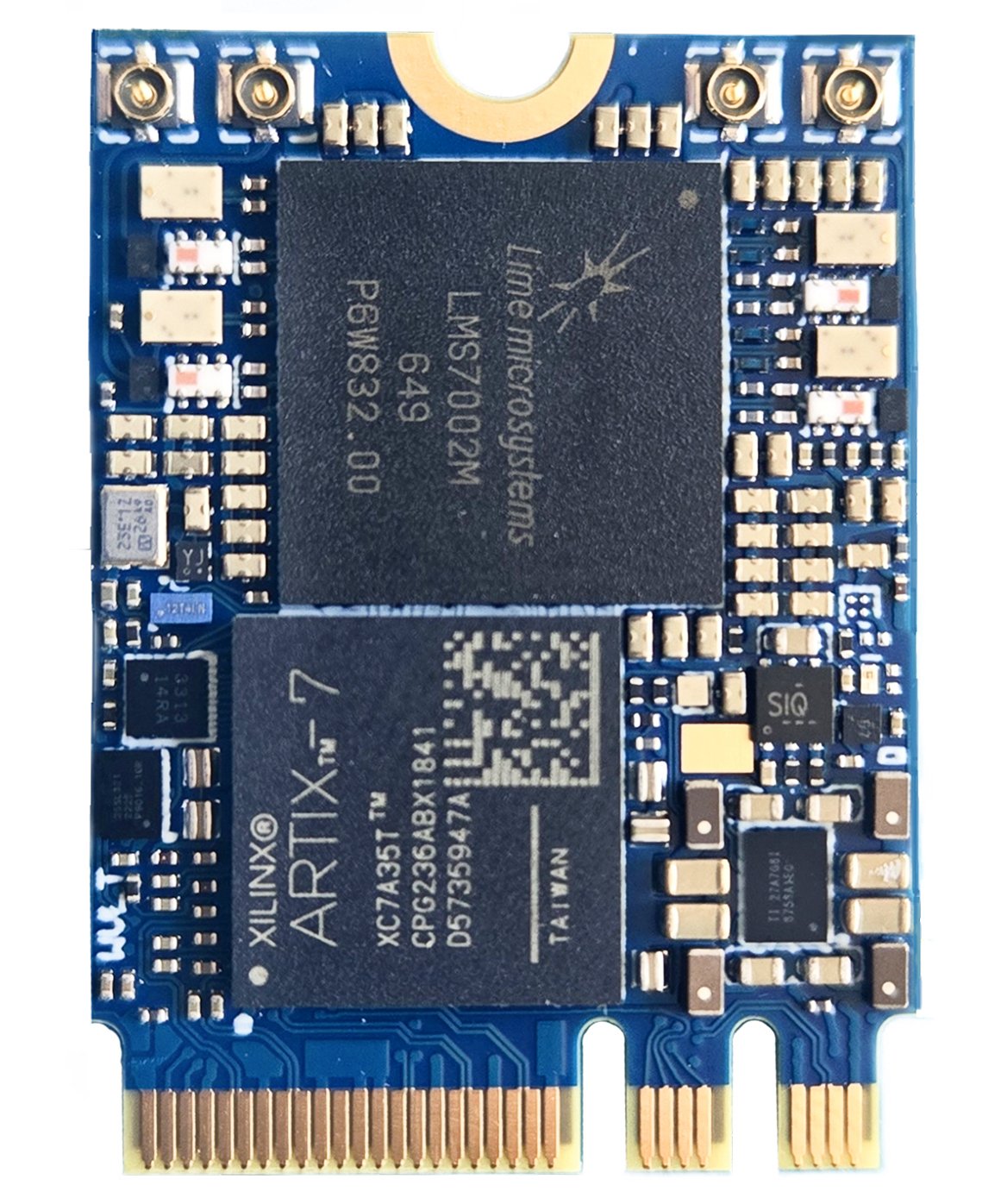
Wavelet Lab’s new xSDR is a remarkably small software-defined radio that can turn an everyday laptop, tablet, or embedded PC into a serious RF exploration machine. Built in an M.2 2230 A+E-key form factor (just 30 mm × 22 mm), the module is designed to slide into a compatible spare M.2 slot and instantly add a flexible 2×2 MIMO SDR platform—useful for everything from cellular network analysis to advanced wireless research.
The project is currently being offered through a crowdfunding campaign and has already reached its funding goal ahead of the March 2026 deadline. It builds on Wavelet Lab’s earlier uSDR concept, but brings a major upgrade by delivering 2×2 MIMO and extended bandwidth without increasing the tiny footprint—an appealing combination for portable SDR setups and compact computing builds.
Inside the xSDR is a Lime Microsystems LMS7002M RF transceiver paired with an AMD Artix-7 XC7A50T FPGA. That hardware combination enables a wide tuning range from 30 MHz up to 3.8 GHz, covering a huge slice of commonly used spectrum for RF experimentation, LTE research, and many sub-6 GHz wireless applications. The module supports sample rates from 0.1 MSPS up to 122.88 MSPS in SISO mode and more than 80 MSPS in MIMO mode, with channel bandwidth options ranging from 0.5 MHz to 90 MHz. For antenna connections, the board includes four MHF4 connectors, providing two receive channels and two transmit channels for true 2×2 operation.
One of the more interesting features for developers and labs is its built-in GPIO access. The xSDR exposes a 12+2-pin 1.8V GPIO header using reserved pins on the M.2 A+E-key interface. This can be used to drive external RF front-ends, switch antenna relays, or enable JTAG for custom FPGA gateware debugging. For precision timing work, one GPIO can be configured as a 1PPS (Pulse Per Second) input, allowing synchronization with a GPS Disciplined Oscillator (GPSDO). That opens the door to phase-coherent setups where multiple boards can be synchronized for multi-channel arrays—useful in advanced direction finding, beamforming experiments, and research-grade RF measurement tasks.
On the software side, the xSDR is positioned to fit into popular SDR workflows. It supports widely used SDR tools including GNU Radio, srsRAN, and SoapySDR. It also works with wsdr.io, a browser-based control platform that uses WebUSB, letting you configure and operate radio functions through a web interface without the usual driver-heavy setup. For users who want fast bring-up and portable experimentation, that kind of simplified control layer can be a big advantage.
Wavelet Lab is marketing the xSDR for LTE and 5G experimentation, embedded RF analysis, custom wireless data links, and research. It can also be adapted for penetration testing and signal investigation using tools such as Universal Radio Hacker. In capable hands and with appropriate legal authorization, an SDR like this can be configured to analyze, decode, or emulate various wireless protocols—one reason devices in this class are typically targeted at professionals, researchers, and experienced hobbyists rather than beginners.
There are a few practical considerations to keep in mind, especially around performance. Although the xSDR supports both USB 2.0 and PCIe 2.0 ×2 over the M.2 interface, certain installations may be limited by USB 2.0 throughput. If your system’s M.2 slot exposes only USB lines rather than PCIe, some high-bandwidth configurations may not be able to reach the module’s full potential.
Pricing is listed at $549, which places it firmly in the prosumer and professional SDR category. Production is planned to be handled by Wavelet Lab, with fulfillment managed through an established electronics distribution pipeline. As with most crowdfunded hardware campaigns, timelines can be affected by real-world factors such as tariffs, component availability, firmware readiness, and certification or compliance requirements—any of which could influence final delivery dates.
For anyone looking to build a compact, travel-friendly SDR workstation or add a powerful sub-6 GHz 2×2 MIMO radio to a small computer, the xSDR’s combination of laptop-friendly M.2 hardware, wide tuning range, FPGA flexibility, and modern software support makes it a compelling new option in the portable software-defined radio space.