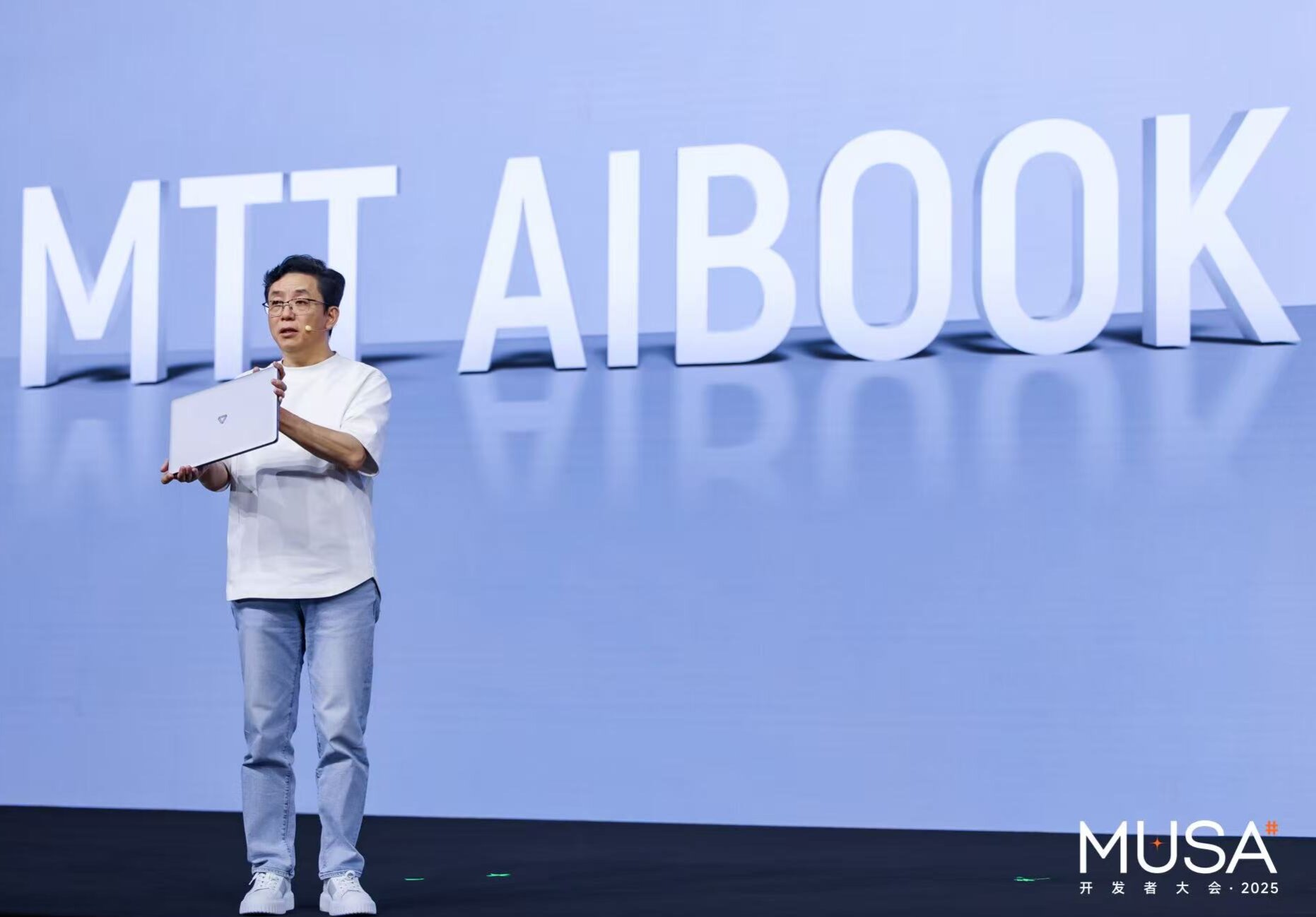
Moore Threads is best known for its push into discrete graphics, but the company is now taking a bigger swing at the laptop market with a high-end APU-style system-on-chip built for modern “AI PC” workloads. The new chip, based on the company’s in-house Yangtze design, pairs CPU, integrated graphics, and an onboard neural processor into a single platform aimed at productivity, content creation, and on-device AI.
Moore Threads has drawn attention in the past for ambitious hardware demos, including an early PCIe 5.0 graphics card that didn’t live up to performance expectations against older mainstream GPUs. This latest move is different in tone: instead of chasing pure graphics performance, the company is positioning its laptop silicon around an increasingly important selling point in 2026-era notebooks—edge AI acceleration.
At the center of the announcement is the Yangtze laptop SoC. It’s built on an ARMv8 CPU design with a 12-core configuration and a quoted boost frequency of 2.65 GHz. Graphics are handled by an integrated GPU using Moore Threads’ own MUSA architecture, aiming to deliver a more complete “all-in-one” experience with native GPU capability and software support integrated into the platform.
The Yangtze chip appears inside the MTT AIBOOK, an OEM laptop offering from Moore Threads that showcases the company’s full-stack approach. The AIBOOK configuration includes 32 GB of DDR5-7500 memory, a 1 TB SSD, and an OLED display rated for a 120 Hz refresh rate—specs that clearly target mid-to-high-end users rather than entry-level buyers.
The most notable component, though, is the NPU. Moore Threads claims up to 50 TOPS of INT8 AI performance from a multi-core neural processing package designed for tasks such as speech recognition and image recognition. That puts the laptop firmly in “AI PC” territory, where local inference and on-device assistants are major priorities—especially in markets where running models locally is becoming more popular due to interest in open-source LLMs and domestic AI ecosystems.
Key advertised features of the Yangtze laptop chip include:
12-core ARMv8 CPU
Up to 2.65 GHz boost clock
Integrated GPU based on the company’s higher-end IP
NPU rated at 50 TOPS (INT8)
Support for H.265, H.264, and AV1 video codecs
Positioning aimed at the AI PC segment
Moore Threads previously discussed this chip family in an 8-core form, so moving to 12 cores suggests the company is quickly iterating and scaling the design to better match current-gen expectations. On paper, the feature set checks many of the right boxes for a modern laptop platform: fast RAM, a high-refresh OLED panel, capable storage, and dedicated AI hardware. The bigger unknown is real-world performance—especially in benchmarks and sustained workloads—since specifications alone don’t confirm how well the CPU, iGPU, drivers, and software ecosystem hold up in day-to-day use.
Pricing is another major talking point. The MTT AIBOOK is listed at roughly $1,440 in China, which is a steep starting point for a first-generation platform. Still, for a company attempting to establish itself in the APU and AI laptop space, the premium may reflect early production positioning and the cost of building an in-house stack across CPU, GPU, and NPU.
If Moore Threads can back up the Yangtze platform with strong performance, stable software, and competitive efficiency, the AIBOOK could become an important signal that the company is serious about more than discrete GPUs—especially as demand rises for laptops that can run AI features locally without relying on the cloud.