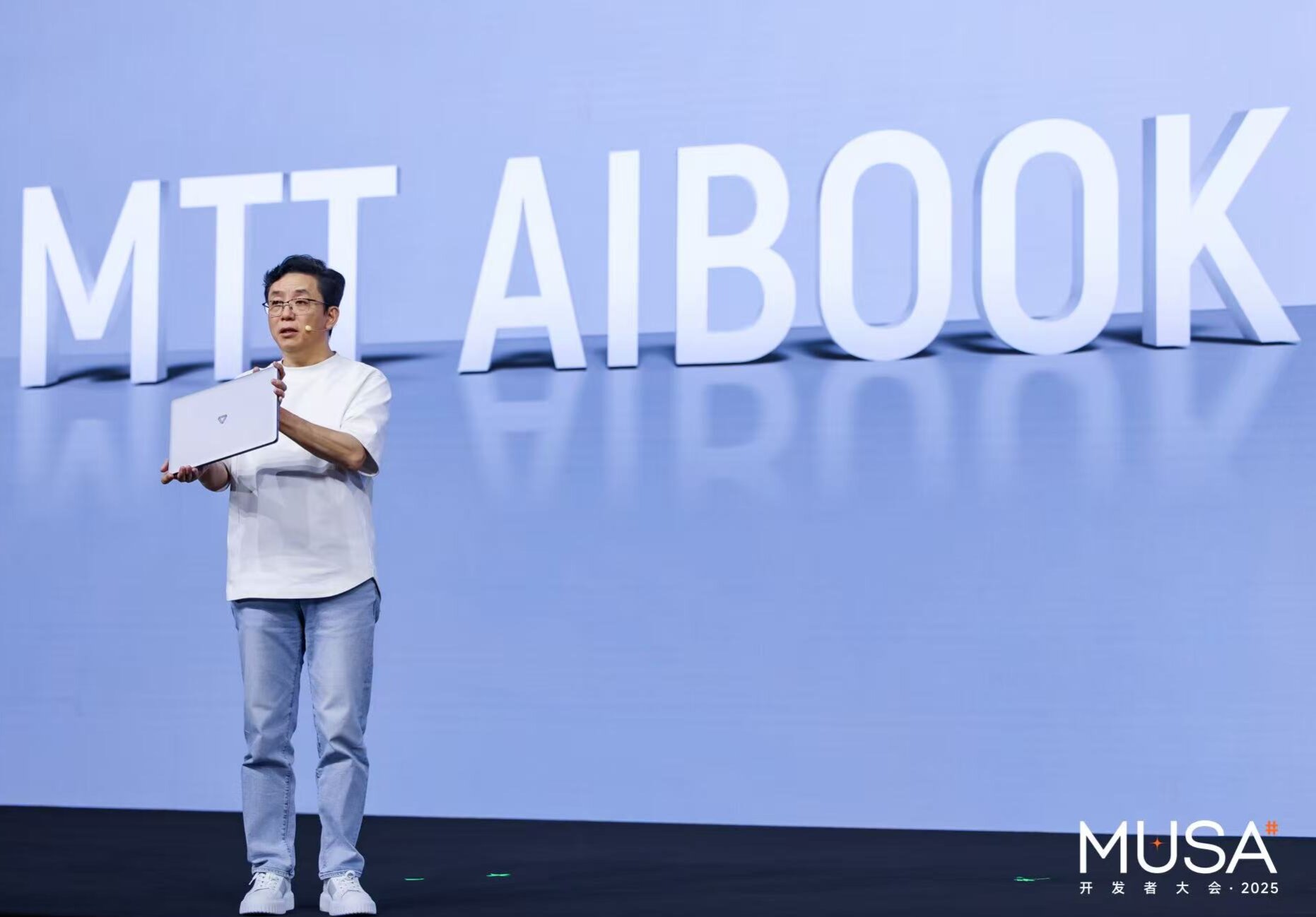
Moore Threads is best known for its push into discrete graphics, but the company is now widening its ambitions with a homegrown laptop-grade SoC aimed at the fast-growing “AI PC” category. The new chip, based on the company’s in-house Yangtze platform, is positioned as a high-end APU-style solution that brings CPU, integrated graphics, and dedicated AI acceleration together in a single package for thin-and-light notebooks.
At the heart of the Yangtze laptop chip is a 12-core CPU built on the ARMv8 architecture, paired with an integrated GPU using Moore Threads’ own MUSA graphics architecture. The CPU is listed with a 2.65 GHz boost clock, and the overall design is presented as a full-stack effort that blends hardware IP with software support—an important factor for any new entrant trying to compete in a market dominated by mature ecosystems.
The first laptop shown with this platform is the MTT AIBOOK, an OEM system from Moore Threads that targets mid-to-high-end workloads. The configuration highlighted includes 32 GB of DDR5-7500 memory, a 1 TB SSD, and an OLED display rated at a 120 Hz refresh rate. On paper, it reads like a premium Windows-alternative style machine built to showcase local silicon capabilities.
What makes this chip especially notable is the integrated NPU, rated at 50 TOPS (INT8). That AI performance figure is designed to catch attention in a segment where on-device inference is increasingly seen as a core feature, not an add-on. Moore Threads frames the NPU as a multi-core neural processor package intended for speech and image recognition tasks, aligning with the broader push toward running AI features locally rather than relying entirely on cloud processing.
Key capabilities and positioning for the Yangtze-based laptop SoC include:
12-core ARMv8 CPU
Up to 2.65 GHz boost clock
Integrated GPU based on Moore Threads’ high-end internal IP (MUSA)
50 TOPS (INT8) NPU for edge AI workloads
Modern media codec support including H.265, H.264, and AV1
A clear focus on the AI PC market
Moore Threads appears to be timing this move to match rising demand in China for running AI models on local hardware. Interest in on-device deployment has been accelerating, especially alongside the growth of open-source large language models and the desire to keep AI workloads closer to the user for privacy, latency, and cost reasons. In that context, a laptop platform emphasizing “edge AI” makes strategic sense.
Still, specs don’t always translate directly into real-world performance. Moore Threads has shown ambitious hardware before, and the real test for this new laptop chip will be how it holds up in practical benchmarks, driver maturity, application compatibility, and sustained performance under everyday workloads.
As for pricing, the MTT AIBOOK is listed at roughly $1,440 in China. That’s a steep entry point for a first-generation platform, but it also reflects the cost often associated with early hardware efforts—especially those attempting to prove a new silicon and software stack in a premium-looking device.
If Moore Threads can deliver solid real-world results and keep improving its ecosystem, this Yangtze-based laptop chip could become an important step in China’s broader push toward domestically developed AI-ready PC hardware.