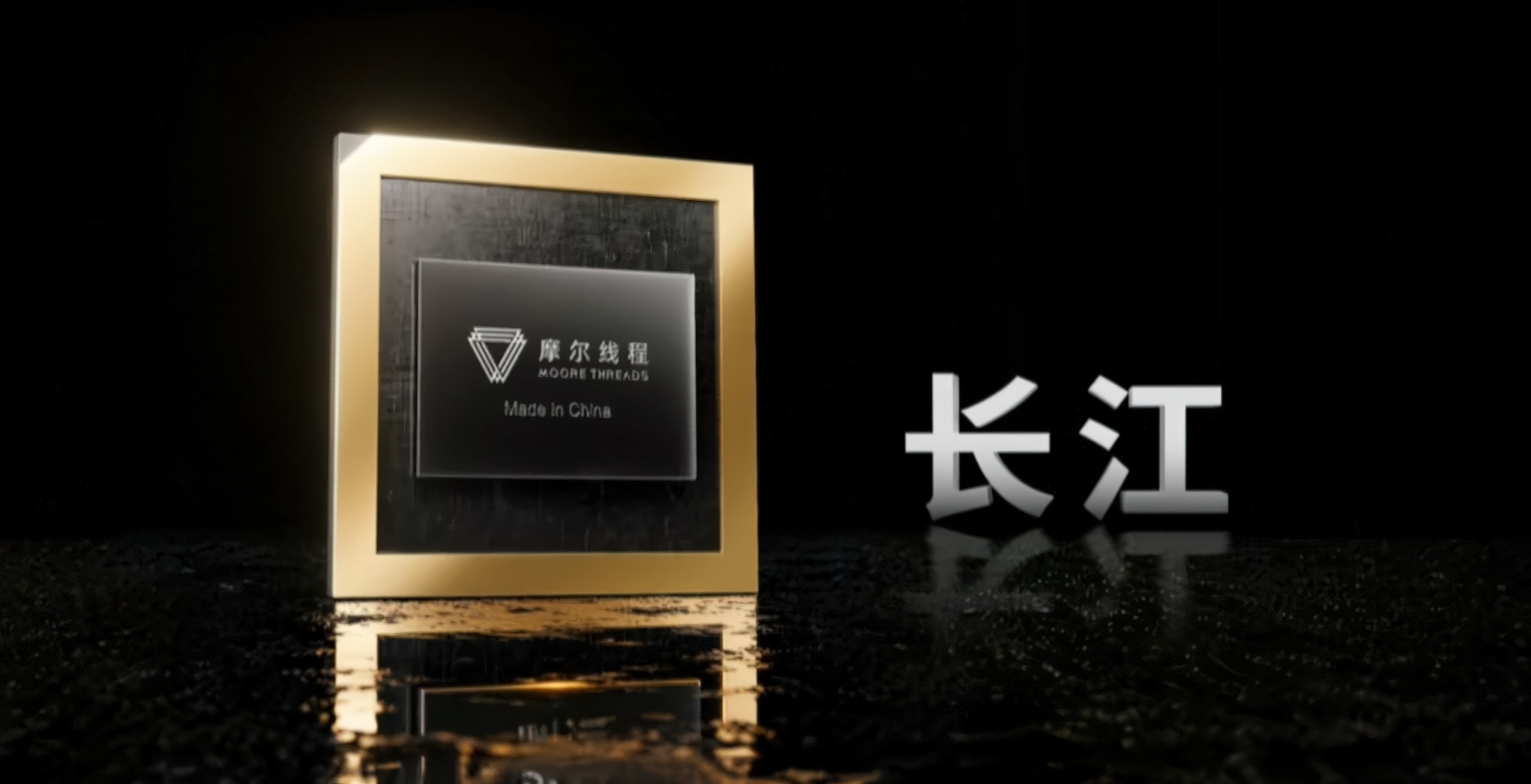
Moore Threads is stepping further into the fast-growing AI PC race with a new fully integrated AI SoC codenamed Yangtze. Unveiled alongside the company’s latest GPU work, Yangtze is positioned as an all-in-one platform built for modern AI-powered laptops and compact desktops, with the first devices already launching in China’s domestic market.
Named after China’s Yangtze River, the chip is designed as a complete system-on-chip solution rather than a traditional “just push CPU clock speeds higher” approach. Moore Threads hasn’t shared details about the internal CPU architecture or which IP blocks are used, but it has confirmed an 8-core CPU that boosts up to 2.65 GHz. While that clock speed may look modest next to today’s 5 GHz-plus processors, Yangtze’s focus is clearly on integrated AI and media capabilities, efficiency, and an expanded set of on-chip accelerators.
At the center of the AI push is a neural processing unit rated at 50 TOPS (INT8). Moore Threads describes the NPU as a multi-core neural processor built for workloads such as speech and image recognition—exactly the kind of tasks increasingly handled locally on “AI PCs” to reduce latency, improve privacy, and keep power usage under control.
Yangtze also includes an integrated GPU described as using high-end IP, aimed at high-performance 3D rendering while also supporting large language model acceleration and hardware video encode/decode. On the media side, the VPU supports modern codecs including H.265, H.264, and AV1, and is rated for 8K at 30 FPS and 4K at 60 FPS—useful for premium video playback, content creation, and conferencing workloads that benefit from hardware acceleration.
Beyond the CPU, NPU, and iGPU, Moore Threads is packing in several specialized blocks to broaden Yangtze’s role as a full PC-class platform. An onboard DPU is designed to drive multiple displays, supporting either dual 8K at 50 Hz or up to eight 4K displays at 50 Hz via DP/MIPI. There’s also a DSP for AI noise reduction and Hi‑Fi audio effects, plus an ISP that supports cameras up to 32MP and HDR—features that align well with thin-and-light laptops, video meetings, and creator-focused devices.
Moore Threads says the CPU should be competitive with other high-end 8-core chips while remaining efficient, reinforcing its claim that the overall SoC targets low-power operation. The chip also supports FP16, FP32, and FP64 compute formats, which can matter for a range of professional and AI-related workloads.
To show the platform in action, Moore Threads introduced two first-wave designs built around Yangtze: a laptop called the MTT AIBook and a mini PC called the MTT AICube. Both configurations support 32GB or 64GB of LPDDR5X memory and offer more than 100 GB/s of memory bandwidth, helping feed the GPU and NPU for graphics, media, and AI tasks.
With Yangtze, Moore Threads is signaling a broader goal: helping build a homegrown AI PC stack in China at a time when next-generation SoCs from major global players are set to make the market even more competitive. Whether buyers are looking for on-device AI features, strong media engines, multi-display flexibility, or compact system designs, Yangtze is Moore Threads’ clearest attempt yet to deliver a full, integrated AI PC platform rather than a single component.