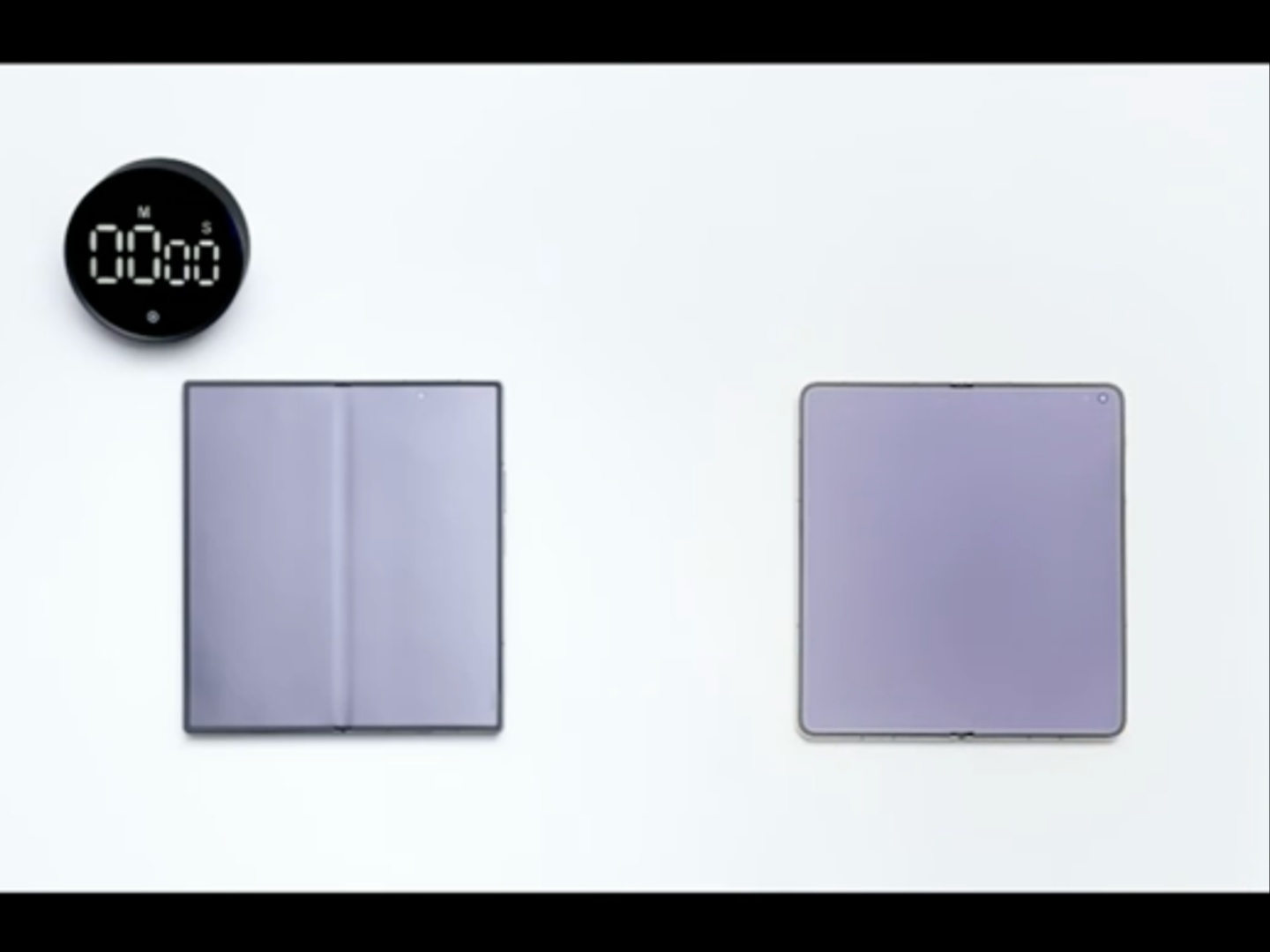
Oppo is stepping up the foldable phone race with the launch of the Find N6, a new foldable designed to tackle one of the biggest complaints about foldable displays: the crease. Oppo claims the Find N6 delivers a “visually invisible” crease, and it didn’t just say it—it demonstrated it by directly comparing its device against Samsung’s Galaxy Z Fold 7 during the launch event.
In a showcase meant to highlight real-world crease behavior, Oppo played a video featuring a brand-new Galaxy Z Fold 7 taken straight from its retail box. After the screen protector sheet was removed, the phone was left folded for an hour. When it was unfolded again, the crease appeared noticeably more prominent than it did right after unboxing. Oppo then unfolded a Find N6 that had been sitting folded, and the display appeared smooth, showing no obvious crease in the same way.
According to Oppo, the Find N6 achieves this cleaner look through a combination of a redesigned hinge and what it calls Auto-Smoothing Flex Glass. The company is positioning this as not only a cosmetic improvement but also a durability win. Oppo says the Find N6 is rated for 600,000 folds, suggesting it can maintain its smooth display performance over an extended lifespan.
That claim also sets up a pointed contrast with Samsung’s Galaxy Z Fold 7. Samsung rates the Z Fold 7 for 500,000 folds, but Oppo argues that rating mainly applies to the folding mechanism, while the display itself can still develop visible creasing quickly—even within a short period of being folded.
Beyond the foldable screen and hinge, Oppo is also leaning on battery upgrades to strengthen its case. The Find N6 uses a silicon carbon battery, pushing capacity to 6,000 mAh and pairing it with 80W wired charging. In comparison, the Galaxy Z Fold 7 is said to come with a 4,400 mAh battery, a sizable gap for users who want longer screen-on time from a foldable. There’s also a reference point in Samsung’s lineup with the now-discontinued Galaxy Z TriFold, which had a 5,600 mAh battery.
All of this points to a simple message: Oppo is aiming to make the foldable experience feel closer to a traditional flagship phone—no distracting crease, stronger long-term durability claims, and a larger battery with faster charging. Meanwhile, Samsung may not stand still for long, with expectations that it could adopt silicon carbon battery technology and increase battery capacity in the next generation Galaxy Z Fold 8.