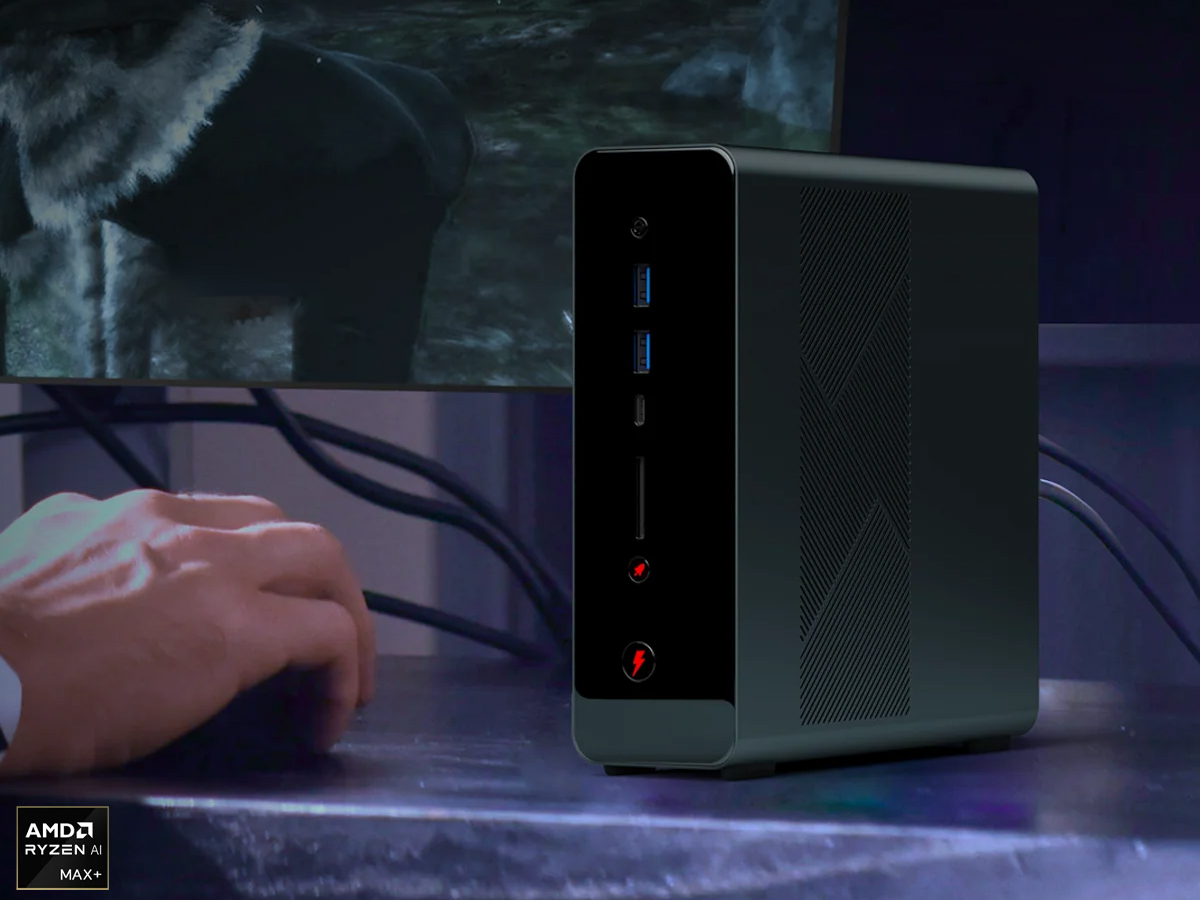
OneXPlayer has quietly added a new contender to the high-end gaming mini PC scene: the OneXStation. Designed for users who want serious performance in a compact footprint, this small desktop arrives powered by AMD’s flagship Ryzen AI Max+ 395 processor from the Strix Halo family, pairing modern Zen 5 CPU architecture with a strong integrated Radeon GPU and AI-focused hardware.
At launch, OneXPlayer is keeping things simple with just one configuration. That model combines the Ryzen AI Max+ 395 with a massive 128GB of LPDDR5X memory clocked at 8,000MHz, targeting gamers, creators, and AI power users who often run into memory limits on smaller desktops. A standout feature here is flexible memory allocation: up to 96GB of that system RAM can be assigned to the Radeon 8060S integrated GPU as VRAM. That’s a big deal for higher-resolution gaming, heavy texture loads, and AI workflows that benefit from large GPU memory pools.
The Radeon 8060S iGPU is positioned as more than “good for integrated graphics.” It’s built to deliver performance that can land in the neighborhood of mid-to-high-end laptop discrete GPUs, making the OneXStation appealing to anyone looking for a cleaner, quieter setup without adding a dedicated graphics card right away. And for users who do want to expand graphics power later, the system’s USB4 connectivity supports external GPUs and DisplayPort 1.4 output, though it’s important to note there’s no power delivery support through those USB4 ports.
Storage expandability is another strong point. The OneXStation includes two PCIe 4.0 x4 M.2 slots, each supporting SSDs up to 4TB. That means you can scale all the way up to 8TB total internal storage, a welcome option for large game libraries, creative projects, and local AI models.
Keeping high performance stable in a small chassis comes down to cooling and power limits, and OneXPlayer is leaning into both. The OneXStation uses a dual-fan cooling setup that includes an internal downward-blowing fan, and the company says the system can sustain up to 120W of performance. Better yet, the TDP is adjustable with three modes—55W, 85W, and 120W—so you can choose quieter operation for everyday work or push it harder for gaming and demanding tasks.
Port selection is robust for a mini PC, covering the essentials for multi-monitor setups, peripherals, and fast networking. You get three USB 3.2 Type-A ports, two USB4 ports, HDMI, DisplayPort, an SD 4.0 card slot, 2.5G Ethernet, and 3.5mm audio (listed twice in the provided details, but effectively confirming it includes a headset/audio jack). This mix makes the OneXStation practical as both a living-room gaming box and a compact workstation.
Visually, the OneXStation follows the familiar style of other Strix Halo-based mini PCs, with a clean, compact chassis. OneXPlayer adds a bit of flair with an LED strip wrapping around the front corners, helping it stand out without looking overly flashy.
Pricing, however, places it firmly in premium territory. The OneXStation is listed at a $2,999 launch price for the single available configuration, which includes 128GB RAM and 1TB of storage. For buyers who value top-tier AMD silicon, huge memory capacity, strong integrated graphics, and compact design, it’s positioned as a no-compromise mini PC—especially for those who want high performance without a full-size desktop tower.