NVIDIA CEO Jensen Huang Arrives in Japan to Push the Next Phase of Physical AI and Robotics
NVIDIA CEO Jensen Huang has arrived in Japan, and his visit is drawing major attention across the tech and robotics world. The trip comes at a time when artificial intelligence is expanding beyond chatbots, copilots, and digital agents into a new frontier: Physical AI.
While agentic AI has become one of the hottest topics in technology, Physical AI may be just as important for the future. This category focuses on machines that can understand, move through, and interact with the real world. In simple terms, if humans are the users of agentic AI, robots are the bodies of Physical AI.
Japan is a fitting place for NVIDIA to highlight this next chapter. The country has long been considered one of the birthplaces of humanoid robotics. Decades ago, companies such as Honda and Sony helped shape the public imagination around intelligent machines with projects like the P-series humanoid robots, ASIMO, and the iconic AIBO robotic dog. Those early creations laid the foundation for a global robotics race that is now accelerating with modern AI.
NVIDIA is positioning itself at the center of this transformation. The company has spent years building a full robotics platform that combines hardware, simulation tools, AI models, robot learning systems, and accelerated computing libraries. Much of this work is powered by NVIDIA Isaac, an open robotics development platform designed to help developers train, simulate, and deploy intelligent robots.
A key part of this platform is Isaac GR00T, which focuses on humanoid robot development. Humanoid robots require more than basic automation. They need to perceive their surroundings, understand instructions, balance, manipulate objects, and respond safely in unpredictable environments. NVIDIA’s robotics ecosystem is designed to give developers the tools needed to build these advanced capabilities.
The timing of Huang’s Japan visit is significant. Robotics is entering a new era as companies around the world race to create more capable humanoid systems. Recent demonstrations from robotics startups have shown machines with increasingly advanced hands, smoother movement, and more natural interactions. Many of these projects are being built with NVIDIA’s AI and robotics technologies behind the scenes, showing how deeply the company is becoming embedded in the future of physical machines.
Reports from Japan suggest that Huang is expected to hold important meetings with robotics partners and may make new announcements related to Physical AI infrastructure. His trip follows recent high-profile visits to other major technology hubs in Asia, where he met with partners, suppliers, developers, and ecosystem leaders.
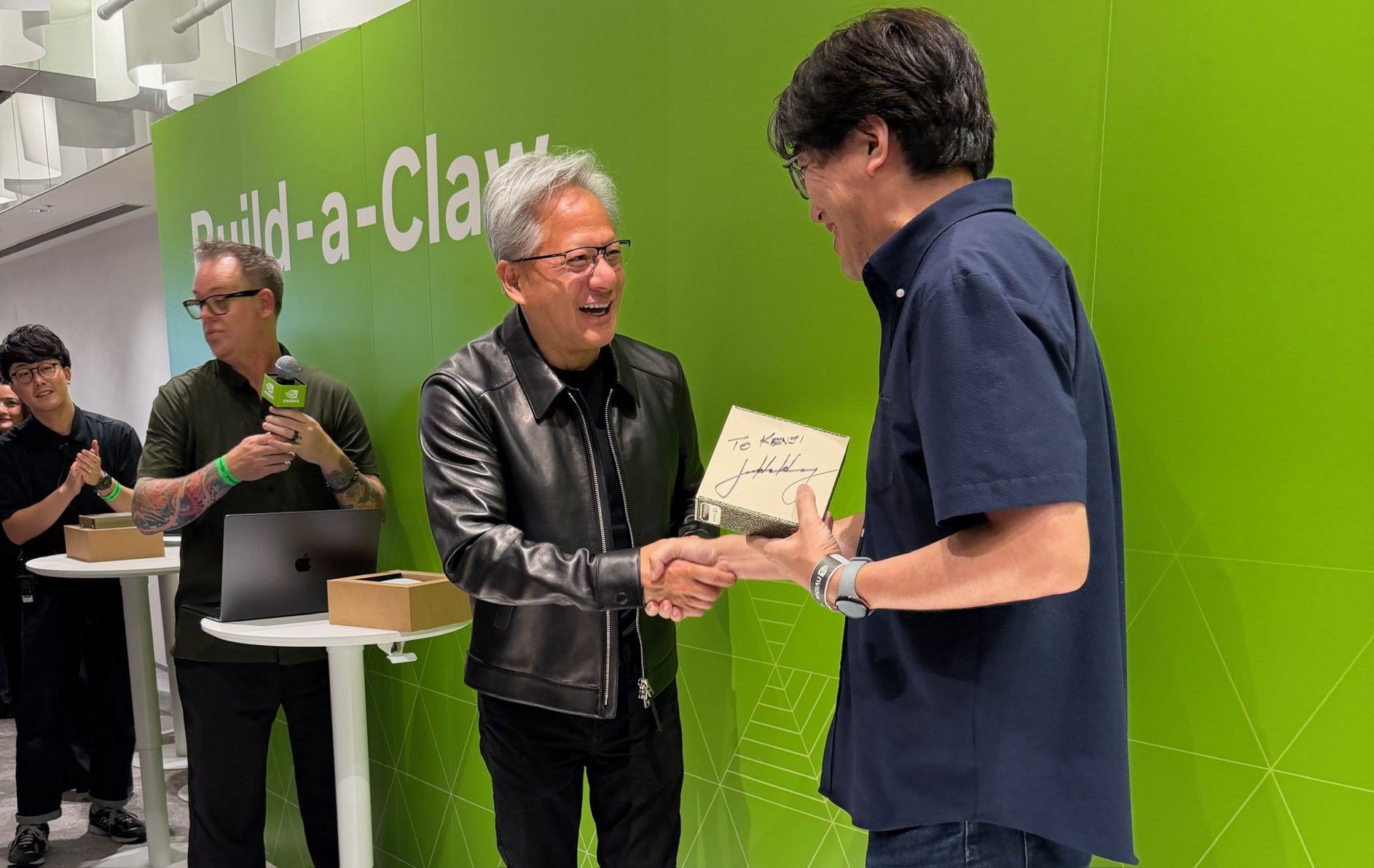
As usual, Huang’s presence has also attracted public attention. Known for his signature leather jacket and approachable style, he has been seen meeting developers, greeting crowds, and exploring local culture. In Tokyo, he reportedly visited a pub in Kanda, where he enjoyed drinks and yakiton. He also made a surprise appearance at a developer-focused event called Build-a-Claw, where he spoke with attendees, held a short Q&A session, and handed out DGX Spark systems.
During the visit, Huang also commented on NVIDIA’s future product roadmap. He reaffirmed that the company’s Vera Rubin platform is progressing as planned, signaling confidence in NVIDIA’s next generation of AI computing technology. He also touched on possible future opportunities involving Japanese semiconductor company Rapidus, which could become an important player in Japan’s advanced chip ambitions.
Huang was also spotted in Akihabara, one of Tokyo’s most famous technology and gaming districts, where he announced an ongoing collaboration with SEGA. The appearance added another layer to his Japan trip, connecting NVIDIA’s AI ambitions with the country’s influential entertainment and technology industries.
The bigger message behind Huang’s visit is clear: NVIDIA wants to show that it is ready for the Physical AI era. The company is no longer only associated with graphics cards, data centers, or AI model training. It is increasingly building the infrastructure that could power the next generation of robots, autonomous systems, industrial machines, and humanoid assistants.
For Japan, this moment also carries symbolic weight. The country helped introduce the world to the idea of friendly, human-like robots decades ago. Now, with the rise of generative AI, simulation, accelerated computing, and advanced sensors, that dream is moving closer to practical reality.
NVIDIA’s role in this shift could be enormous. By offering the computing platforms, software frameworks, and AI tools needed to train robots in simulation before deploying them in the real world, the company is helping reduce one of the biggest barriers in robotics development. Instead of relying only on slow and expensive real-world testing, developers can use virtual environments to teach robots how to move, grasp, navigate, and respond to different scenarios.
This is why Physical AI is becoming such a major focus for the industry. The future of AI will not be limited to screens and servers. It will increasingly appear in factories, hospitals, warehouses, homes, vehicles, and public spaces. Robots powered by Physical AI could assist with manufacturing, elder care, logistics, disaster response, research, and everyday household tasks.
Jensen Huang’s arrival in Japan is more than a routine business trip. It is a strategic signal that NVIDIA sees robotics as one of the next major growth engines for artificial intelligence. With Japan’s deep robotics history and NVIDIA’s expanding AI platform, the visit could mark an important step toward bringing intelligent machines into the physical world at scale.