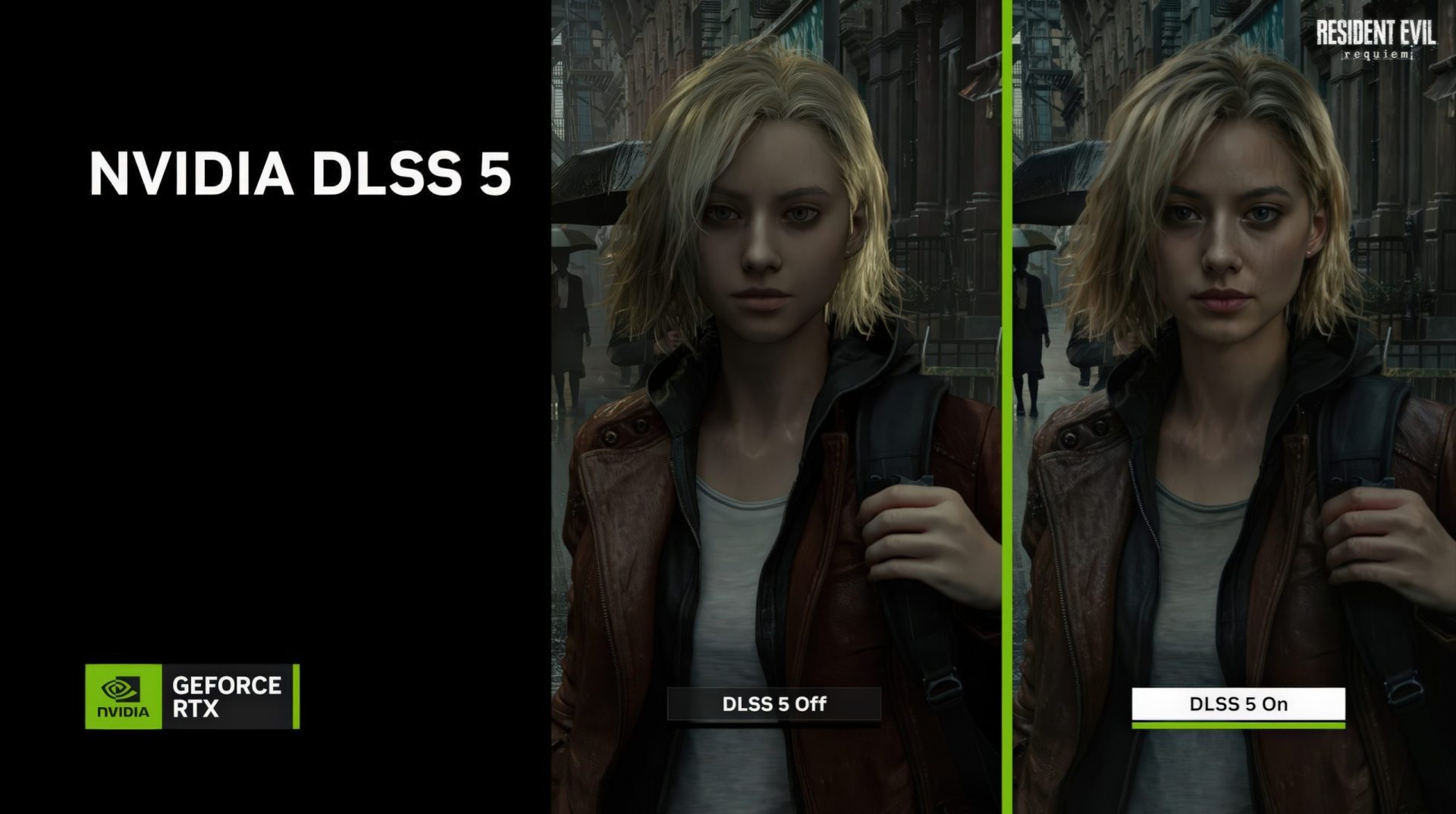
DLSS 5 is NVIDIA’s most ambitious leap yet in AI-driven graphics rendering, and it’s positioned as more than a simple upgrade to DLSS Super Resolution or Frame Generation. Revealed at GTC 2026 and expected to arrive later this year, DLSS 5 shifts the conversation from “AI helps you run games faster” to “AI helps you render the image itself better.” If NVIDIA delivers on what it has shown so far, DLSS 5 could reshape how real-time graphics are produced, especially in demanding AAA PC games.
So what is DLSS 5, exactly? In NVIDIA’s own framing, it’s the biggest jump in its rendering stack since real-time ray tracing. The key difference is that DLSS 5 isn’t primarily about reconstructing a higher-resolution frame from a lower-resolution input, or inserting AI-generated frames to increase smoothness. Instead, it’s a real-time neural rendering model that enhances the final image by infusing frames with more photoreal lighting and material response, while still staying anchored to the game’s underlying 3D scene data.
That “infusion” concept is what has sparked debate. Some viewers immediately described what they saw as an AI filter layered on top of a game. NVIDIA’s counterargument is that DLSS 5 isn’t meant to randomly stylize visuals or replace the game’s art direction. The company says it uses engine-provided signals and an end-to-end trained model that understands what it’s looking at, such as skin, hair, fabric, and translucent surfaces, then applies lighting and material improvements in a way that remains temporally stable and consistent in motion.
Based on what NVIDIA has publicly disclosed so far, DLSS 5 works by consuming each frame’s color data along with motion vectors. The goal is a deterministic and temporally stable result, meaning the enhanced image shouldn’t shimmer, crawl, or “rewrite itself” from frame to frame. NVIDIA also says the model is trained to recognize semantic categories and lighting contexts from a single frame, then use that understanding to produce more realistic interactions like skin scattering, fabric sheen, and hair highlights.
Just as important as the tech itself is the control developers reportedly get. NVIDIA says DLSS 5 is tunable, letting studios adjust intensity, color grading, and masking. That’s a direct response to concerns that neural rendering might override a game’s intended look. In theory, DLSS 5 can be dialed in to complement a specific art style rather than forcing a one-size-fits-all photoreal treatment.
Performance is the other major question, and it’s impossible to talk about DLSS 5 without addressing the demo setup that caught everyone’s attention. Early showings at GTC 2026 were reportedly running on a dual GeForce RTX 5090 configuration, with one GPU effectively handling the neural rendering workload while the other rendered the game. That’s far from a typical consumer PC, and it immediately raised concerns about real-world requirements, latency, and whether DLSS 5 will be practical outside extreme high-end rigs.
At the same time, NVIDIA has signaled that what was shown is an early, unoptimized demonstration meant to prove what’s possible. The company has indicated the shipping version is being refined to run on a single GPU, with improvements expected in efficiency, memory use, and overall performance before launch. Still, until real benchmarks land on normal single-GPU systems, performance remains the biggest unanswered part of the story.
On hardware support, NVIDIA has not published an official compatibility list or minimum specs yet. Early indications suggest DLSS 5 may be tied to GeForce RTX 50 Series GPUs and above, but that is not confirmed as a final requirement. In other words, if you’re wondering whether older RTX cards will benefit, the only honest answer right now is that NVIDIA hasn’t fully said.
Game support could move quickly if NVIDIA’s claims hold up. The company says DLSS 5 will be adopted by major publishers and studios, and it has already named an initial wave of titles including Starfield, Hogwarts Legacy, and Resident Evil Requiem, along with additional games. If those releases ship with DLSS 5 features intact and well-tuned, that first wave will likely determine whether neural rendering becomes a new standard or remains a premium, selectively used feature.
For integration, DLSS 5 is expected to plug into games through NVIDIA Streamline, the same framework used for existing DLSS and Reflex features. Streamline is pitched as a way to reduce integration friction for developers who want to support multiple upscaling and frame-generation-style solutions across different engines and GPU vendors, rather than building and maintaining separate pipelines for every technology.
To understand what makes DLSS 5 such a turning point, it helps to compare it to earlier generations. DLSS 1 focused on machine learning-based spatial upscaling using per-game training. DLSS 2 moved to generalized temporal upscaling that reconstructs detail from motion and history across frames. DLSS 3 added Frame Generation as a major performance multiplier, using additional signals to generate intermediate frames for smoother motion. DLSS 4 and DLSS 4.5 pushed further with bigger performance multipliers, improved Transformer-based models for Super Resolution and Ray Reconstruction, and expanded multi-frame generation techniques on newer RTX hardware. DLSS 5 changes the emphasis again, aiming less at multiplying performance and more at upgrading image fidelity directly through AI-enhanced lighting and material rendering grounded in engine inputs.
As for release timing, NVIDIA DLSS 5 is expected to launch in Fall 2026. Like past DLSS rollouts, it will likely arrive first in big-budget PC games and on higher-end RTX GPUs, then expand as tools mature and studios learn how to tune neural rendering without compromising performance or artistic intent.
If DLSS 5 succeeds, the future of PC graphics may look less like “render everything traditionally, then upscale,” and more like a hybrid pipeline where AI participates in the final image formation itself. That’s a profound shift, and it’s why DLSS 5 is already one of the most talked-about real-time graphics technologies on the horizon—even before NVIDIA shares final hardware requirements, real-world benchmarks, and shipping-quality gameplay comparisons.