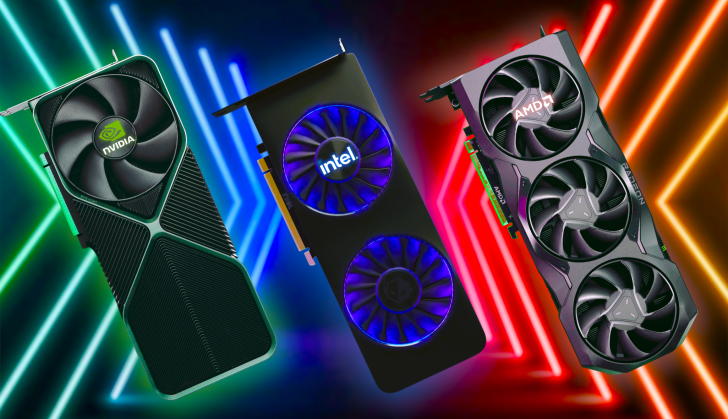
Amidst a shifting landscape in the AIB (Add-In Board) graphics processing unit market, NVIDIA has emerged as the dominant force, escalating its foothold to an 88% market share at the onset of 2022. This development delineates a considerable margin over its competitors, AMD and Intel, with the latter not securing any market share in the first quarter of the year.
In the first quarter of 2024, the AIB GPU market experienced a downturn, seeing a 7.9% decrease in shipments compared to the preceding quarter, despite a 39.2% year-over-year surge. With a total of 8.7 million units shipped during this quarter, a reduction from 9.5 million at the end of 2023, the industry demonstrated significant volatility. However, NVIDIA defied this trend, not only fortifying its market share but also realizing a 0.9% uptick in shipments from the last quarter and a 45.6% leap over the previous year. This has solidified NVIDIA’s preeminence with a commanding 88% slice of the market.
AMD, conversely, faced a challenging quarter with a staggering 41% quarterly drop in shipments. Despite this, the company did witness a 39% annual increase. Nonetheless, their market share decreased from 19% in the fourth quarter of 2023 to just 12% at the close of this quarter. On the other end of the spectrum, Intel observed its market share dwindle to an insignificant level. With the introduction of its Arc discrete GPUs for desktop and laptops in late 2022, aimed at the budget-conscious consumer, Intel struggled to gain a meaningful foothold and witnessed its market share plummet to 0%.
Exploring another sector of the market, desktop CPU shipments remained robust, with figures hovering around 16-17 million units, outpacing the demand for discrete graphics cards, which generally carry a higher price tag.
NVIDIA, currently basking in its success and recognition as the second most valuable tech company globally, shows no signs of complacency. The company continues to innovate, and buzz has already started around the anticipated next-generation GeForce RTX 50 series GPUs, which may pose new challenges for competitors AMD and Intel.
For AMD, whose most recent financial disclosures anticipated a downturn in gaming and Radeon graphics, and Intel, who’s yet to make a significant dent in this space, the pressure is mounting to devise creative strategies to capture the interest and investment of GPU consumers. As the industry landscape continues to evolve, the moves made by these companies in response to NVIDIA’s dominance could reshape market dynamics in the spaces of AI, data centers, cloud computing, and gaming graphics.