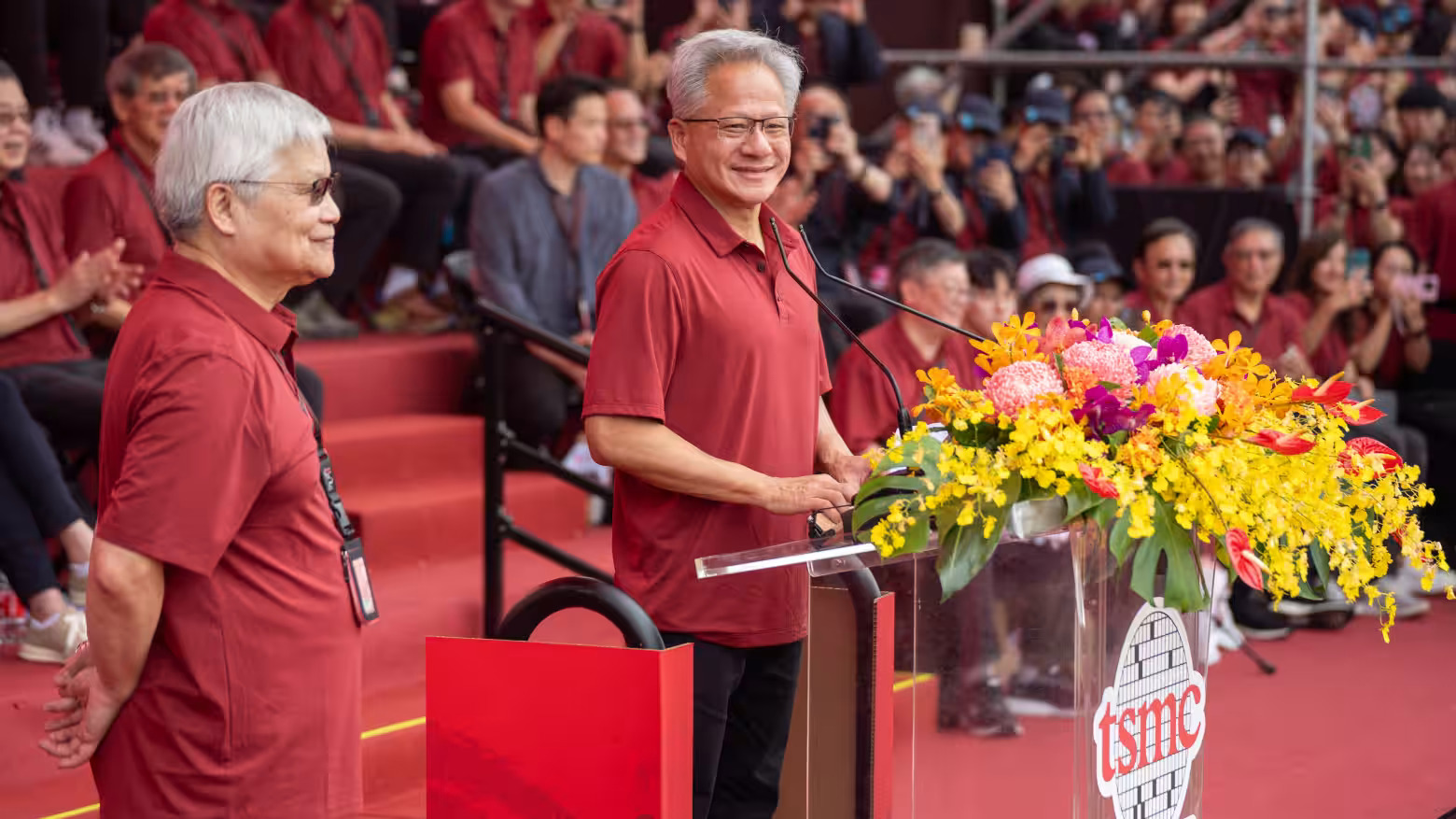
NVIDIA CEO Jensen Huang has made his fifth trip to Taiwan this year, timing his latest visit around the Thanksgiving period and sending a clear signal: Taiwan remains central to NVIDIA’s plans as the global AI boom accelerates.
Taiwan’s importance to NVIDIA goes far beyond being home to the world’s most advanced chip manufacturing ecosystem. A huge portion of NVIDIA’s AI supply chain depends on Taiwanese partners such as Foxconn, Quanta, Wistron, and others that help turn cutting-edge designs into real, large-scale AI systems. According to local reports, Huang’s visit focused on supply chain discussions and also included a personal moment, as he reportedly checked in on the health of TSMC founder Morris Chang.
The timing makes sense. Competition in AI hardware is evolving rapidly, and NVIDIA can’t afford delays as it prepares future platforms and data center GPUs, including the next wave of AI products tied to its Rubin roadmap. Keeping close contact with suppliers and manufacturing partners helps NVIDIA ensure production readiness, manage capacity, and avoid bottlenecks that could slow shipments.
When asked about current AI demand and supply conditions, Huang pointed to continued constraints across critical parts of the AI infrastructure. It’s not just about chips—he highlighted shortages and supply pressure involving memory, advanced packaging, cabling, and power supplies. In other words, building and deploying AI at scale is now limited by multiple components across the stack, not a single part.
Naturally, questions also continue to swirl around NVIDIA’s long-term dominance, especially as more companies explore custom AI chips (ASICs) designed for specific workloads. Huang’s answer emphasized NVIDIA’s strength as a versatile platform, supported by a deep combination of hardware and software. That integrated ecosystem—accelerators, networking, systems, and the software layer that developers rely on—remains a key reason NVIDIA believes it can maintain its lead.
Even so, one detail stands out: Taiwan is deeply embedded in nearly every step of that ecosystem. From manufacturing and packaging to assembly and system build-out, Taiwanese partners play a major role in bringing NVIDIA’s AI vision to life. Huang’s repeated trips underscore how critical it is for NVIDIA to keep that machine running smoothly as rivals intensify the pressure.
Looking ahead, NVIDIA’s compute portfolio is facing more competition than it did in previous years, raising the stakes for each new architecture and performance leap. If the AI era is defined by speed—faster product cycles, faster scaling, faster deployments—then NVIDIA’s close coordination with Taiwan’s supply chain could remain one of its biggest strategic advantages.